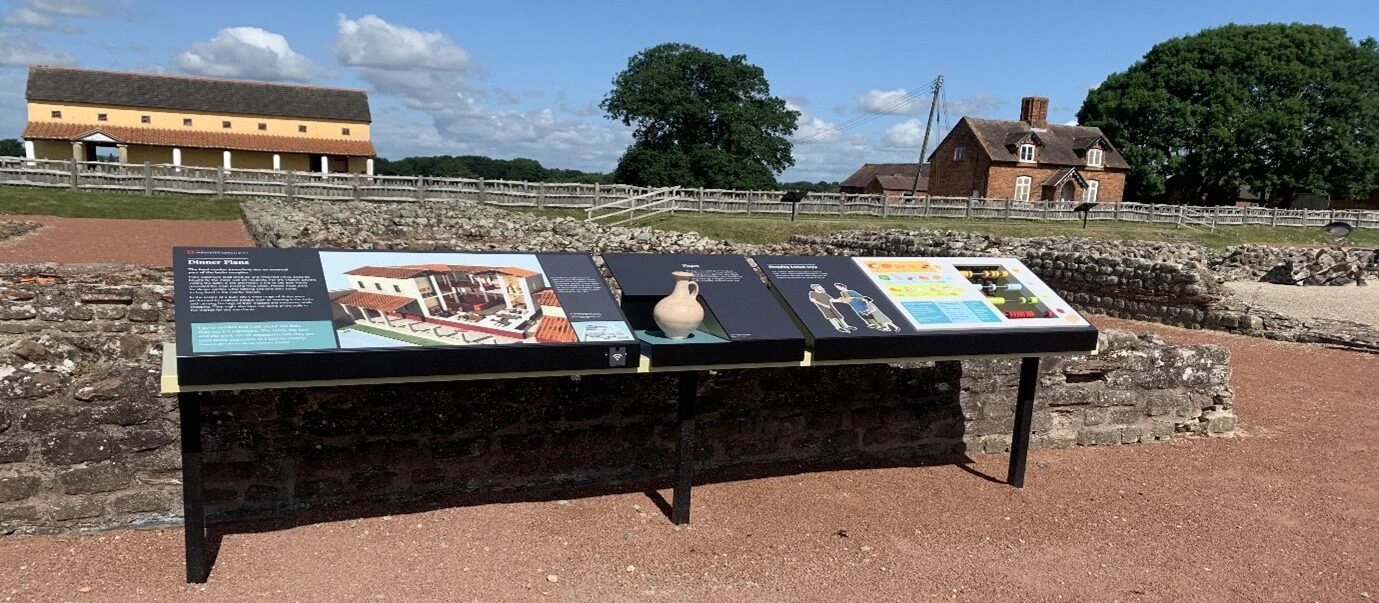
Wroxeter Roman City in Shropshire was one of the largest cities in Roman Britain. Today visitors can walk around the remains of the bathhouse complex, see a replica town house and fragments of columns from the front of the forum, and visit our small museum.
The site has good physical access with ramps in place to provide step-free access, a fixed induction loop for the shop and all-terrain wheelchairs that can be borrowed by visitors.
Interested in how to make your museum more accessible to disabled visitors?
Come to All Inclusive: Championing Accessible Museums on 7 May for best practice advice and guidance
In 2020, we embarked on a project to reinterpret the site and develop a new museum exhibition. After the planning stage, we commissioned Direct Access, an access advisory company, to review the designs for display cases, graphics, family interactives and lighting.
We opened the museum exhibition to the public in May 2023, and a few months later, we launched a pilot of accessible resources to provide the organisation with a case study in intellectual access to narrative content.
These resources include:
- A social story for pre-visit information.
- Grade 1 braille guides for the museum and ruins.
- Sensory loan bags.
- Large-print guides.
- An audio-described tour.
- Gallery scopes for visitors to use in the museum.
Advertisement
We also worked with a company called Heritage Interpreters to develop a pre-recorded British Sign Language (BSL) tour, which provides content available in the site audio tour.
The audio tour had too much content for the BSL version, so we worked together to edit this down.
Direct Access is now creating a tactile map of the site and 3D printed object replicas to add to a handling collection, which can be used to engage with all visitors.
Working with a company that employs a lot of staff with disabilities has been a fantastic experience. I highly recommend ensuring consultation with people with disabilities as part of the process to develop your accessible offer.
The next stage for Wroxeter Roman City will be to evaluate the offer.
Our intention is to bring a group of people with varying disabilities to the site to undertake this. Based on our learning from this project, we are creating new intellectual access guidelines to inform future projects.
Angharad Brading is the interpretation manager for English Heritage