This article is one of a series in which Veronica Simpson explores the important role that museums, galleries and artists are playing to address the climate crisis through campaigns, creativity and becoming part of local ecosystems
- Climate action | It’s time for museums to take their place at the table
- Climate action | Sewing seeds of hope
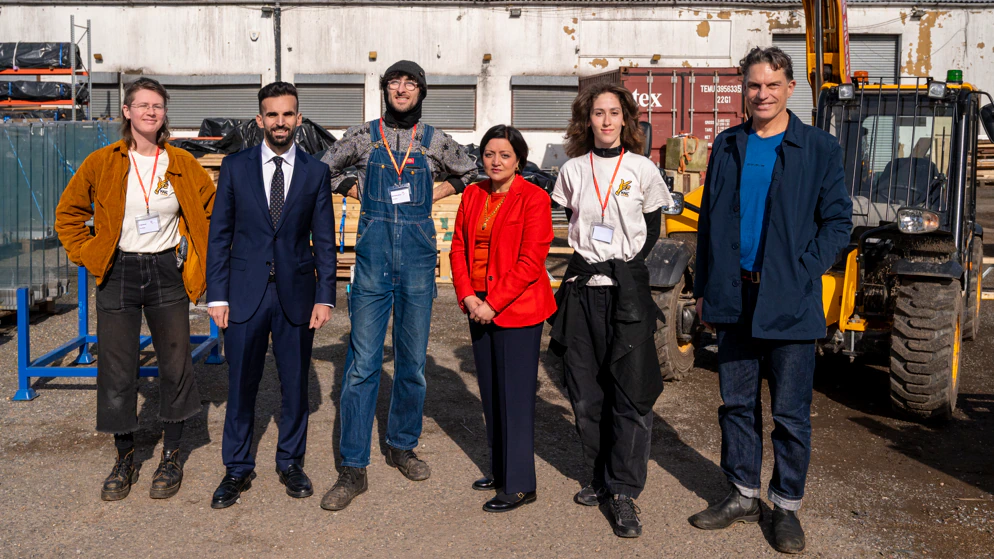
On a sunny spring morning in March, a large crowd gathered in a former light industrial estate in Silvertown, east London, to celebrate the launch of the UK’s first full-scale circular economy construction hub, Tipping Point East.
Conceived by three young architecture, design and construction practices, Resolve Collective, Yes Make and Material Cultures, the cultural sector is already one of the hub’s main clients.
The site contains materials from exhibitions held by the Design Museum, Victoria and Albert Museum, Tate, the ICA and Wellcome Collection. Clients from film and television are lining up to participate. Even rock legend Elton John has offered to send them the remnants from his latest kitchen refurb.
Advertisement
Circular construction is the logical endpoint to the idea of reuse, repurpose, recycle. But the means of making it viable at scale have eluded the UK’s architecture and design professionals for decades.
To gather waste in bulk, you need sufficient storage space in which to hold it, the infrastructure and equipment for collecting, logging, advertising and despatching your stock, and a policy and testing framework that will allow you to supply building contractors and clients with the pre-loved materials. Tipping Point East now offers all of the above as part of its aim to support a just transition in the built environment.
The relationships these young architects had built with museum clients played a major part in convincing them it was viable. Resolve Collective has established a solid track record for designing low-carbon exhibitions and community engagement.
It was invited to consult with Tate Liverpool as it was contemplating what to do with leftovers from the redevelopment of the gallery on the city’s Albert Dock. The scheme, led by 6A Architects and services engineer Ritchie and Daffin, has stripped the building back to the bones of the Grade I-listed 19th-century warehouse.
Tate Liverpool director Helen Legg explains: “We had an auditorium on the top floor, and were getting rid of sound equipment, old projectors and seating. It’s far from state of the art, and we were planning to invest in new equipment.”
Resolve rehoused the projector and audio equipment with a local film club and built much-needed storage out of rejected materials for a Chinese community group.
Advertisement
Other items are on offer at Tipping Point East. As part of the hub’s social justice ethos, there is a community membership scheme, with a monthly fee of around £2, and a workshop and tool-sharing library. As Resolve co-founder Akil Scafe-Smith said at the opening of Tipping Point: “We’re turning cultural waste into community assets.”
Tipping Point East may be the first UK facility able to offer circularity at scale, but there are hubs elsewhere in the UK for materials sharing and innovation. These include We Can Make in Bristol, Birmingham’s Civic Square, and Scotland’s region-wide Circular Arts Network.
Many individual galleries also work with artists to deliver on shared commitments in sustainable sourcing and recycling.
Sustainable artworks
Talbot Rice Gallery, part of Edinburgh University, has an art school on the premises, and anything the exhibition team can’t recycle is offered up in a designated materials hub.
Director Tessa Giblin says: “There’s a whole clause in our artists agreement that we have a sustainability action plan, and we require artists to have conversations that relate to it. A high-end video artist is no longer able to bully me into wall-to-wall carpet that’s going into landfill afterwards. Those days are over.”
Advertisement
It’s all about the brief, as Elise Foster Vander Elst, head of exhibitions and environmental impact lead at London’s Design Museum, says: “Doing things in a sustainable way isn’t more expensive. Constraints and briefs, that’s our jam. If there are no constraints, you don’t always get the best results.”
For example, with its The Offbeat Sari exhibition (19 May-17 September 2023), the Design Museum sourced Marks & Spencer mannequins heading for landfill.
“We worked with conservators and refurbished them all,” Vander Elst says. “We were really proud of that. And we saved money.”
Tapping into people and places
Holistic sustainability and social justice strategies have seen museums looking beyond the materials and artefacts in the building to embrace the resources on their doorstep – both the natural world, and their audiences.
The Irish Museum of Modern Art (IMMA) is one of many examples. Its strategy and sustainability lead Lisa Fitzsimmons has developed a “regenerative” framework for the museum. With this approach, she says, the institution starts to ask, “how can we grow the vitality of the systems we are part of?”
This includes the grounds in which its historic building is set, which has been used for walks, nature trails and, for the past five years, an annual Earth Festival, celebrating local flora, local culture and championing sustainable lifestyles.
Fitzsimmons hopes, ultimately, to create new Key Performance Indicators (KPIs). She says: “What are the KPI’s you could create for regenerative museums that are more about signs of life – like living metrics? Is it new species of wild bees that we see on site, or new flowers that appear, or birds? Is it the amount of different materials that we get to reuse? If you can create KPIs or measures of success that show that IMMA is a living, thriving museum, that could be really exciting.”
The Horniman Museum in south London is reaping the rewards of that kind of thinking, six years into a bold new “reset” programme created by its former director Nick Merriman, and celebrated in its 2022 victory in the Art Fund Museum of the Year award.
Since then, the Horniman has continued its passion for environment sustainability and diversifying its audience across the site. At the lower end of its 16.5-hectare garden – where an empty boating lake used to sit – a new play garden is materialising. It is being developed with local families, featuring elements inspired by favourite creatures identified by the under-fives, and a new family cafe and older children’s play space are taking shape beside it.
This is part of the Horniman’s Love + Nature programme, which will also see newly erected glasshouses at the top of the site become an integral part of a community garden, aimed at bringing the joys of growing and sharing fresh produce to local volunteers, families and school visitors.
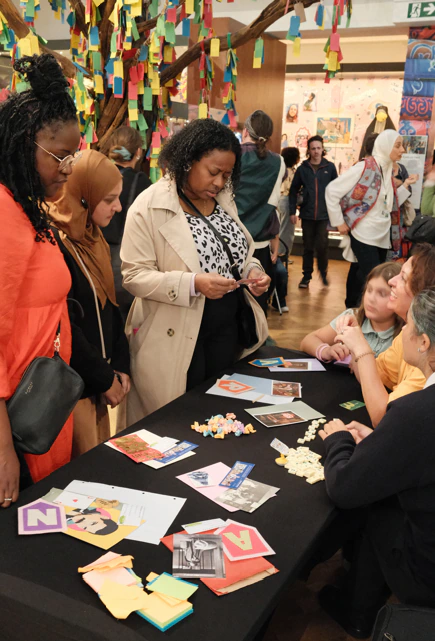
The Horniman is also now participating in an Outdoor Social Prescription scheme run by the South London and Maudsley NHS Trust, and developing an indoor Art Psychotherapy option for indoors, using the handling collection.
“What our audience research tells us is that what many people have in common is love for the natural world and for the next generation,” says Peronel Craddock, the Horniman’s director of content: “So we’re trying to inspire people to protect that world for their children and grandchildren.”
The Horniman has also drawn on local networks to rethink its Victorian Natural History Gallery, which hadn’t been touched for 60 years.
“We’ve been co-producing areas of the new natural history gallery with primary and secondary schools,” Craddock says. “Many groups are involved in consultation, acting as critical friends, helping us develop the content of the museum.”
That includes decolonising and recontextualising the ethnological artefacts drawn from all over the globe. These have also played their part in bringing in under-represented communities for special social events, such as a recent All Eyes On Her event, which attracted hundreds of visitors, many from the South Asian diaspora, enticed by music, workshops and storytelling around the South Asian collection.
Tate Liverpool’s refurbishment is also as much about community as the building’s carbon footprint.
“A huge part of the project is about bringing more of the community in, being more embedded in the landscape,” Legg says. “That facilitates relationships in the long term and it allows you to be trusted as an organisation.”
As well as switching from gas-powered energy to a water source heat pump and air-source heating, Tate Liverpool’s building is being opened up, with large, formerly windowless elevations looking onto the docks now punctured by doors and windows. This will massively boost natural daylight, and animate the building from outside and in.
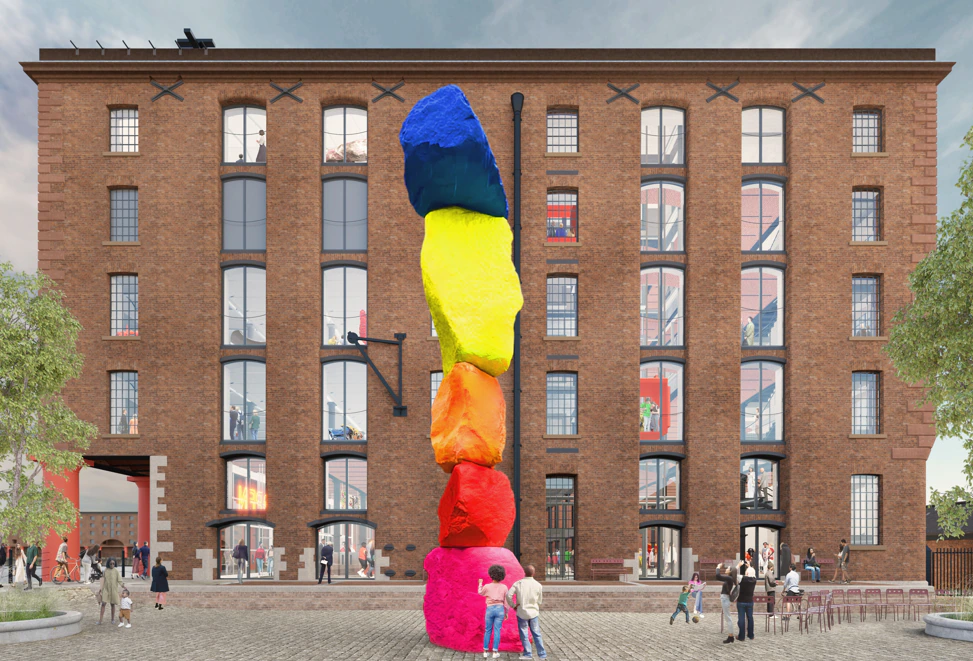
By clustering the gallery spaces that require state-of-the-art environmental controls, more of the building has been freed up for shared social, workshop and hospitality space, much of it devised in consultation with locals, refugee organisations and local prisons.
“We want to work with communities, so we have to understand how we can value them,” Legg says. “The starting point is always ‘how can we help, what can we do’.”
Tate Liverpool and 6A Architects have initiated discussions with Liverpool Council on creating a green route to the docks so that residents living nearby where the route to the gallery is blocked by road infrastructure, will be able to more easily walk or cycle to the venue.
“The council was really responsive,” Legg says. “They have brought in architects to masterplan the waterfront. They understand the opportunity.”