This article is one of a series in which Veronica Simpson explores the important role that museums, galleries and artists are playing to address the climate crisis through campaigns, creativity and becoming part of local ecosystem
- Climate action | ‘We’re turning cultural waste into community assets’
- Climate action | Sewing seeds of hope
It took six years of campaigning, but the 30th United Nations Conference of the Parties (Cop30), which was held in Brazil in November last year, finally acknowledged culture’s importance “as a driver of climate action, resilience and inclusive solutions”.
This statement, under the headline, Culture Moves to the Heart of Global Climate Action, came from Unesco’s post-Cop online summary, although what impact it will have on funding or policy has yet to be seen.
The UK’s cultural institutions, including museums and galleries, alongside creatives and campaigning organisations, played a significant part in this achievement, coordinating responses and aligning objectives across the sector and across borders.
Since the Culture Declares Emergency launch event in April 2019 – with practitioners parading banners, on foot and on horseback, through London’s streets to the Tate Modern Turbine Hall – the issue has been gaining serious traction in the sector, further galvanised by the Covid-19 pandemic.
Advertisement
By 2023, there was still much to be done, with a real sense of urgency communicated at a UK Museum Cop conference, organised by the National Museum Directors’ Council (NMDC) and held at Tate Modern.
This was a follow-up to a two-day event in 2022 at Manchester’s Whitworth Art Gallery, called Museums and Galleries Responding to the Climate and Ecological Crisis.
In 2023, Maria Balshaw, then NMDC chair and director of Tate, concluded: “Everybody needs to act now if we are to have a hope of reaching net-zero targets and protecting the planet for future generations.”
Since then, progress has accelerated. In 2023, Tate announced it was on target to reach net zero by 2030. It will reopen Tate Liverpool in 2027 (it closed to the public in 2023), after a £29m-plus refurbishment that has addressed every aspect of its environmental impact, from low-carbon construction and deconstruction to community inclusion.
Elise Foster Vander Elst is the head of exhibitions and environmental lead at London’s Design Museum. She has seen lots of positive change since the London venue’s first post-covid show, Waste Age: What Can Design Do? This opened in October 2021, timed to coincide with Cop26 in Glasgow.
Vander Elst says: “One of the big questions we had was how can we do a big show about waste without mindfully understanding the wasteful impacts of the exhibition. We had little experience in calculating carbon impact; there weren’t even any tools to do that at the time. So, we built an Excel spreadsheet, which was really robust, and we made our first carbon assessment of that exhibition, but it didn’t mean a lot at that point because we had nothing to compare it with, no benchmark.
Advertisement
“This catalyst of a show helped everyone align around the problem and focused our attention to ensure we were working with integrity and accountability,” she continues. “That for us was a big gear changing moment. Since then, we’ve calculated the carbon of all our exhibitions, to learn, to empower staff and to really understand what the impact of decisions is.”
The Design Museum put all the lessons learned into a toolkit, which was published in 2023. Shortly after, the team switched to using a Carbon Calculator created by the Gallery Climate Coalition (GCC), an international community of arts organisations working to reduce the art sector’s environmental impacts. The tool has been downloaded and used by thousands across the sector to understand, track and monitor their emissions.
Says Vander Elst: “We’ve done a lot of advocacy to use that calculator, because we’re comparing apples with apples. And for contractors, it’s so much easier for them. We send them the same template, they give us carbon data, and we upload it to our calculator. A few years ago, it was hard to get data from contractors, but now it’s just normalised – they want to do their bit.”
Tracking progress
Last November, alongside Cop30, GCC trialled an Art + Climate event across 25 venues in London, inviting audiences as well as artists into a shared conversational space. It also launched a GCC stocktake report that reveals progress made among its members, noting 79% of those who began tracking emissions in 2019 had reduced them by 25%. Flights, freight and building emissions continue to account for 80-95% of operational emissions across all GCC members. But now 80% of them have green teams, tackling these issues.
Advertisement
The GCC report also revealed that the biggest names could do more, with the largest 22% of their member organisations responsible for 50% of the sector’s emissions. This rings true for Culture Declares Emergency founder Bridget McKenzie.
“The biggest changes are happening in the smaller to mid-range museums rather than the big nationals,” McKenzie says.
“The British Museum and Science Museum are still getting worse in terms of their relationships with fossil fuels. The smaller and middle range museums, like the National Food Museum in Stowmarket, Derby Museums – the Museum of Making in particular – the Natural History Museum in Oxford, Bristol Museums, Manchester Museum – they are all brilliant.”
Information about these museums is available on Culture Declares Emergency’s website. There are also many informative case studies shared on the Museums Association (MA) website, along with comprehensive advice and information to drive engagement, including a “climate resources bank”.
The work that the MA is doing in this area is powered by its own Museums for Climate Justice steering group.
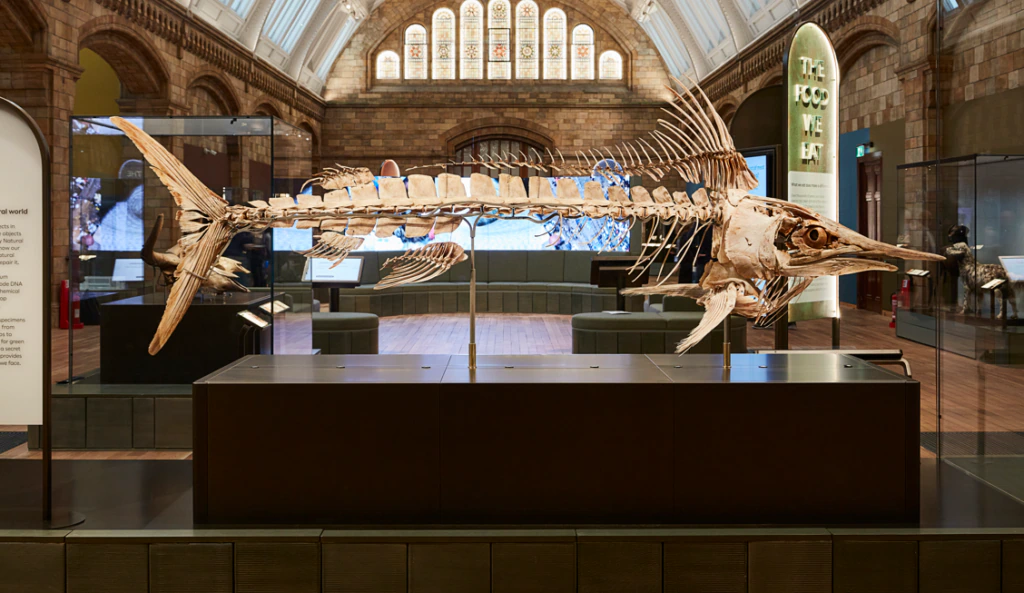
The Natural History Museum (NHM) is one national museum that is championing climate consciousness, having expanded its previous focus on creatures and rocks to incorporate a whole planet approach, expressed in an ambitious capital redevelopment programme.
In 2024, it unveiled the first of several initiatives transforming the five acres of green spaces around the historic building into various welcoming sensory and educational areas focused on plants and biodiversity.
In 2025, it launched its Fixing Our Broken Planet permanent gallery. The latter was visited by more than two million people in its launch year, while Our Story with David Attenborough (on until 26 August), an immersive cinematic experience, has attracted more than 133,000 visitors since opening in June 2025.
This shift has clearly hit the public’s imagination: the NHM beat the British Museum to the top visitor spot in 2025, with a 13% increase in visitors according to figures from the Association of Leading Visitor Attractions. What’s more, the NHM’s relandscaping project was one of the sector’s first to claim net zero carbon and zero waste construction credentials.
“The cherishing of heritage is about enabling the right relationship with nature,” McKenzie says. “I am really keen on this notion of the arts and museums and heritage and design working together in alliances with a focus on place-based change.”
To this end, Culture Declares Emergency has developed a range of resources for support and training, around its core values: truth-telling, care-taking and change-making. This includes a Culture Takes Action starter kit.
McKenzie has developed an Earth Talk training course and established a Climate Museum UK network for concerned sector professionals. The aim is to build knowledge and resilience for organisations as well as the many freelance individuals within the cultural sector who don’t get the kind of support that those within institutions can access.

Tools for carbon literacy
Many others offer useful training and insights for sector professionals, including the NHM, with its Fixing Our Broken Planet community of practice. The Design Museum also provides training in carbon literacy and now has a consultancy arm that recently worked with a group of 20 museums on a Going Places project researching environmental objectives for touring exhibitions.
The Design Museum has also set up a peer support network, Museums 2030, and is working closely with 23 other cultural providers (including the Victoria and Albert Museum, and Imperial College) within its South Kensington neighbourhood to become an exemplar of a low-carbon neighbourhood.
Longstanding advocates and supporters of climate consciousness include Culture for Climate Scotland (established in 2011 as Creative Carbon Scotland, relaunched in 2025) and Julie’s Bicycle, a not-for-profit organisation mobilising arts and culture to take action around climate. It balances environmental consultancy for major institutions with vigorous campaigning on the international stage.
For example, its We Make Tomorrow initiative, launched at Cop30, was designed to help artists be visible among the technocrats, bureaucrats and fossil fuel lobbyists.
Whatever that future looks like, there is a consensus that museums are able to make a difference.
“There’s this unique role museums have,” Vander Elst says. “We are trusted as sources. A recent IPSOS Mori Veracity poll put museums fifth, equal with teachers, just below doctors, nurses and librarians. How can we not use that position to support people to change cultural behaviour?”