This article is one of a series in which Veronica Simpson explores the important role that museums, galleries and artists are playing to address the climate crisis through campaigns, creativity and becoming part of local ecosystem
- Climate action | It’s time for museums to take their place at the table
- Climate action | ‘We’re turning cultural waste into community assets’
In June 2021, as the world held its breath to see whether an emergence from pandemic conditions was possible, Finland bravely launched its inaugural Helsinki Biennial.
With global travel still on pause, only Finns were able to attend for the first few months. It seemed novel but apposite at the time that the eco-conscious Finns had chosen to showcase art that expressed the fragility and connectivity of our crumbling planet and natural ecosystems.
Set on the uninhabited Vallassaari island, a former military base now largely reclaimed by nature, the biennial could be reached only by small ferries from Helsinki harbour.
The key question was could an entire public art festival of 41 artworks, from international and Finnish artists sustain interest in the planetary emergency? The answer was a resounding “yes”.
Advertisement
A rich array of works, themes and materials were arranged across this small island’s rolling terrain. Highlights included Finnish artist Teemu Lehmusruusu’s pale, mycelial-moulded pipes arranged over rotting tree stumps, along with microphones and organ pipes, to capture the sound of their decay (House of Polypores, 2021).
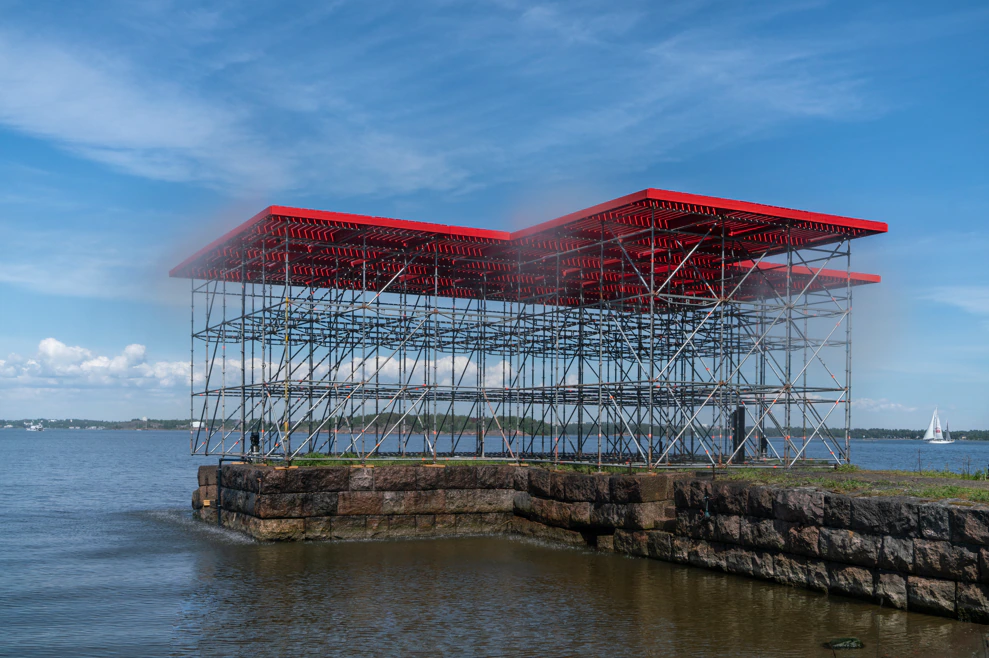
Along the shore, Jaakko Niemelä’s Quay 6 (2021) offered a stark warning of potential sea levels. A red platform, perched on metal scaffolding marked the line that seas will reach, should we fail to meet the then UN goal of keeping global warming to just 1.5°C.
I visited the island in September 2021 and an awed silence came over the group I was with as we arrived at Polish artist Alicja Kwade’s Pars pro Toto (2018). Eight huge stone spheres lay along the rugged shoreline like exquisite marbles tossed by a careless giant.
Wordlessly we sat down to contemplate this serene and surreal scene, subtly but profoundly aware of the echoing geometries between these delicately veined, carved and quarried orbs, the planet we live on, the constellations beyond us, and the molecules inside our bodies.
Many of the works had been made on site, often from local materials, with the whole project guided by ecological consultant Kiira Kivisaarito. This was the first time, we were told, such a consultant had been employed for a project of this size.
Other institutions flew the flag for climate consciousness that year, too, albeit on a smaller scale. There was a pioneering exhibition at the Herbert Art Gallery & Museum in Coventry: UnNatural History. Its brilliant selection of work and artists (including Tania Kovats, Sarah Sze, Christina Agapakis, Doug Aitken and Francis Upritchard) enriched understanding of how ideas of natural history, ecology, climate change and biodiversity have been shaped.
Advertisement
It was curated by Alice Sharp, founder and artistic director of Invisible Dust, which was set up in 2009 as a vehicle for climate aware arts programming.
“At that time, the contemporary arts world saw us as ‘very niche’,” says Sharp. “We were cutting a new path really. We’ve worked ever since finding opportunities to bring together artists and scientists to make the invisible visible.”
Being considered “niche” didn’t limit Sharp’s ambition. Museum shows include Mariele Neudecker’s Re-Think Environment (2014-15) at the National Maritime Museum, Laura Harrington’s 2015 immersive exploration of the relationship between carbon and land, via the upland peat moss flats of the North Pennines, at the Woodhorn Mining Museum, Ashington, and the Owl Project (2016) at Manchester Museum.
Sharp welcomes the sustained and growing interest in this field, as evidenced by shows including the Back to Earth exhibition at the Serpentine Gallery, London, in 2022; Queer Nature at Kew Gardens in 2023; and Dear Earth at the Hayward Gallery, London, also in 2023.
There were also two ground-breaking shows at London’s Somerset House – Mushrooms: The Art, Design and Future of Fungi in 2020 and Soil in 2025.
World biennials have followed suit, exploding centuries-old norms around who gets to make art, about what and why.
Advertisement
The female perspective
The Venice Art Biennale in 2022 was curated for the first time by a solo woman, Cecilia Alemani. It featured majority female artists, “because it reflects the richness of the creative force of our time”, Alemani said.
The event was aiming for carbon neutrality, as was the biennale that followed in 2024. That year saw curator Adriano Pedrosa’s extravaganza of artists from the global south and indigenous artists, under the title Foreigners Everywhere, showcase ancient art forms, ritual practices and philosophies that aligned human activities more closely with their “more than human” counterparts.
Sharp has contributed to City of Culture programmes in Hull in 2017 and Coventry in 2021. She has also been involved in this year’s Glasgow International, a contemporary art festival that took place on 5-21 June.
The festival included The Ocean’s Edge at Kelvin Hall, the fruits of a multi-year collaboration Sharp has engineered between scientists and artists and the UK being realised as an immersive meditation on what it is to live on the edge of the sea, rather than the edge of the land. This features screenings of works by Glasgow-based Barbadian Scottish artist Alberta Whittle and Brazilian artists Leticia Ramos and Licida Vidal.
Sharp’s practice also involves taking this kind of art and thinking outside the museum. She has worked with the city of Oulu in Northern Finland, currently celebrating its European Capital of Culture status, to present a region-wide art trail called Climate Clock.
Sharp says that museums are also a precious forum for discussion.
“Because we’ve got a digital world, we aren’t sure all the time whether things are fake or not,” Sharp says. “With museums you’ve got something tangible. You can see the turtle egg, you know it exists. And museums play a key role in our thinking about the future.”
A museum butterfly collection from, say, 1890, might include data on all the butterflies seen in that specific field and place where they were gathered. This means people can go back to that same place now, if it still exists, and do the same study.
Creative talent is crucial
For this rich seam of artistic and intellectual enquiry around our environments to keep flourishing, says Sharp, there’s a need to maintain the highest standards – it’s not enough for the art to be ecological, it also has to be good.
“It is about presenting interesting ideas, not dumbing things down, being challenging, asking interesting questions, bringing in historical perspectives – it’s an exciting time for that,” Sharp says.
Tessa Giblin, director of Edinburgh’s Talbot Rice Gallery, agrees. Her team has followed the gallery’s 2021 exhibition The Normal with explorations of debt in The Accursed Share, 2023, and memorials for displaced communities in the 2026 spring show The Dead Don’t Go Until We Do.
Giblin says: “What impacts audiences time after time is artworks that shift your understanding about the logical realm of time that your brain is capable of perceiving – to stretch that human imagination more and more, and make the consequences of our actions now more tangible.”
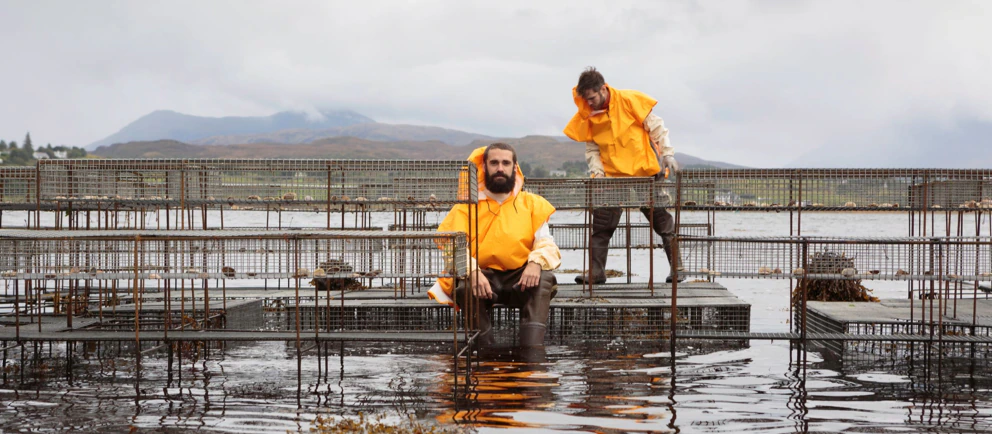
Cooking Sections, comprising artist activist duo Daniel Fernández Pascual and Alon Schwabe, who emerged from Goldsmiths’ pioneering Centre for Research Architecture department, have found ways to effect real change through their investigations. Working closely with local communities and real ecological issues, their Climavore explorations into the harmful effects of intensive salmon farming on the Scottish Isle of Skye, which garnered them a Turner Prize nomination in 2021, has resulted in local restaurants (and those at the Tate) choosing not to offer farmed salmon.
Last year they devised a Ministry of Sewers project with local campaigners, as part of Folkestone Triennial. Setting up a Ministry hub, manned by water pollution activists, they collected hundreds of testimonies from visitors on incidents of pollution in the sea or rivers, which could now be used as evidence in legal cases against negligent water companies.
Another potentially impactful Cooking Sections initiative is a project sparked by news that southern Italy’s oldest indigenous crops of fruit and vegetables are endangered.
Fernández Pascual, of Cooking Sections, says: “Even with seeds that have been propagated for generations, the law does not allow you to cultivate them without patenting. That happens everywhere in the world, more and more. If you want to grow carrots or beans that have been in your family for hundreds of years, if you don’t pay the 10,000 Euros to register them you are not entitled to sell them. It puts at risk communities who are not part of big agribusiness.”
In response, the duo contacted a curator at Rome’s Museo Della Civilita to make an artwork there using these seeds. That then allowed the museum to register them as a cultural artefact, with a certificate of provenance. Now, these precious crops can remain part of the local ecology.
Pascual says that blending art and activism is a fine balance. “Over the years we’ve learned how to do it a little bit better by trial and error,” he says.
“Time is important, as is involving people who are on the ground to amplify what they are already doing rather than inventing something. It does work. Maybe not always, but it’s a good place to start.”