
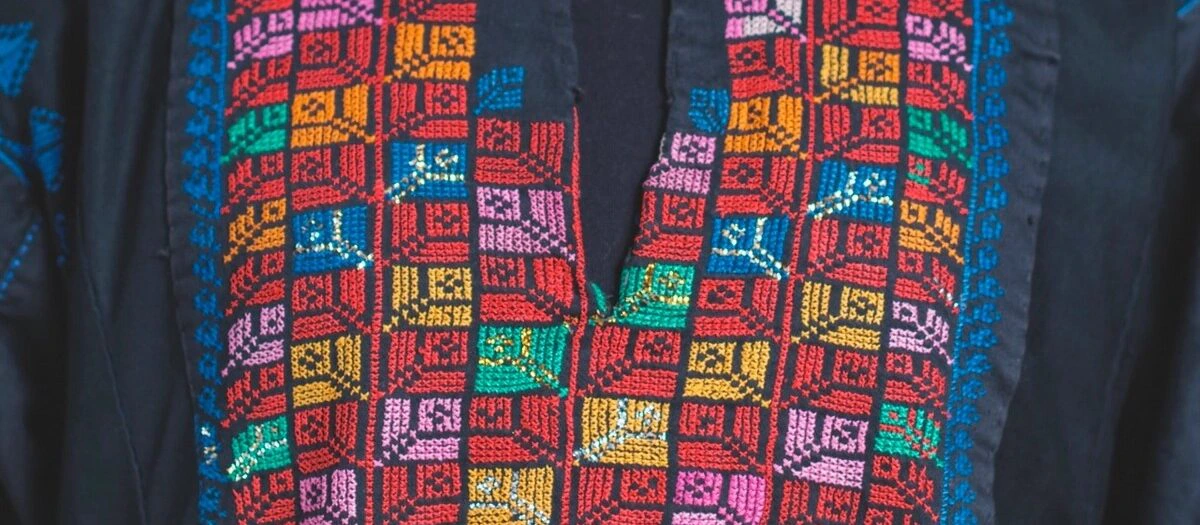
Upstairs in the V&A Dundee, located next to the Garden Futures: Designing with Nature sensory show, is the free exhibition Thread Memory: Embroidery from Palestine.
The sign for the exhibition is surrounded by black and white photographs of six Palestinian women wearing beautiful, embroidered dresses. In the middle, a video in colour shows a pair of woman’s hands embroidering with red and purple thread. It’s evident even before I step foot inside that this is an exhibition that celebrates the creative contributions of Palestinian women.
The opening text sets the tone for the exhibition – this is a story of celebration, resilience and hope. The text in the exhibition is in both English and Arabic and I learn that Tatreez is the word for the intricate and impressive hand-embroidery found on Palestinian dress.
Thread Memory: Embroidery from Palestine was created in partnership with Art Jameel, the Palestinian Museum, V&A South Kensington and V&A Dundee and expands on an exhibition of the same name shown in Hayy Jameel in Jeddah, Saudi Arabia in 2025.
It’s clear why this exhibition belongs at the V&A Dundee - the city has been twinned with Nablus in Palestine for 45 years.
The first room is filled with beautiful, vibrant, embroidered dresses and scarves. The text panels focus on the design of the dresses, how they were made, and how they were worn.
Advertisement
I’m struck by how much bigger the exhibition is than I expected. Spanning three rooms, the exhibition gives the space needed to thoughtfully discuss the important themes of identity, solidarity, family, social change and resistance.
In the second room, text panels inform visitors of the Nakba, explaining that it refers to the mass displacement and dispossession of Palestinians before and during the 1948 Arab-Israeli war, and how it altered the way embroidery was produced.
One of the dresses on display had been made by a woman from Beit Nabala, one of 530 Palestinian villages destroyed during the Nakba. It demonstrates how intrinsically linked design history is with the political.
Among the most thought-provoking objects is an installation of 626 clay tablets featuring a motif of a cypress tree, created by the Palestinian artist Leena Nammari. Each tablet represents a destroyed Palestinian, village, town or habitation.
Symbol of defiance
The third room addresses the relationship between embroidery and protest. My eyes are immediately drawn to the Palestinian flag, a powerful symbol of solidarity and defiance, especially because Israel punishes the display of Palestinian flags. I learn that in response to this, Palestinian women began to stitch “Intifada dresses”, which use both traditional Palestinian motifs in national colours and new designs that represent resistance.
Advertisement
The exhibition doesn’t shy away from the realities of the humanitarian crisis in Palestine. The text panels share stories of violence and displacement, and Palestinian embroiderers share their experiences in interviews.
I was relieved by the decision not to show images of suffering in the exhibition. Instead, throughout the displays there are images of Palestinian children smiling, couples celebrating weddings, and families enjoying time at the beach.
The exhibition chooses to centre memories of joy, celebration and family, but this adds to the sadness of the story when juxtaposed with experiences of destruction and loss.
A thobe (dress) made for a little girl damaged in the targeted bombing of the Rafah Museum in October 2023 lies in a glass case. With visible tears and bleach marks from the sun, it is symbolic of the destruction of cultural heritage and the immense loss of human lives in Palestine.
Powerful and political
According to official sources, it is estimated that the Israeli military has killed more than 54,000 Palestinian people and injured over 125,000 in the Gaza strip, 70% of whom are women and children.
Advertisement
Far from just being an exhibition about design, Thread Memory is powerful and political in how it addresses the devastation and grief in Palestine alongside showcasing the art of Palestinian embroidery.
This link is perfectly summed up by in an interview with Subhiye Krayem, an embroiderer in Saida, Lebanon featured in the exhibition, who explains that “politics is the expression of the self so folklore is a politics in itself”.
By platforming the voices of Palestinian women and weaving together stories of design and identity, loss and hope, this exhibition demonstrates perfectly how museums can stand in solidarity with Palestine.
Thread Memory: Embroidery from Palestine is on at the V&A Dundee now until spring 2026



Both they and you refuse to use the term “genocide” so I’m afraid the exhibition like this review does in fact “shy away from the realities”.