
Before anyone sticks their hand up to complain, yes I know it’s Chinggis Khan (or Khaan) not Genghis Khan. The Royal Armouries in Leeds knows too.
In fact, the first text panel one encounters in its latest temporary exhibition (which opened on 26 June and runs until 1 November) explains that the more familiar spelling of the legendary Mongol ruler is outdated, probably a error introduced as tales of the warrior’s deeds travelled west.
The name of the exhibition, which is visible across Leeds in a targeted marketing campaign, is a nod to the fact that most of us know very little about this period of history, and probably even less about the man himself.
His name isn’t the only misconception that the exhibition attempts to redress. Most of us know Khaan and his descendants as utterly ruthless military leaders who used violence, force and horses to found and lead the Mongol Empire, the largest contiguous land empire in human history.
While the exhibition does acknowledge that extreme violence was used by the Mongols, its focus is how the societies they created across Eurasia prompted major shifts in the wider world. From trade to art and technology, to the role of women and maps, the Mongols’ influence on linking the East and the West (and therefore global history) is here laid bare.
Bringing in the crowds
Before I take you through the displays, it’s worth noting that this is a touring exhibition produced by Nomad Exhibitions in association with France’s Nantes History Museum and in partnership with the Chinggis Khaan National Museum in Ulan Bator, Mongolia, and Mongolian Ministry of Culture.
Advertisement
For this first UK showing. its curators (Natasha Bennett, curator of Asian and African collections at the Royal Armouries and the historian Marie Favereau) have been able to customise it to this setting and its audiences.
This is the second touring exhibition the museum has put on, having stopped producing shows in-house a decade ago. Last year, its Gladiators exhibition (developed by the Italian company Contemporanea Progetti and curated by Rossella Rea, the former director of the Colosseum in Rome), was seen by about 40,000 people and brought in new income for the Yorkshire-based national institution.
Next summer, it will co-create another blockbuster show before launching its first entirely in-house offering in 2028. The subjects of both shows are still a tightly guarded secret, but will no doubt be crowd-pleasers with a remit to bring in new audiences.
Object-rich exploration
Gladiators taught the in-house team a lot about what visitors expect from temporary exhibitions: feedback was positive, but some people said they expected to see more than the 44 objects on display.
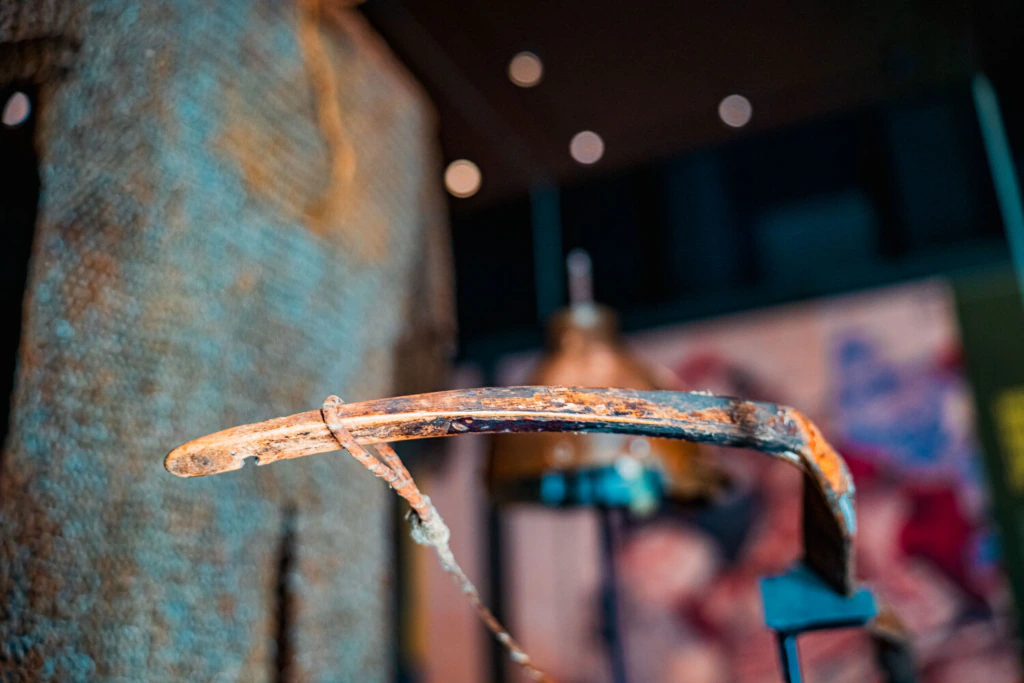
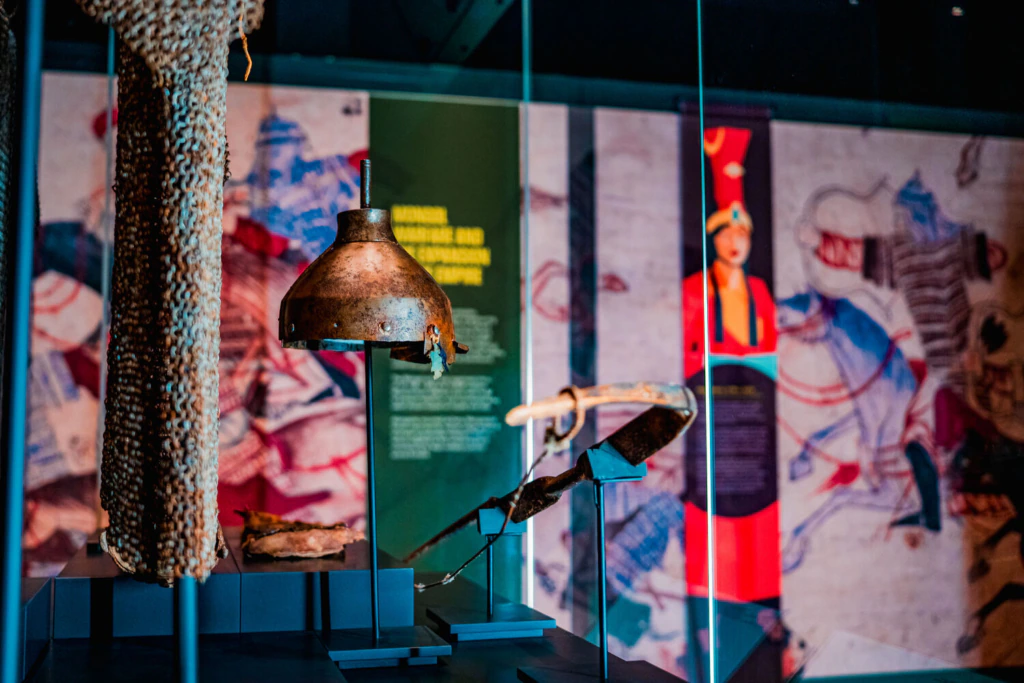
As a result, there are exactly 255 objects on show in Chinggis Khaan – including paper money from the Yuan dynasty (1271-1368 CE), a reconstructed porcelain vase from the 13th-14th century and a huge array of intricate jewelry, horse-related equipment and (of course) weapons – including a beautifully preserved compound bow made from wood, horn, bone, sinew and leather on loan from the Chinggis Khaan National Museum.
Throughout there are also films, soundscapes and interactives designed to bring this vast empire to life.
Advertisement
The exhibition situates visitors at the very start – there is a useful timeline that connects key events in Mongol history with what was going on elsewhere in Britain and Europe. For someone like me, with a keen interest but very little knowledge of the Middle Ages, this made everything that was to come later so much clearer.
It also made me wonder if the exhibition couldn’t have been strengthened with objects from British history – not to detract from the richness of Mongolian culture but to show how Khaan and those who came after him created connections that can be seen in our own past, even if we don’t always recognise them.
The exhibition has a chronological timeline telling of the rise of Khaan and his heirs, while simultaneously exploring nomadic life on the steppes, such as the role of horses, art and culture and “woollen” homes (known as gers or tents) made from pressed sheep’s wool.
I really enjoyed learning about yam (the Mongol’s horse-powered postal system) and seeing a boqtaq (a tall headdress worn by Mongol noblewomen that reminded me of conical hats worn around the same time in Europe).
Throughout, lovely vertical banners highlight fictional children’s stories and pose quiz questions and treasure hunts for children. Entry to the exhibition is free for under 16s, and although I doubt many will know much about Khaan, the popularity of this year’s Race Across the World (which included Mongolia in its route) could be a draw for family audiences. In a stroke of genius, there is even a replica of a traditional horse saddle available for people to sit on and presumably pose for photos (no, I wasn’t tempted to try it).
Complex narratives
There is a huge amount of history on display here, including several different dynasties, and after a while it did start to all merge into one. I found myself entranced by the beautiful objects on display and informative text panels on the Kitan and Xiongnu empires – but unable to easily connect the two.
Advertisement
While we hear about a lot of Mongolian men of this period, we also have the pleasure to be introduced to many notable women – from Khaan’s first wife and close adviser, Börte, to his favourite daughter Alaqai Beki, who was married into a Turkish-speaking Mongolian tribe and later ruled them while also supporting her father’s military campaigns. There’s also Khutulun, celebrated across the Mongol empire for her wrestling abilities and rumoured to have never lost a match.
The second half of the exhibition brings out these stories but feels less object-rich than the first half. The exhibition walls illustrate Mongolian scenery – they look lovely but don’t quite hide the lack of display cases.
There is a film well worth watching close to the end, which demonstrates how the Mongols were perhaps the first people to use maps to navigate the world rather than perpetuate theological beliefs. But there aren’t any objects to expand on this.
The exhibition ends with The Soul of Chinggis Khaan – a trident set atop the Black Banner, a powerful symbol of his empire.
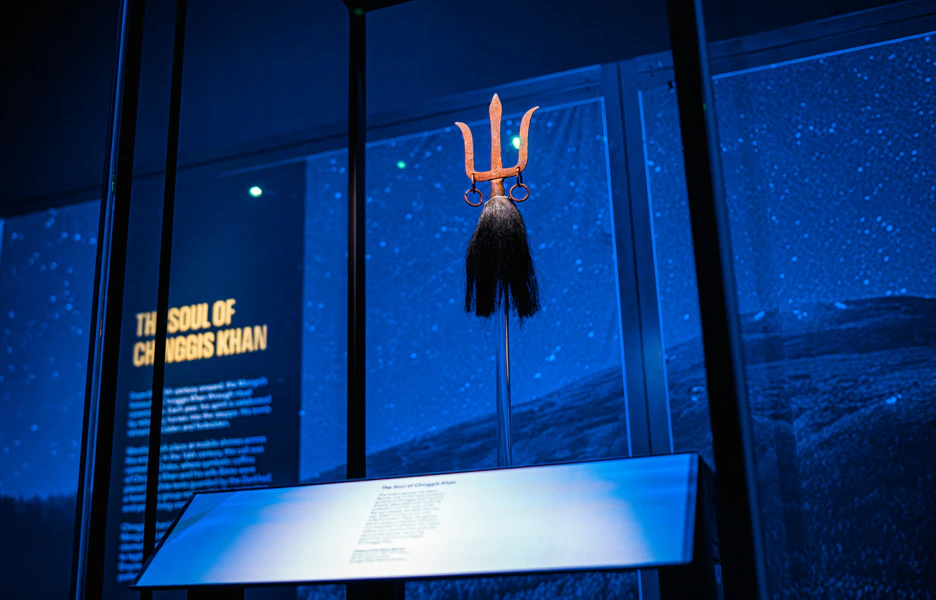
This object is of immerse importance to the Mongolian people today – the country was a Soviet satellite from 1924 until the collapse of the USSR in 1990, during which time its rich history was suppressed.
Today the Mongolian government is keen to celebrate the days of empire and has enthusiastically supported this exhibition. It’s great to see how the in-house curators have taken this content and run with it to produce an exhibition that could easily be on display at the British Museum or similar.
I am keen to know how the exhibition performs for the Royal Armouries, in terms of visitor numbers and income, and how it will help shape its future forays into the fascinating world of temporary exhibitions.
Project data
Produced by
Nomad Exhibitions in association with Nantes History Museum
Partners
Chinggis Khaan National Museum and the Mongolian Ministry of Culture
Exhibition content
Bertrand Guillet, Marie Favereau, Jean-Paul Desroches and Tim Pethick
Exhibition installation services
Exhibition Site Management
Exhibition graphic production
FaberExposize
AV content producers
Chris Bain Design, Shosho, Pernel Media and Fleur de Papier
AV hardware installation
Fusion LX
Illustrations
Richard Stevenson
Entrance projection
Pangaea Television Production
Lighting
Record Lighting
AV consultation
767 AV Consultants
Marketing and PR
Peter & Paul, The Ark Media and Root Media, Animo PR, and Steve Gabbett
Additional content design
PLB, Norse Sky and Flock 24
Insurance of setworks
Alan Boswell Insurance Brokers
Transport and handling
Momart and Bar 1 Freight