“If you’d told me 10 years ago that the most satisfying part of my job would be the financial side, I would have laughed. I thought the fun part was setting up the museum, but that was the honeymoon period – keeping afloat and continuing to grow is the hard bit.”
I’m speaking with Sarah Hayes, director of Birmingham Conservation Trust, which runs the Coffin Works museum. She is in the busy and often stressful run-up to the end of the tax year.
Despite her background in collections, Hayes has discovered a talent for managing profit-and-loss spreadsheets and taking a multi-income approach to running the small independent museum.
The Coffin Works is something of a dream job for museum nerds. Based in Birmingham city centre on the periphery of the historic Jewellery Quarter, the museum opened in 2014 in the Newman Brothers’ coffin furniture manufactory.
Newman Brothers supplied fittings for royal funerals in the 20th century, including those of the late Queen Elizabeth II and Princess Diana.
Advertisement
“The royal connection helps, but it’s the working-class stories the factory tells and the opportunity to step into a bygone era that really brings people in,” Hayes says.
Tours at Conference 2026
Monday 2 November
Explore the Coffin Works and other Brummie heritage highlights as part of our jam-packed programme of tours on day one of the Museums Association’s annual conference.
A new lease of life
When the business ceased trading in 1998, its last owner, Joyce Green, handed everything over to the trust – the tools, machinery, stock and business archives.
“It’s like walking into a private space and wondering ‘where is everybody?’,” Hayes says. “It’s like they’ve gone out for lunch.”
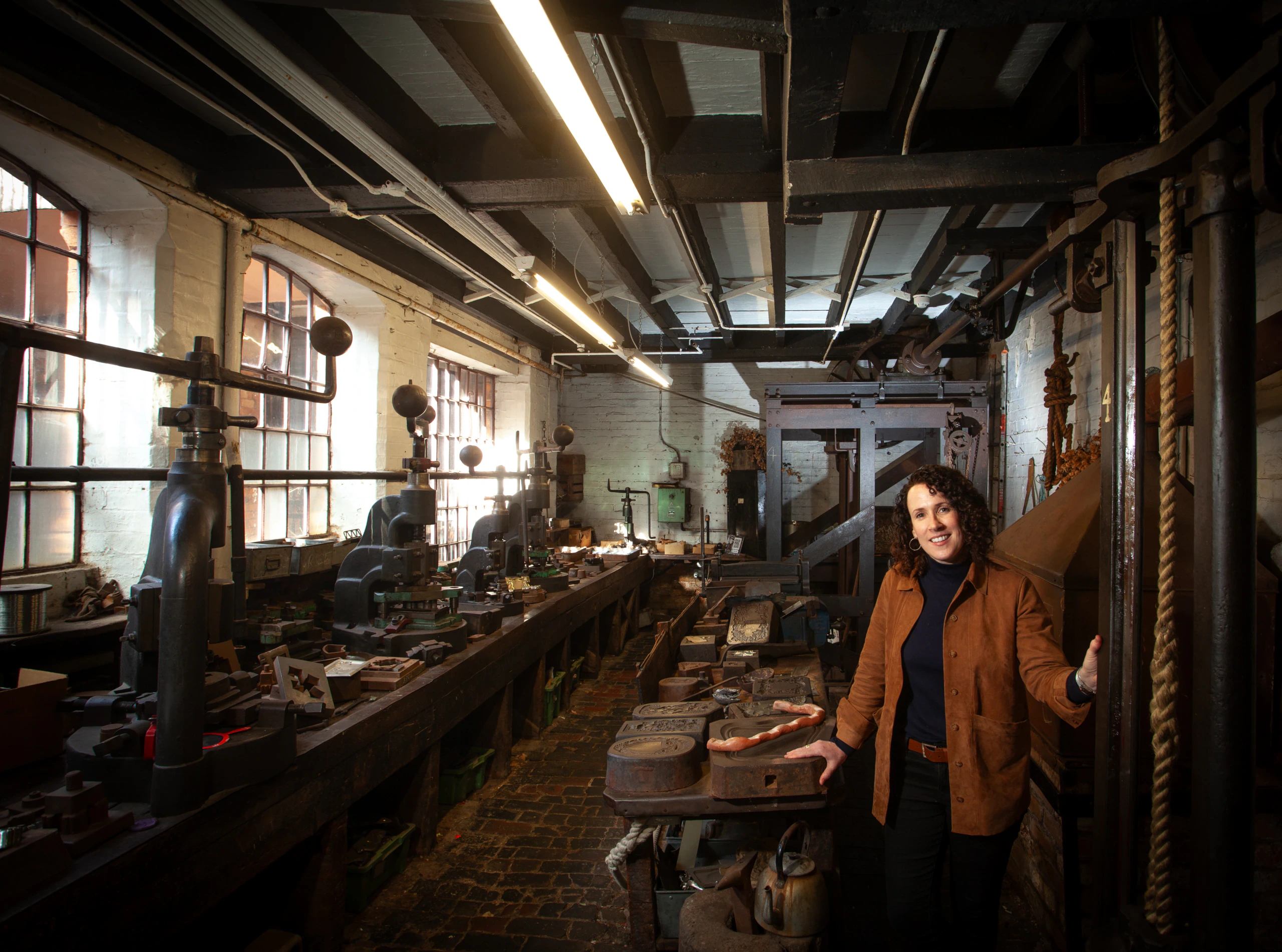
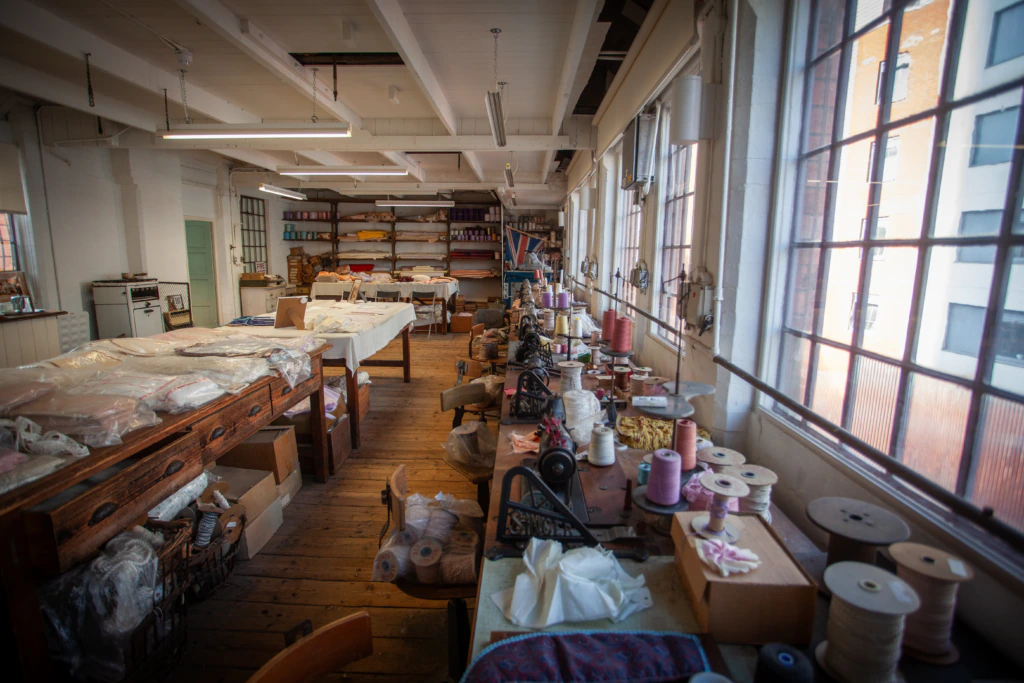
Visitors can explore the Coffin Works through a guided tour or at their own pace, experiencing what the site would have looked like in the 1960s – there’s Victorian machinery, office space (a bottle of essence of peppermint unashamedly displayed on the vintage wooden cabinets) and the shroud room where funeral robes were made, complete with historic sewing machines and a beautifully laid tea trolly.
Advertisement
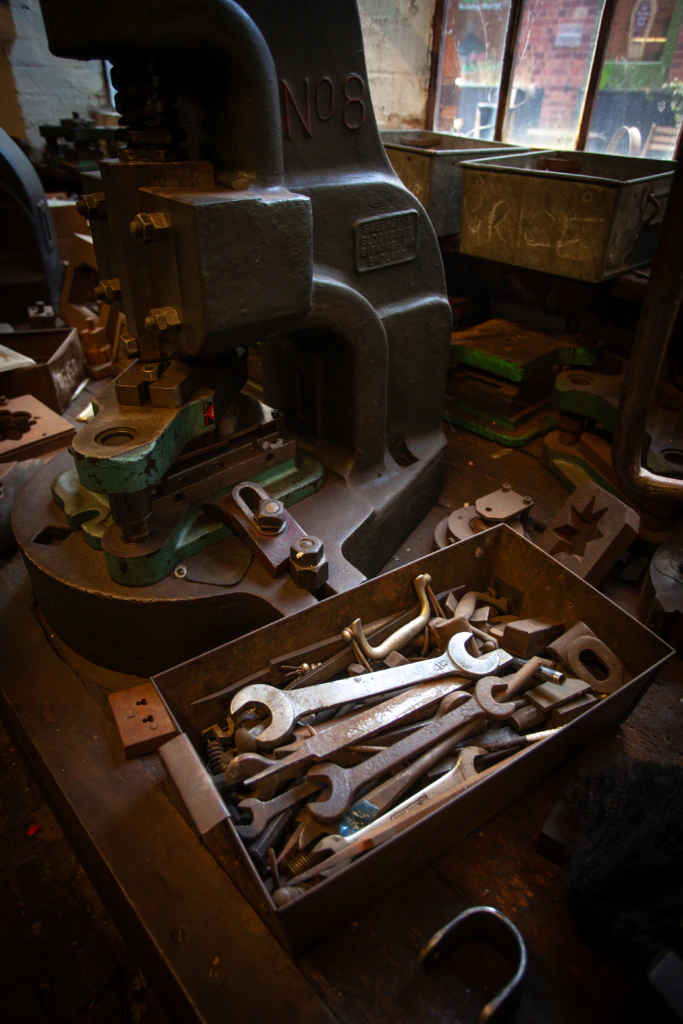
There are no glass cabinets and staff are trained to demonstrate the heavy “drop stamps” (seen in photograph, left) once used to create a coffin lid adornment. Recently, the team opened a small cafe, and the board has just decided to turn a space previously rented out to tenants (the museum has several) into an event and temporary exhibition area.
Sarah Hayes
Sarah Hayes has been director of Birmingham Conservation Trust and its museum, the Coffin Works, since 2023, having already spent nine years at the charity, latterly as museum manager.
Her career began in 2005 as a visitor assistant at the Museum of the
Jewellery Quarter. In 2007, she briefly moved to the Black Country Living Museum, before returning to her home city and the trust to
undertake short-term collection projects.In 2012, she became a curator at Birmingham Museum & Art Gallery,
and sat on committees of the Social History Curators’ Group and Friends of the Centre of West Midlands History.Hayes has an MA in museum studies from the University of Leicester. She is a member of this year’s Museums Association Conference panel.
As well as the objects and machinery, there is a rich collection of oral histories – personal stories from the men and women who worked in the factory before it closed. Hayes tells a moving tale of Sheila Maher who in 1960, while three months’ pregnant and urgently needing to get married, stole lace and silk from the workroom to make her own wedding dress.
“She would wrap it round her belly and was scared to stand up during the day in case it fell out,” Hayes says.
Attracting visitors
Before Covid, 20% of the venue’s visitors were international tourists. This has now reduced to 12%, but Hayes says domestic tourism is potentially a big growth area with residents from across the UK increasingly drawn to Birmingham, not least for its reputation as a foodie paradise.
Advertisement
“When we were first set up [as a museum], we overestimated how many visitors we’d get,” says Hayes. “Local people just don’t know we exist. We have had to contract in the years since – going from six [employees] at the start to three full-time equivalents now – and it’s an ongoing battle as prices rise and visitor numbers shrink.”
It is a picture that will feel familiar to museums up and down the UK. Much of Hayes’s work is focused on finding that extra money – by exploring tax relief, for example, but also by making difficult decisions such as increasing ticket prices.
“I was reluctant to do it, but we have to be more business savvy,” she says. “Museums shouldn’t be afraid of income-generation – we are a form of entertainment as well as education, and we need to be confident in our offer and believe our worth.”
Money Talks: Income Generation for Museums
16 September, online
Discover practical, creative and achievable ways that your museum can generate sustainable income while staying true to its core mission.
Despite the challenges, she says the museum has never been stronger. The development of new income streams – through its tenants, events programme and venue hire – has helped the museum to grow, and it recently created a new position to manage the team of 85 volunteers.
“I’ve always been proud of my city, and I never wanted to leave,” says Hayes. “I’m in my dream job so it’s easy to be passionate. Part of why I’m so happy in my role is our position in the Jewellery Quarter – it’s less than one square mile of the city but we have active jewellery heritage, incredible food, three museums, 200 listed buildings and the last Georgian square in Birmingham.”
Like many from a working class background, Hayes didn’t think about a career in the sector until she was an adult and studying medieval history and English at the University of Birmingham. During her second year, she did a placement at Blakesley Hall, now part of Birmingham Museums Trust, which opened her eyes to a career that could encompass working with people, history and her city’s rich heritage.
Although her role encompasses leading the Coffin Works, Hayes is director of Birmingham Conservation Trust, a charity that exists “to preserve and enhance Birmingham’s threatened architectural heritage and to promote an enjoyment and understanding of the city’s historic buildings”.
Before the Coffin Works, it did this by restoring historic buildings, finding new uses for them and selling them, raising the funds to purchase the next property. One example is the Birmingham Back to Backs, the restoration of a court of terraced houses, with 200 years of history, which are now run by the National Trust.
Ready for another challenge
The Newman Brothers’ funerary factory was the first time the charity decided to run one of its projects, initially with the aim to make enough money to invest elsewhere. While this hasn’t happened, the fact that the museum is now self-sustaining means the trust can look for a new opportunity.
In 2024, it purchased the Golden Lion, a 16th-century timber-framed pub, and funding from Historic England and others have enabled it to undertake a feasibility study and start essential restoration work.
“There is no back-up – the museum has to wash its own face to survive, and I get to put my creative side into that”
“We need to prove the concept and find more funding to create some additional positions that will enable me to spend more time on the building preservation side of my role,” Hayes says. The restoration will complete this July, but what the building will become is still unknown. Being accessible to the community is vital, but it also needs to be self-sustaining financially.
Meanwhile, progress at the Coffin Works won’t stand still. Hayes is working with other museums in the Jewellery Quarter on initiatives such as joint tickets as well as looking to boost individual giving and exploring how social media might help raise awareness of the site among locals.
“The beauty of running a smaller independent site is that you can make things happen quickly without too much red tape,” Hayes says.
“The role is so varied – one day I’ll be working on marketing campaigns, the next grant applications, the next reviewing energy contracts. What’s driven things is that there is no back-up – the museum has to wash its own face to survive, and I get to put my creative side into that.”
Celebrating Birmingham at Conference 2026
The Museums Association’s 2026 Conference takes place at Birmingham Repertory Theatre and Library of Birmingham from 2 to 4 November. Delegates will have the chance to explore the city’s wide cultural offer through a programme of tours taking place on 2 November, as well as through three evening events and many conference sessions delivered on 3 and 4 November.
This year’s conference celebrates how the sector is finding inventive ways to work with communities through challenging times to create a positive future. Birmingham and the Midlands provide the perfect context for these discussions as a vibrant and varied region that has a history of innovation and radicalism, where diversity is nurtured and celebrated.