When she was starting her career, Helen Hartstein says she never would have predicted that she’d end up in a place like Exeter’s Royal Albert Memorial Museum (Ramm) – or that she’d even be working in museums at all.
“I have quite an unusual story – I don’t have a typical museum background and I’m really proud of getting to where I have,” says Hartstein. “It’s taken me a while to get here.”
Hartstein became the sole manager of the local authority museum in February after several years of running it as part of a co-leadership team.
Raised in North Yorkshire, she was the first person in her working-class family to go to university.
“My parents were my inspiration. My dad worked in a factory testing malt for whisky, my mum was a cleaner in a hotel. Both of them had real aspirations.”
Advertisement
Her father built their house from scratch, coming home from his day job to tackle the plumbing or electrics, while the family lived in a caravan on a self-sufficient site with pigs, hens and a goat.
“I remember some very snowy winters having to trek to the bottom of the garden in our wellies to use the loo,” she says.
Harstein was the “brainy kid” at school and her parents instilled in her a love of history and museums. “My mum is 80-something now, and she still talks about when her painting was in Ferens Art Gallery [in Hull] in the early fifties; that’s the kind of impact that museums and galleries can have on people,” she says.
But after getting a master’s degree in medieval history – moonlighting at evening classes while working as a receptionist during the day – she hit a brick wall in the heritage sector, which has always been a difficult place to break into for anyone from a working-class background.
“After I finished my master’s, I couldn’t get a job related to medieval history, so I ended up getting a job in IT,” says Hartstein.
This led to an 11-year stint working in marketing and communications for Silicon Valley’s then-emerging billion-dollar tech companies. “There was lots of travel. There were really big budgets. It was the time just before the dotcom bubble burst, so there was loads of money to spend in marketing. It was fun.”
Advertisement
After marriage and children, Hartstein gave up working for multinationals. “It was quite high pressure,” says Hartstein. “So we decided to go and live in Spain for a few years and have an adventure.”
It was here that her early passion for museums and heritage came back into focus. Hartstein found herself translating tourist brochures and giving tours of the local olive oil museum and when she returned to England she worked for a while at the Landmark Trust, the building conservation charity that rescues historic buildings and lets them out as places to stay.
Even then, her route into museums wasn’t straightforward.
“After that I ended up becoming head of communications and marketing for an NHS Trust in Northern Devon,” says Hartstein. This unexpected diversion into the health service gave her invaluable experience. “The NHS taught me how to work in crisis communications, and also the importance of engagement and listening to people, to patients and communities.”
It was then that she saw an advertisement for her “dream job”: audience development manager at Ramm.
“I thought it was a long shot, because I didn’t have a museum background,” says Hartstein. But Ramm’s longstanding former manager, Camilla Hampshire – who retired in 2023 – looked beyond her CV.
Advertisement
“She must have seen something in me. It was a little bit of a risk, but she believed in me and she gave me the opportunity, and for that I am eternally grateful.”
Hartstein credits her predecessor for transforming Ramm, both aesthetically and operationally, during the latter’s 23-year tenure.
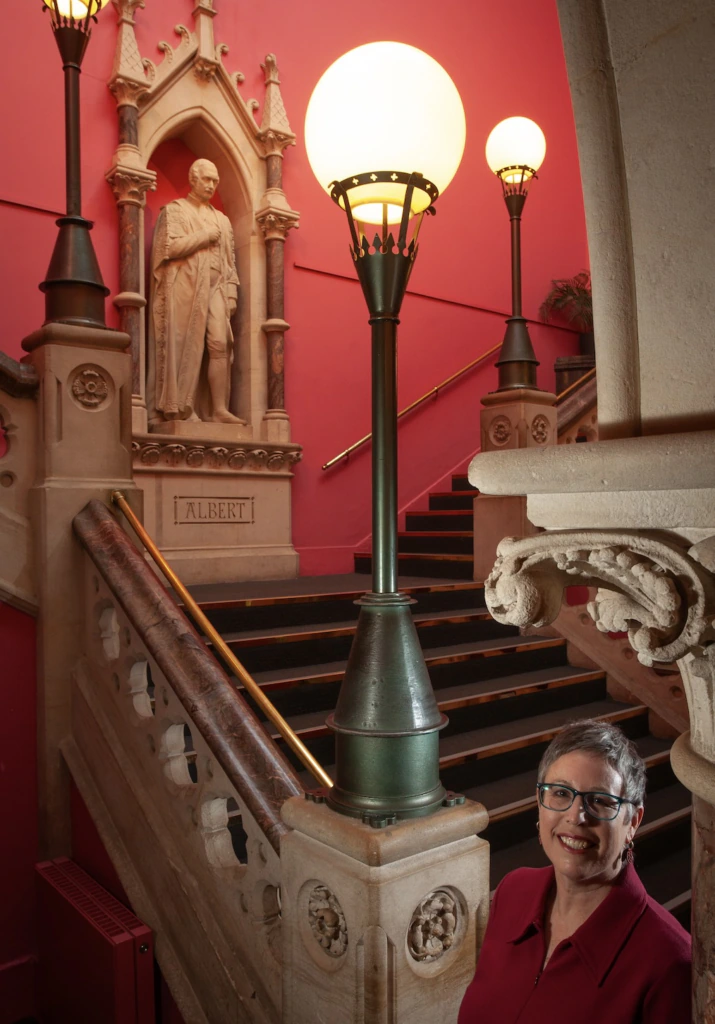
“It is a remarkable museum,” says Hartstein. “I remember the first time I set foot in it – you walk into the foyer and there’s a statue of Albert in front of you, and the walls are pink, bright pink – I later found out the actual colour is ‘kinky pink’. I just went, ‘wow, this is not what I expected from the Victorian facade. This is something a bit different’.
“Wandering around the museum, you could just tell the quality of the displays, the interpretation, the way the museum was laid out and presented, was just special – a notch above anything else.”
She is full of praise for her colleagues, who she says took her under their wing from the start.
“I learnt so much from working with my colleagues. They taught me about museums, about collections, they educated me and supported me in my development within the museum.”
Joint management model
When Hampshire stepped down, Hartstein and three colleagues – Julien Parsons, Alison Hopper Bishop and Joseph Harvey – came together to form a co-leadership team, which was eventually whittled down to a partnership between her and Parsons.
“There have been quite a lot of changes in the leadership of the museum, but the co-leadership team was very much about taking people who had their subject matter expertise, keeping that expertise and then together, we would be responsible for the strategy and the planning.”
Hartstein says this operational model worked well. “The different skills complement each other, as long as you communicate well and you respect each other’s decision-making powers.
“For example, if I wasn’t around and Julian needed to make a decision, I would respect his decision. It doesn’t have to be everything done together all of the time. I think that made for a balanced way of managing the museum.”
However, the expectations of external bodies haven’t quite caught up with this way of working. She says: “While it worked well for us internally, I think externally, people often want a single figurehead leader.”
Earlier this year, Exeter City Council decided to go back to a one-manager model, and Hartstein stepped into the role. Unlike some local authorities, she says the council has always been supportive of the museum.
“We’ve been extremely fortunate to be part of Exeter City Council, who’ve supported the museum amazingly well, financially. There are a lot of museums in a much worse financial situation than we are.”
However, there are some nerves about what the future holds, with a reorganisation of England’s local government landscape just around the corner.
“Our council won’t exist anymore – it will be a different unitary authority,” says Hartstein. This has its worries, she says, but it could also bring new opportunities for the museum to contribute to local health, social care and education agendas.
Like many other museums, Ramm’s visitor figures haven’t quite caught up to pre-Covid levels yet, remaining about 40,000 lower than they were in 2019.
“I do just wonder sometimes, where are those people? Why did they decide they weren’t coming to a museum anymore? We’ve got still some work to do,” she says.
Hartstein is enthusiastic about the move in government towards creating an overarching strategic framework for England’s civic museums. “There’s a lot of work to be done to advocate for a national strategy to really shout about the importance of civic museums and the role that we play in the ecosystem.”
For Hartstein, this means continuing to embrace Ramm’s appetite for ambition and risk-taking. The museum has been at the forefront of some significant developments in the sector.
Spearheading change
In 2020 it made headlines after winning a landmark case at the High Court that has helped reduce business rates for many museums and heritage sites.
Ramm is also known for being one of the first local authority institutions in England to return items to a native American community, handing back several items of sacred regalia to the Siksika nation in recent years.
And in 2024 the museum became one of just a few cultural heritage institutions in the UK to make its entire public domain collections open access, allowing everyone to use ts digitised copyright-free artworks.
“Ambition is one of the things that we pride ourselves on – taking risks and stepping outside of our comfort zone and doing something new is really important to us. It’s part of the ethos of the organisation,” says Hartstein.
“Ramm is seen as being one of the best regional museums in the country, and I’m stepping into large boots here. I really want to make sure that I maintain that level of quality and ambition and excellence.”
It’s been a long and winding route for Hartstein to get into the sector, but her diverse career path has given her a valuable insight into the importance of museums.
“What my general background has given me is a belief in how museums can affect people and change people’s lives,” she says. “I’m thrilled to be finally leading the museum of my dreams.”
Helen Hartstein
Helen Hartstein grew up in North Yorkshire. She studied English and history at Keele University, Staffordshire, before completing a master’s degree in medieval history at Birkbeck University, London.
Hartstein spent 11 years working in the tech industry for a variety of multinational companies, including Sun Microsystems.
After a period living in Spain, she returned to the UK and worked in marketing and communications roles at the Landmark Trust and the NHS.
She joined Exeter’s Royal Albert Memorial Museum in 2018 as head of audience development, becoming part of its co-leadership team in 2023. She was appointed museum manager in 2026.
Royal Albert Memorial Museum
Opened in 1868, at the peak of the Victorian era, the then-Devon and Exeter Albert Memorial was founded to advance the late Prince Albert’s modernising vision for education and the arts.
The grand neo-gothic building features a museum, library and art gallery, and originally housed colleges of art and engineering, which later went on to become separate institutions. It has been a flagship service of Exeter City Council for more than 150 years.
The museum’s “royal” title came when its York Wing was opened by the Duke and Duchess of York – later King George V and Queen Mary – in 1898, transforming it into the Royal Albert Memorial Museum (Ramm).
With a collection of more than a million objects, the institution is sometimes described as the quintessential “curator’s museum”.
It unveiled a major £24m redevelopment in 2011. The work, which meant the museum had to close for four years, involved modernising the Victorian building and adding a new entrance and galleries.
As a result it was named Art Fund Museum of the Year in 2012, winning a prize of £100,000.