A new cultural heritage programme has launched as part of a week-long series of events focused on deepening the cultural partnership between the UK and Ukraine.
The new programme will be delivered by Historic England in collaboration with Ukrainian and UK partners. It held its inaugural advisory board meeting in London on 15 September.
This week's events also saw the Victoria & Albert Museum (V&A) open a display of historic treasures from the National Preserve Kyiv-Pechersk Lavra, the monastery and Unesco World Heritage Site that is one of Ukraine’s most important state institutions. A Russian drone strike on 15 June severely damaged the roof of the Dormition Cathedral within the monastery complex.
The V&A also hosted a symposium on the protection and interpretation of Ukrainian heritage on 15 September.
Historic England's Cultural Heritage Programme is funded by the Department for Digital, Culture, Media and Sport (DCMS) and forms part of the UK-Ukraine 100 Year Partnership established last year between the two countries.
The inaugural meeting was attended by Tetiana Berezhna, Ukraine’s deputy prime minister and minister for culture. The advisory board is chaired by Historic England chairman Neil Mendoza and includes representatives from Historic England, DCMS, the British Council, Ukraine’s Ministry of Culture, the Ukrainian Institute and the Ukrainian Cultural Heritage Foundation.
Advertisement
The programme will run for three years and aims to support educational exchange, professional development and capacity building for people working to protect, preserve and restore Ukraine’s cultural heritage.
Its first pilot project is a partnership with the Taras Shevchenko National Museum in Kyiv to conserve 11 historic photographic objects and develop specialist photographic conservation skills.
Historic England conservators will work alongside Ukrainian conservation professionals on the objects, with training and professional development provided for Ukrainian conservators.
The programme will also explore a future UK-Ukraine exhibition featuring the conserved photographs and other material relating to Taras Shevchenko, one of Ukraine’s major cultural and literary figures.
“Russia is increasing its targeted attacks on museums and cultural heritage, like the drone bombing of the Dormition Cathedral in Kyiv in June,” Mendoza said. “We are deeply committed to working with our colleagues in Ukraine to ensure that Ukrainian heritage is protected, preserved and restored.”
Berezhna said: “Ukraine’s cultural heritage is under daily threat from Russia’s war, and protecting it requires both urgent action and long-term investment. Through the 100 Year Partnership, we are bringing together British and Ukrainian expertise to preserve collections, strengthen professional capacity and prepare for the recovery ahead.”
Advertisement
Richard Garrett, the director, Ukraine at the British Council, said the board’s inaugural meeting had brought UK and Ukrainian partners together around shared priorities for cultural heritage.
“The 100-Year Partnership gives us an important long-term framework for this cooperation, and the British Council is pleased to contribute its experience in cultural relations and collaboration between the UK and Ukraine,” he said.
The advisory board will meet every six months until the programme’s planned completion in March 2029.
V&A display
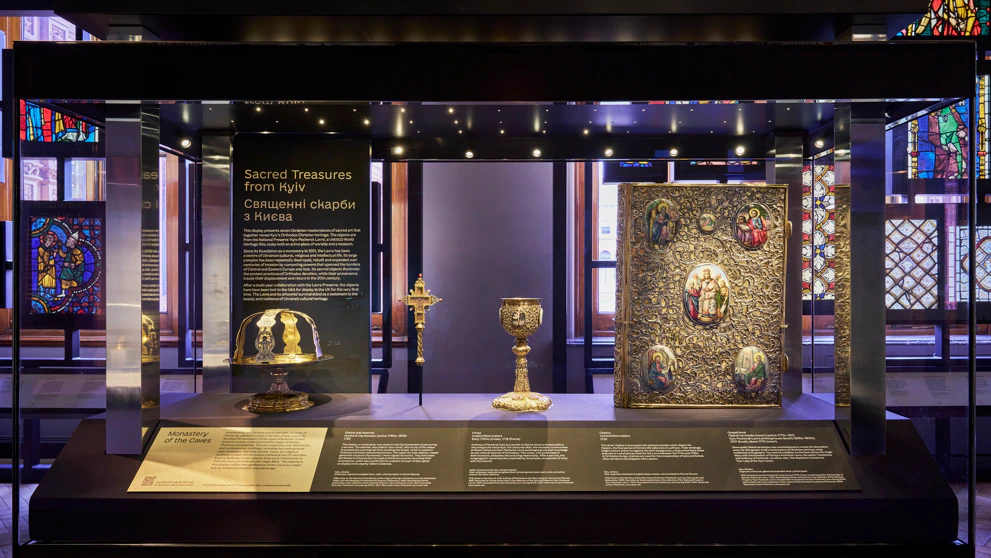
The announcement came as the V&A opened Sacred Treasures from Kyiv, a free display of seven 18th-century objects loaned by Kyiv-Pechersk Lavra.
The display opened at V&A South Kensington on 14 September and runs until 17 September 2027. It is the first time the objects have been displayed in the UK.
Advertisement
The artefacts include an icon, a silver-bound altar gospel, a diskos used to carry the eucharist during the Divine Liturgy, and a silver-gilt chalice depicting the crucifixion.
The British Council supported the transport of the seven objects to the UK.
The display builds on a multi-year partnership between the V&A and Kyiv-Pechersk Lavra, which also includes provenance research into two pairs of rare silver-gilt Holy Gates that are part of the V&A’s Gilbert Collection.
The Holy Gates originated from the monastery and are now displayed in the London museum’s newly transformed Gilbert Galleries. The V&A says they are the only known examples of their kind outside the Orthodox world.
The provenance research has been carried out with Kyiv-Pechersk Lavra, the Ukrainian Institute and ICOM UK, and involved examining the history of the Lavra and its collections, and exploring questions of ownership, displacement and exchange.
The project also involves the Ministry of Culture of Ukraine, the Ministry of Foreign Affairs of Ukraine and the Embassy of Ukraine in the UK.
V&A director Tristram Hunt said: “These national treasures showcase the exceptional skill of Ukrainian silversmiths and illuminate the rich artistic heritage preserved by the Lavra. We hope that the display and conference this September will inspire greater appreciation of Ukraine’s unique heritage and foster collaboration across the cultural sector to uncover and share the country’s remarkable story.”
Maksym Ostapenko, the general director of Kyiv-Pechersk Lavra, said the objects provided an opportunity to introduce international audiences to the Ukrainian school of 18th-century sacred goldsmithing.
He said the partnership would allow the story to be presented internationally “as an integral part of Europe’s shared cultural heritage”.
Scott McDonald, the CEO of the British Council, said the collaboration brought Ukrainian and UK experts together to share knowledge and expertise.
Symposium
The V&A display was accompanied by the one-day symposium Ukrainian Cultural Heritage and UK Institutions: Shifting Perspectives and Practice, held on 15 September.
The event brought together museum professionals, academics, lawyers, heritage organisations and Ukrainian cultural specialists to discuss the protection, preservation and interpretation of Ukrainian cultural heritage during and after Russia’s war.
Delivering the opening address, Hunt said: “The full-scale invasion by Russia has placed Ukraine's museums, collections, and cultural workers under intolerable pressure. It has also given UK institutions a clear responsibility to examine how we understand, describe, and support Ukrainian heritage.”
Hunt said the aim of the symposium was to “bring colleagues together, connect work already underway, and turn emergency solidarity into sustained scholarship and cooperation”.
“A single conference will not resolve an entire field, but we hope to act as a point of departure,” he added.
Speakers at the event outlined the scale of destruction to Ukraine’s cultural heritage. Deputy prime minister and culture minister Berezhna said that 2,640 cultural institutions had been damaged during the war, with 569 completely destroyed.
This figure includes 148 museum buildings either damaged or destroyed; more than 150,000 objects have been evacuated to safer areas.
Meanwhile, 124 museums holding around 2.39 million objects remain in occupied territories. In just one museum, Kherson Regional Art Museum, Russian forces stole more than 10,000 artworks and transported them to occupied Crimea.
The symposium heard about measures being developed in Ukraine including museum registration and digitisation, emergency storage, legal protections and work to strengthen the evacuation coordination centre. International initiatives include the Ukrainian Cultural Heritage Fund, Cultural Resilience Alliance and Culture for Recovery.
Another session focused on the recently published guide for museums on the decolonisation of Ukrainian heritage.
The guide was developed by the Ukrainian Institute, ICOM UK, ICOM Ukraine and the Museums Association, with support from the British Council. It covers attribution, acquisition, exhibition interpretation, terminology and research practices relating to Russian, imperial and Soviet frameworks.
The guide is now available in English and Ukrainian, with French and German translations planned.
A further session at the symposium explored the legal routes that Ukraine may take against Russia related to cultural heritage. These may include the restitution of displaced objects, reparations for cultural damage and international accountability for cultural heritage crimes.
Caecilia Dance, art and luxury lawyer at the law firm Wedlake Bell, said evidence relating to ownership, identity, damage, location, value and responsibility would be important to future claims.