
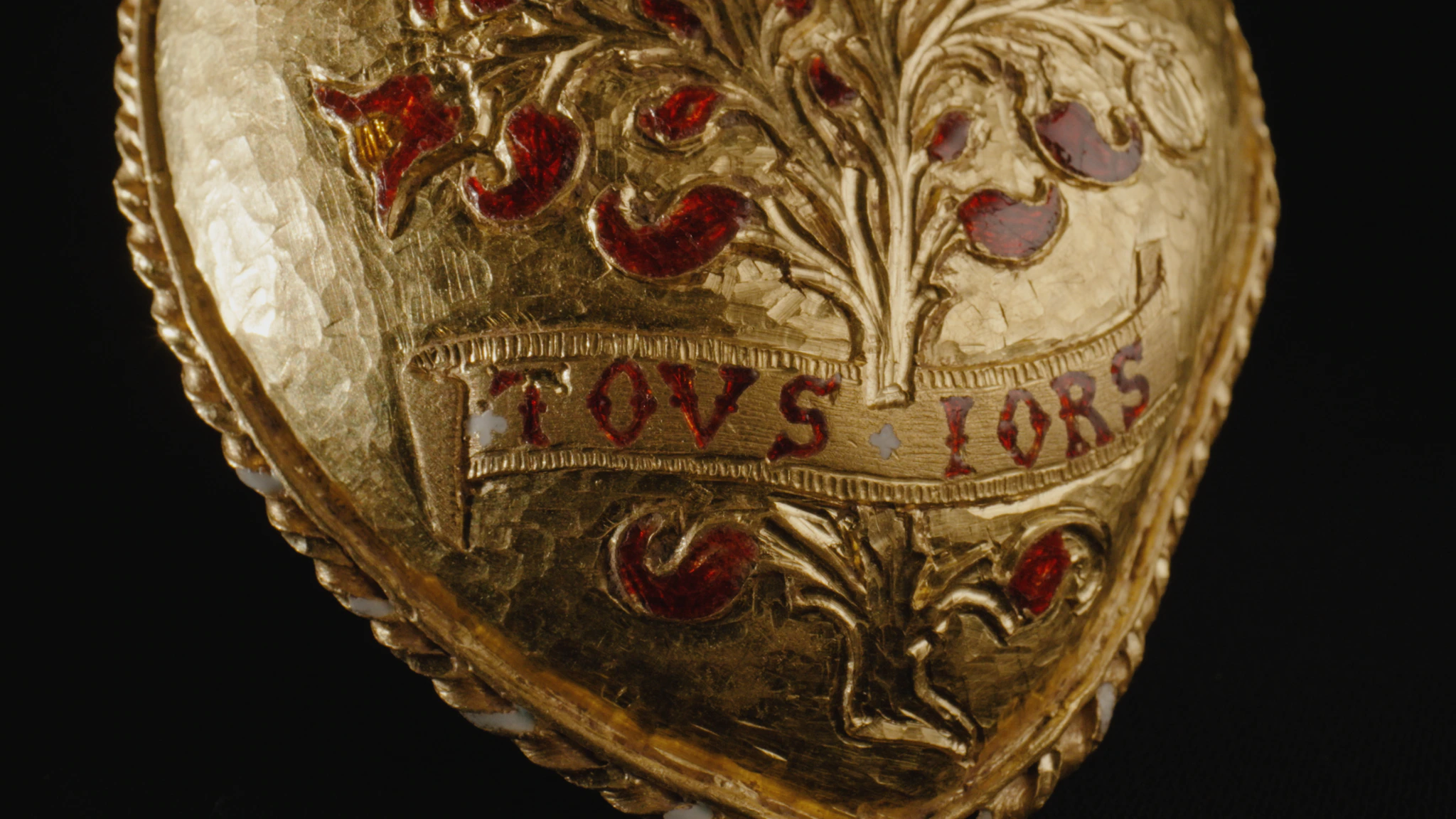
The British Museum has raised £3.5m in four months to acquire the Tudor Heart pendant, an exceptionally rare piece of jewellery linked to the marriage of Henry VIII and Katherine of Aragon.
The gold item was found by a metal detectorist in Warwickshire in 2019.
More than 45,000 members of the public donated around £380,000 towards the acquisition. Other major donations came from the Julia Rausing Trust, which gave £500,000, Art Fund, which gave £400,000 including a contribution from the Rought Fund, and the American Friends of the British Museum who gave £300,000.
A £1.75m award from the National Heritage Memorial Fund brought the fundraising bid over the line last week.
The British Museum said the “overwhelmingly positive public response and major awards from other arts bodies and donations from individual philanthropists, secured the campaign’s success and meant the funding target has been reached before April”.
The museum has announced plans for a future national tour, including a display in Warwickshire near to where the pendant was found.
Advertisement
Nicholas Cullinan, the director of the British Museum, said the success of the campaign “shows the power of history to spark the imagination and why objects like the Tudor Heart should be in a museum”.
“This beautiful survivor tells us about a piece of English history few of us knew, but in which we can all now share. I am looking forward to saying more soon on our plans for it to tour the UK in the future,” he added.
Debate over cost
However, debate is growing over how much the Treasure and Portable Antiquities Scheme (PAS) is costing the museum and heritage sector.
The system, which records archaeological finds in England and Wales and makes treasure discoveries available to museums to acquire for public benefit, is under strain due to an explosion of interest in metal detecting, particularly since the Covid pandemic.
The most recent Treasure and PAS annual report showed that 2024/25 was the third consecutive record-breaking year for reported finds and Treasure cases.
Advertisement
Freedom of Information (FOI) requests submitted by the archaeologist and torc expert Tess Machling last year show that more than £7.2m was paid out to metal detectorists and landowners in 2024/25 to acquire treasure and other archaeological finds for the public.
Machling told Museums Journal that there is disquiet among heritage and archaeological professionals over the high costs associated with the system, the loss of archaeological data and context as a result of metal detecting, and the strain the scheme is placing on museums and their staff.
She said important finds were being lost to public ownership because of these issues, citing the example of the Knaresborough ring, a rare ring believed to date from the iron age that was sold at auction to a private collector in 2022.
Machling highlighted the pressure on museums to deal with finds and fundraise for acquisitions at a time when the sector is already under severe strain.
“The amount of time museum professionals are spending on fundraising is a big problem,” she said.
Machling said millions of pounds in costs were being incurred by the public, via grant-in-aid, funding bodies, crowdfunding donations, museum payments and staff time, to acquire items that were already part of “our shared heritage”.
“That would pay for a lot of curators,” she said.
Machling said there is a growing feeling in the sector that Treasure and the PAS should be overhauled, and that the metal detecting community should be asked to contribute more to support the scheme.


The recent report that the British Museum has raised £3.5m to acquire a Tudor heart pendant has prompted some complicated reflections for me.
As a former archaeologist, I know archaeology operates within limits. There are sites everywhere; preservation conditions are deteriorating in many areas due to things like deep ploughing and changing water tables associated with modern farming practices, leading in some cases to the drying out of peat and near surface sites being destroyed. Most archaeological work happens alongside development, as research funds for academic archaeology are in short supply. In that context, it is not realistic to assume that material can simply be left in the ground for future excavation.
Responsible metal detectorists, working within the Portable Antiquities Scheme, bring to light and record objects that might otherwise be lost entirely. The archaeological context argument matters, but it has to be weighed against environmental change, finite excavation capacity and the reality of how archaeology is funded and practised.
So I do not object to acquisition in principle.
I also recognise the very real strain that Treasure/PAS acquisitions place on already stretched museum teams. Institutions are absorbing growing responsibilities for assessment, conservation and storage without equivalent structural investment.
That tension is not solved by vilifying detectorists, nor by assuming that appeals to “shared heritage” will override market forces. The issue is systemic: how do we properly fund the long-term stewardship obligations that follow discovery?
£3.5m is a significant sum in a sector where institutions are struggling to:
– Resource research
– Properly care for existing collections
– Fund interpretation
– Maintain facilities
– Employ enough curatorial and conservation staff
The question, for me, isn’t whether the pendant is “worth it” in isolation. It’s what this fundraising success reveals about how cultural value is mobilised.
A glittering Tudor object will attract philanthropic and public support in a way that an appeal for curatorial capacity or collections care rarely does. That is not because the latter is less important, arguably it is far more structurally significant, but because singular, tangible objects are easier to rally around.
In that sense, this isn’t just a story about one acquisition. It is about the economics of attention in the heritage sector.
If that money was never realistically going to fund additional curators or long-term research infrastructure, is it wrong that it secures an object instead? Or should we be asking harder questions about how we make the invisible work of stewardship and scholarship equally compelling to funders?
I’m genuinely interested in how others are thinking about this. This tension runs through much of how we fund and frame cultural work.