The Nigerian president Bola Ahmed Tinubu has intervened in a row over the new Museum of West African Art (Mowaa).
Due to officially open to the public on 11 November, the institution, in Benin City in the country’s Edo State, has indefinitely postponed all activities related to the opening after protesters disrupted a preview event.
According to local media, the protesters are supporters of the Oba (king) of Benin, the spiritual and cultural leader of Edo State, who believe that the museum has moved away from its original local remit, and are demanding that it be placed under the authority of the Oba (see box below).
One protester told DW News: “We consider the commissioning of Mowaa as illegal, as an insult on our revered throne.”
According to reports, Benin residents also feel the museum is attempting to take over ownership of Benin bronzes returned by western institutions, which the federal government has acknowledged as the rightful property of the Oba.
Mowaa has been accused of misrepresenting itself as a royal museum and custodian of the Benin bronzes order to secure international funding, an accusation it strongly denies.
Advertisement
“There's not one institutional investor that has given us money that has any notion that we are anything other than the Museum of West African Art. We have never pretended to be anything else,” Phillip Ihenacho, the director of Mowaa, told DW News this week.
Following the protests the Edo State governor revoked the museum’s land license, awarded by a previous administration, saying the land had been intended for a public hospital.
A high-level presidential committee has now been appointed to develop a “comprehensive framework for the permanent resolution of all related matters through dialogue, mutual respect and adherence to constitutional provisions”.
The committee is chaired by the minister of art, culture, tourism and creative economy, Hannatu Musa Musawa, and includes representatives from the presidency, the Federal Ministry of Art, Culture, Tourism and Creative Economy, the National Council for Arts and Culture, the National Commission for Museums and Monuments, the Palace of the Oba of Benin, Edo State Government, and international partners including German and French embassy representatives.
Musawa said: “Cultural institutions are pillars of our national identity and must be protected through collaborative approaches that respect both traditional custodianship and modern institutional structures.”
In a statement this week, Mowaa confirmed that it had made the “difficult but necessary decision” to postpone the planned opening of its inaugural exhibition, Nigeria Imaginary: Homecoming, in response to recent events, which it described as “local protests regarding broader regional development projects, and misconceptions about Mowaa’s vision and role within Benin City’s cultural landscape”.
Advertisement
The flagship Nigeria Imaginary: Homecoming exhibition features works by Nigerian diaspora artists such as Yinka Shonibare, Toyin Ojih Odutola, Precious Okoyomon, and Tunji Adeniyi-Jones, many of whom have rarely exhibited in the country up to now.
Shonibare's Monument to the Restitution of the Mind and Soul, a pyramid-shaped sculpture featuring 150 clay replicas of the Benin bronzes, is a centrepiece of the exhibition.
The museum said it was working “closely with local and national decision-makers to ensure that the museum continues to offer a safe, inclusive and welcoming space for all visitors”.
Mowaa said it “remains dedicated to balancing Nigeria’s important sovereign cultural interests with international partnerships and diplomatic considerations, to the benefit of its core audiences”.
The statement said ongoing programmes at the Mowaa Institute – the space on the Mowaa campus dedicated to scientific research, conservation, education and training – would remain fully active during the public closure.
It continued: “Mowaa is positive that the continuation of these dialogues will clarify the institution's intentions to all, ensuring the museum can soon welcome audiences to a fully operational, world-class centre which serves its core audiences – local communities, national stakeholders and international visitors – in a transparent, accountable and culturally respectful manner.”
Advertisement
Ihenacho said the institution remains “dedicated to engaging respectfully and collectively to the contribution of the preservation and advancement of Benin City’s rich cultural legacy, and its people”.
He said the museum holds Oba Ewuare II “in the highest esteem and continues to uphold deep respect for the Benin Throne”.
“We believe this moment can pave the way to renewed dialogue, engagement and understanding, so that together we can realise the full potential of what Mowaa can represent for Nigeria and Africa at large,” he added.
Ore Disu, the director of Mowaa Institute, said: “We set out to demonstrate that it’s possible to build world-class conservation facilities, research and exhibition spaces right here in Nigeria.
“We’ve shown that African stories can be told on our own terms, and I’m incredibly proud and grateful for what we’ve accomplished so far. This is a gift for Black and African people everywhere; for people today and future generations.”
Disu added: “We have deep respect for the monarch and people of Benin City. Over the last four years have sought to build inclusive practices that bring benefit to the city, its schools, universities and families. We wish to deepen and improve on this, as we work towards welcoming others through our doors.”
The institution will share further updates on the new public opening date for Nigeria Imaginary: Homecoming in the coming weeks.
Mowaa is described as an independent non-profit institution “dedicated to the preservation of heritage, expansion of knowledge and celebration of West African arts and culture”.
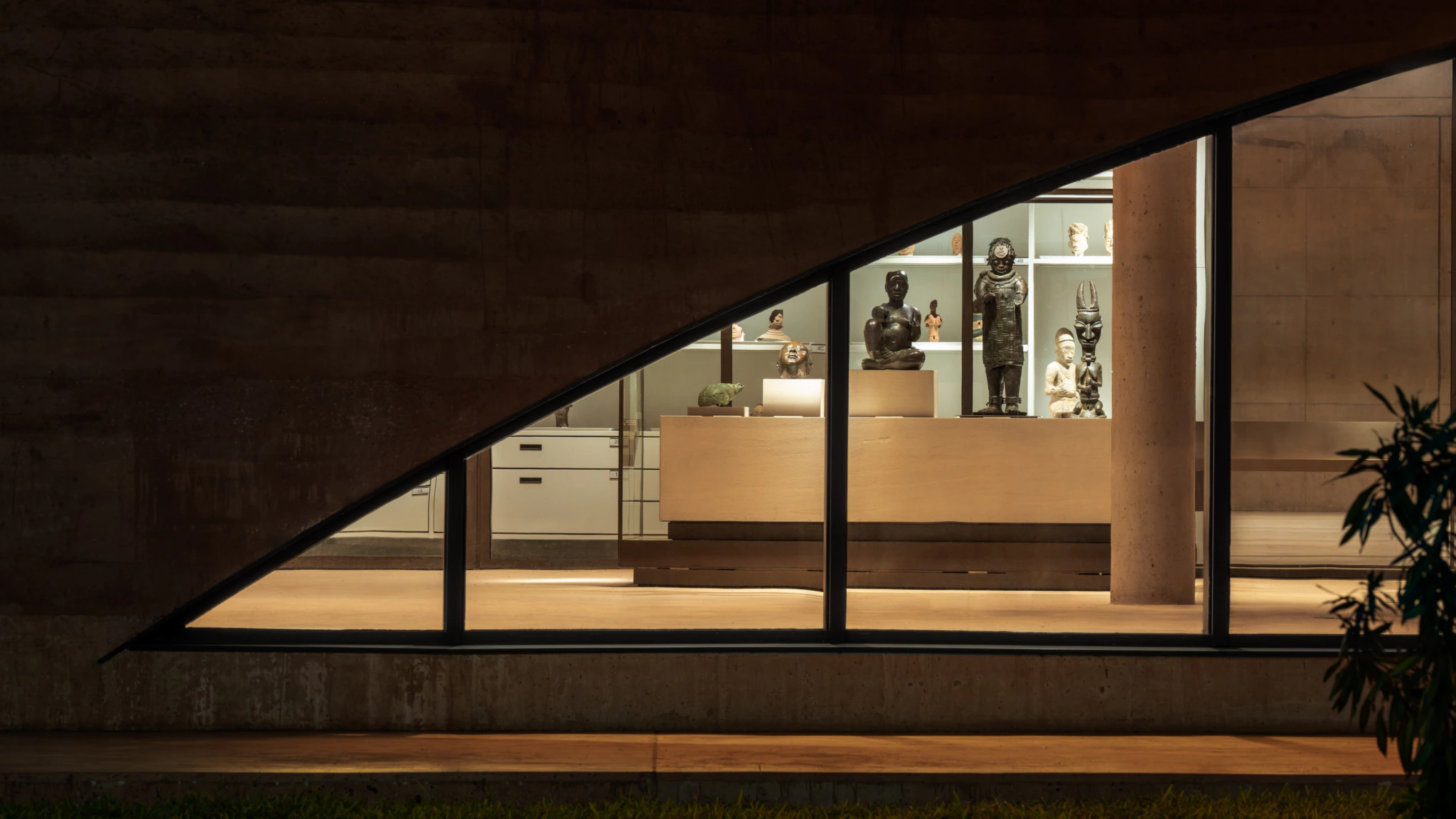
The Mowaa campus, designed by Adjaye Architects, is in the centre of Benin City and includes a welcome pavilion, the Mowaa Institute, temporary exhibition spaces, a historical collections display, a store and public spaces and gardens.
Background to the Mowaa dispute
As efforts to repatriate African cultural property from western institutions accelerated over the past decade, the then-Edo Museum of West African Art was envisaged in 2020 as a world-class venue to care for, research and display returning Benin bronzes, the historical artworks looted by British forces in the 1897 punitive raid on Benin City.
However, matters became more complicated in 2023 when Nigeria’s outgoing president, Muhammadu Buhari, ruled that all cultural property looted from Benin City should return to the direct ownership of the Oba of Benin, Ewuare II, rather than the state. Ewuare II is the descendant of Oba Ovonramwen, the kingdom’s ruler at the time of the theft.
Around 150 original bronzes have been returned to Nigeria in the past five years, some from private collections and some from state institutions. A new royal museum is being planned by the Oba to house the artefacts.
In response to these developments, Mowaa dropped “Edo” from its name and broadened its remit to broader West African art, research, education and conservation, with a focus on modern and contemporary art as well as historical works from Nigeria and beyond.
This led to accusations that the museum’s original focus on Edo culture and history had been “hijacked”, with protesters calling for Mowaa to be placed under the direct authority of the Oba.
The museum has also been accused of misrepresenting itself as a royal museum and eventual home for the Benin bronzes in order to secure international funding. It has strongly rejected these claims.
Mowaa’s director and chair Phillip Ihenacho recently said western institutions had failed to take local politics into account in their “well-intentioned” rush to return Benin bronzes.
“In the west, there was a race about who was going to be the first institution to restitute,” he told The Guardian last month. “And there was not enough of a focus on to whom they would be restituted to.
“I think that there was a well-intentioned effort that was focused very much around being seen to be a pioneer in this area. But a lot of people in the west failed to understand the complexities within those countries.”