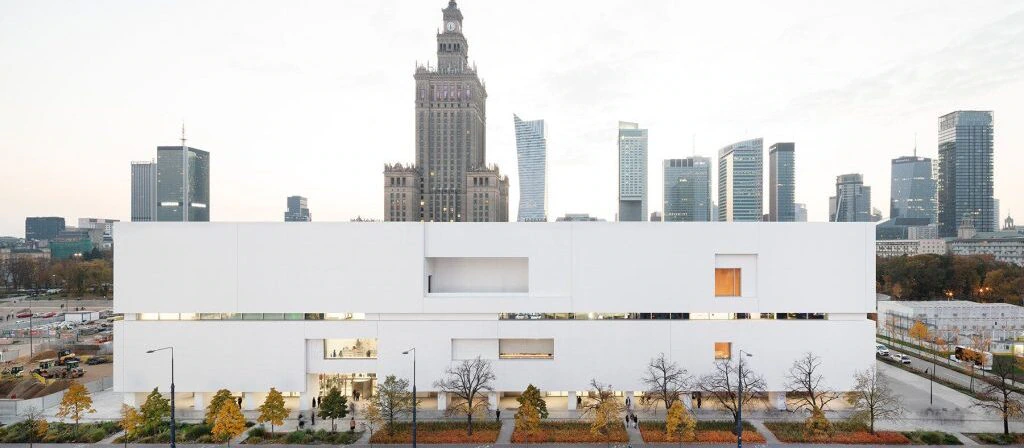
The new Museum of Modern Art in Warsaw (MSN Warsaw) sits opposite the Palace of Culture and Science, an imposing building opened in 1955 in the centre of the city to reflect the might of the Soviet Union, the communist state that controlled eastern Europe after world war two.
The museum is part of the redevelopment of Parade Square, which was built alongside the palace as the largest city square in Europe and another symbol of communist power. MSN Warsaw also sits within the boundaries of what was the Warsaw ghetto, where 460,000 Jewish people were imprisoned after Germany invaded Poland at the start of world war two.
It was the largest ghetto created by the Nazis during the war and many of its residents died in concentration camps or in the ghetto itself, which was demolished by the Nazis after an uprising in May 1943. Much of the rest of Warsaw was destroyed in 1944 after a 63-day uprising led by the Polish underground organisation attempting to liberate the city from German occupation.
After the war, Poland, which became a communist state, embarked on a huge rebuilding project. Another wave of construction followed the fall of communism in 1989 and the beginning of democracy in the country.
More recently, city authorities have improved Warsaw’s cultural infrastructure, including new museums such as the Polin Museum of the History of Polish Jews, which opened in 2013, and the Warsaw Rising Museum, which reopened last year after a revamp.
Advertisement
MSN Warsaw is the latest cultural addition to the city, although it has been a long time coming. The organisation was founded in 2005 and has a remit to collect, present, and interpret international art made since 1989, making it focused on contemporary rather than modern art, despite its name. Until its permanent home was completed in October last year, it spent 20 years as a nomadic institution, staging exhibitions at various Warsaw locations.
MSN Warsaw’s collection was developed at a time when Poland was looking to the future as a country released from communist control and taking its place as a forward-thinking democratic state.
Art was seen as an important part of this, but political divisions within Polish society have tempered this optimism. Eight years of populist rule under the Law and Justice party from 2015 saw the government try to reshape the country’s arts and cultural landscape to advance right-wing, nationalist narratives.
Part of this involved intimidating artists, curators and museum directors. This oppressive period ended after the 2023 election resulted in a new coalition government.
As Joanna Mytkowska, the director of MSN Warsaw, writes in one of the publications that accompanies the new museum: “The culture wars have sidetracked our hopes of building a broad consensus under liberal values, while existing tensions and polarisation have made it difficult to not only identify shared common values but also to formulate nuanced statements that can transcend the conflict.”
With its prominent new home, MSN Warsaw has had to learn to deal with controversy, including criticism from right-wing figures in politics and the media.
Advertisement
The organisation had been jointly operated by the City of Warsaw and the Ministry of Culture and National Heritage, but the differing priorities of the Law and Justice party made this difficult to sustain. In 2023, the City of Warsaw took on sole responsibility for it.
The development of the new museum was also affected by Russia’s invasion of Ukraine in 2022, as Ukrainians working on the site returned home to fight.
At the start of the war, the organisation provided support for the many refugees who came the other way, crossing the border between Ukraine and Poland and heading to Warsaw to escape the conflict.
This work has had a big impact on the development of the museum’s programme, with the institution exploring the idea of “friendship of the peoples” for its opening exhibition.
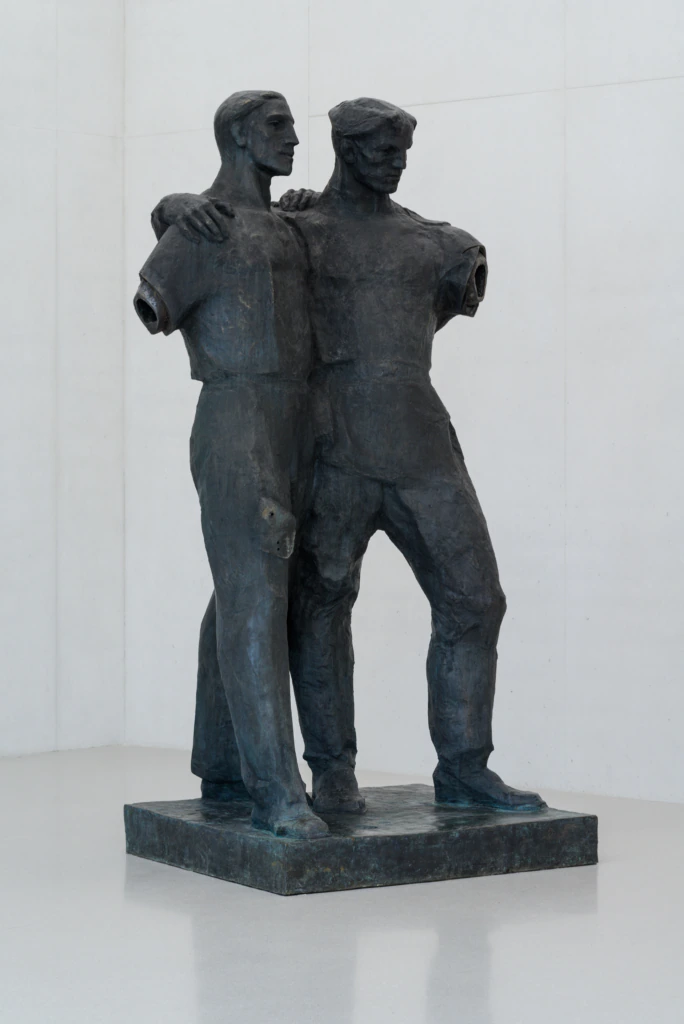
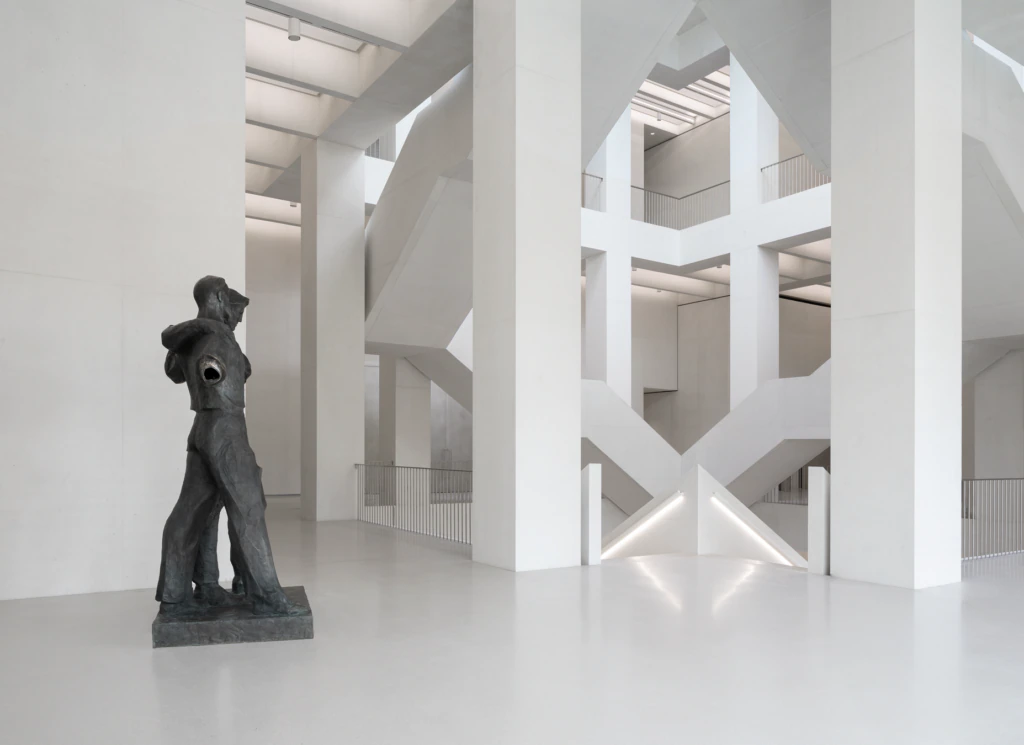
One of the first things you see as you reach the top of the stairs on the second floor is a socialist-realist sculpture, Monument to Polish-Soviet Friendship, by Alina Szapocznikow. The work, created in 1954 to stand in the entrance hall in the Palace of Culture, features two men embracing. Each of them lost an arm when the sculpture was removed from the palace in 1992. The flag they were carrying was also removed.
Advertisement
The prominence of the sculpture provides an appropriate entry point to the rest of the opening exhibition, which is called The Impermanent: Four Takes on the Collection.
Drawing from the museum’s holdings of more than 4,300 artworks by Polish and international artists, the exhibition includes more than 150 works, half of which were created by women artists from the 1950s to the present.
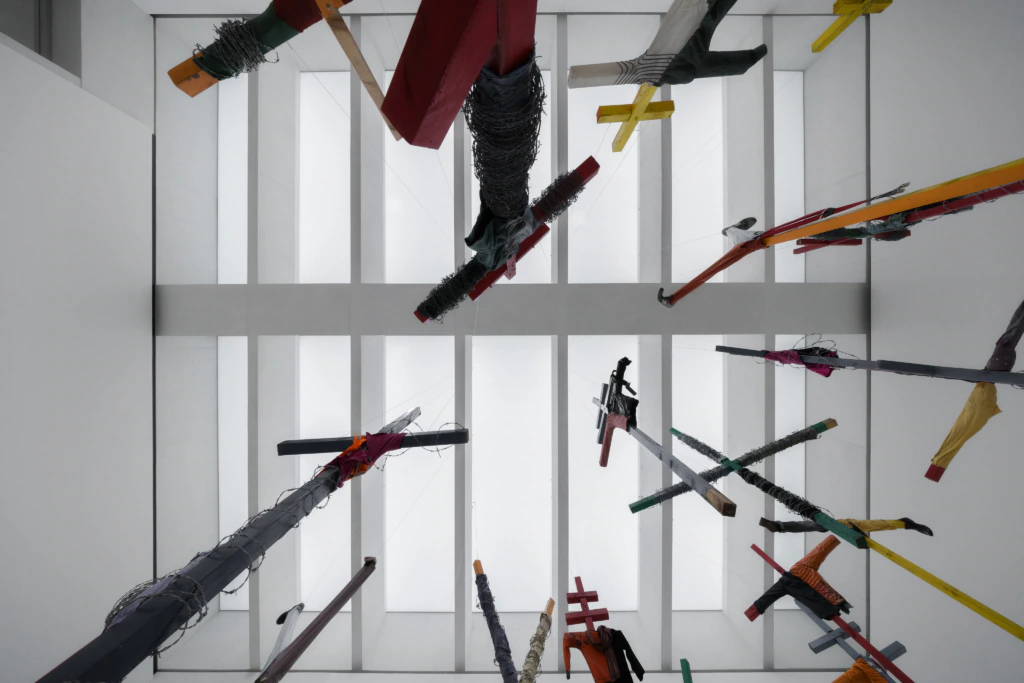
The exhibition is divided into four themes across the second and third floors of the museum. Banner: Engagement, Realism and Political Art explores how art has been an integral part of wider debates concerning rights, policies and power.
Synthetic Materialities: Body, Commodity and Fetish from the Cold War to the Present looks at consumerism, pop culture and mass media.
Dark Planet: Art, Spirituality and Future Coexistence comprises works from isolated artistic practices, such as folk, amateur and Indigenous art.
And finally, Real Abstractions: The Autonomy of Art Against the Catastrophes of Modernity presents artworks that explore the promises of modernism and the collapse of its utopian dream.
Museums Journal spoke to MSN Warsaw director Joanna Mytkowska about her thoughts on the new museum.
How has the idea of friendship and solidarity influenced the museum and its programming?
Joanna Mytkowska: It is from the sculpture by Alina Szapocznikow called Friendship. It is a bit ironic, because the sculpture was referring to the Polish-Russian friendship that was a Soviet concept at the time. But this notion appeals to communities of activists and artists who are convinced about the duty of taking care of those who were excluded in Poland during the recent populist government – people such as migrants and the LGBT community.
The meaning changed again when the war in Ukraine started and Warsaw saw the biggest number of migrants in a few days. Our former temporary space was close to the railway station, so it was like we were on the front line. We organised basic help like food distribution, information, lawyers and so on. I promised myself we would remember those few weeks because we often don’t have a good opinion about what Poles are able to do. But those weeks were amazing because people – from whatever political position – organised themselves to help.
How has this fed into your collections and displays?
Politics is an important part of artistic life here. We have quite a few examples of radical art in the collection, and we also have art that explains why politics is important and how artists were living through political events.
We are coming from the perspective that politics is our life and everything is political. We don’t want our life to be taken from us, so that’s why we have to deal with politics. But we still hope that our exhibition gives the impression that art also has autonomy. We are open to different perspectives, and also different political and artistic positions.
What do Warsaw’s citizens think about the museum?
We want to convince people that contemporary culture and art is a tool for communication. This is our mission. We just need time, and the museum will become a part of the life of this city.
How will the exhibition programme develop?
In October, we will open the Kyiv Biennial, in November there is a big project dedicated to the history of iconography of female art and we will have a historical show curated by American curator Alison Gingeras. There will be smaller projects showing contemporary positions and we are collaborating with several museums, such as the Lenbach House gallery in Munich, and Reina Sofia in Madrid. Every year we will have five to six big shows, and then smaller projects.
Design notes
With the imposing Palace of Culture and Science behind it, the new Museum of Modern Art in Warsaw (MSN Warsaw) has a lot to compete with architecturally.
This is architect Thomas Phifer’s first European museum, although he has designed the North Carolina Museum of Art in Raleigh, North Carolina, and extensions for Glenstone Museum in Potomac, Maryland, and the Corning Museum of Glass in Corning, New York.
Phifer wanted the museum to have a strong impact within what is a huge public square. The result is a striking building composed of two rectangular forms with a white concrete facade.
“The museum is located between the palace, with its history, and the city that has grown up around it across the street,” Phifer says. “So, we wanted to give this building a real sense of presence, and a sense of permanence for the institution.”
MSN Warsaw, a nomadic institution since it was founded in 2005, now has a home that includes space for long-term and temporary exhibitions, a 150-seat theatre, conservation studios, a performance auditorium, education spaces and a bookshop and cafe on the ground floor.
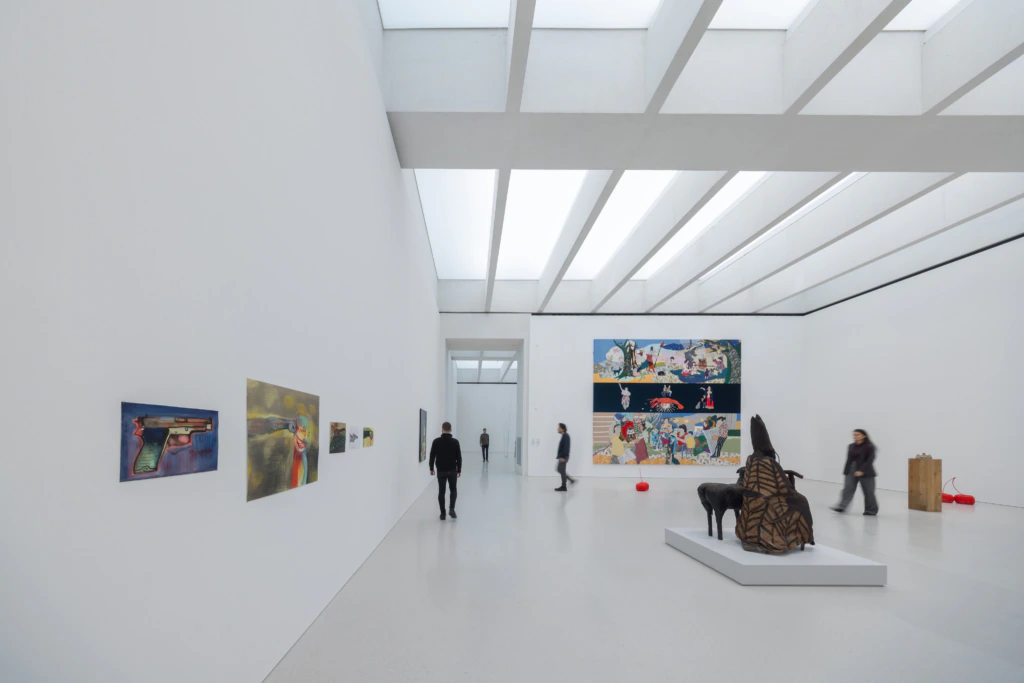
In one sense, it is unusual for a modern art gallery in that the exhibition spaces are fixed. Instead of flexible spaces that can be changed with each exhibition, MSN Warsaw has different-sized permanent rooms, ranging in height from 4m to 7.5m, for the curators to work with.
The galleries are punctuated by what Phifer calls “city rooms” – smaller, wood-panelled spaces with large windows where visitors can sit and look out at the city. These spaces, which contrast with the white-walled galleries, will sometimes have small artistic interventions in them.
The glazed roof brings diffused daylight into the galleries and for Phifer, the way the light interacts with the interior is crucial. “We wanted to make this building a vitrine of light. It is the thing that weaves together the art experience with this place. As you walk into the rooms, the architecture begins to dissolve a little bit as you see these works there.”
A monumental, classically inspired double-symmetrical staircase at the heart of the museum is designed as a place for people to meet.
“One of the things we talked about from the beginning was that this place had to be a place for people, a place to encounter the art and to encounter each other,” Phifer says.
Project data
Cost
$145m
Main funder
City of Warsaw
Design architect
Thomas Phifer and Partners
Local architect
APA Wojciechowski Architects
Engineer
Buro Happold
Concrete facade engineering structure
Skidmore Owings and Merrill
Construction management
Portico
Lighting design and gallery acoustics
Arup
Building acoustics
AkustiX
Audiovisual consultant
Harvey Marshall Berling Associates
Building enclosure consultant
Studio Profil
Surveyor
Progeo
Cost consultant
LB-Projekt
Graphic design
Ludovic Balland