Every generation has its national moments – World Cup penalty shoot-outs, Olympic victories, prime ministers resigning in front of 10 Downing Street.
In September, the British Museum (BM) is hoping to add another memory to the collective consciousness when it opens its Bayeux Tapestry exhibition, the first time that arguably the most significant artefact in England’s history returns to these shores in a thousand years. The first tranche of tickets to the exhibition sold out within hours of their release earlier this month, crashing the BM website.
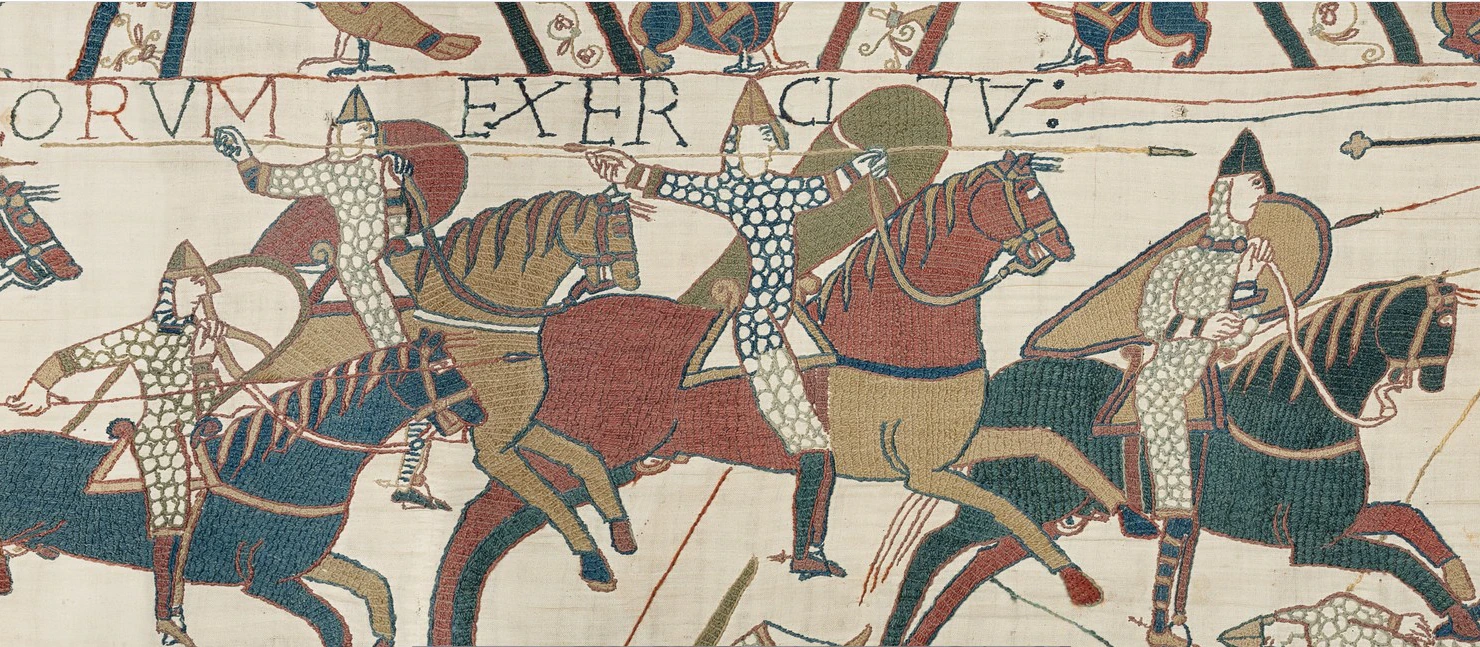
The loan is one of the most complex ever arranged by the institution. Leaving aside the delicate political negotiations between A section of the 70-metre long linen tapestry, which portrays the events surrounding William the Conqueror’s invasion of England in 1066
France and the UK, which were nearly derailed several times by changing diplomatic winds, the artefact itself presents a conundrum for anyone involved in its packing, transport and display.
How do you box up 68.3 metres of ancient linen, already in a fragile state after a millennium of wear and tear, and take it safely across the English Channel? And how on earth do you find a secure, environmentally controlled space large enough to even display the thing?
Not everyone believes the authorities involved have the answers. There are still many doubters to the loan - last year almost 70,000 people signed a petition urging France’s president Emmanuel Macron to call it off.
Advertisement
But if there are any nerves about the daunting scale of this task, they’re not showing among the team preparing for what the BM expects to be one of its biggest-ever blockbusters.
“I don’t feel very stressed,” says Michael Lewis, who has been seconded from his usual role as head of the Portable Antiquities Scheme to lead on curating the Bayeux Tapestry exhibition. “Because we’re such a big organisation, that sense of responsibility is quite dispersed.”
Lewis is one of the UK’s foremost experts on the tapestry and has been involved in discussions about the loan since 2013, when it was first proposed that the artefact could be taken to England when Normandy’s Musée de la Tapisserie de Bayeux eventually closed for redevelopment.
Lewis stresses there’s much more thought and planning behind the loan than has been portrayed by the media. “It’s been presented a little bit in the news as some sort of vanity project for president Macron,” he says.
“Obviously, there’s a lot of background to get discussions to the point where somebody like the president can announce that. He’s not Trumpesque, he’s a considered guy in terms of what he can do, so he obviously made that promise knowing there was a reality behind it.”
Battle stations
Confident as they feel, the BM’s exhibition team are well aware of the unique significance of the loan. Although they hit the ground running after Macron’s announcement last July, they’ve still had only a little over a year to prepare for the type of show that would normally be half a decade in the planning.
Advertisement
“It’s an incredible turnaround,” says Lewis. “And it’s not so much that it’s a curatorial venture, because in some ways that’s quite simple, but it’s the other aspects – the logistics of transferring the tapestry to this country and the complexities given the systems of government in this country, which are very different to that in France.”
The building of the showcase – which will display the tapestry horizontally in a single length for the first time, and will go to Normandy with the artefact when the exhibition ends – is a case in point. It is being constructed by Meyvaert NV and was developed in collaboration with the exhibition’s designer, Opera Amsterdam.
“It’s the longest showcase in the world,” says Lewis. “It’s not like we can just reuse a case we have upstairs and take it down and polish it a bit. It has to meet particular requirements, not only that we’re satisfied with, but that the French are satisfied with.”
In spite of these complexities, Lewis says the technical aspects of moving the tapestry are straightforward: “This is no doubt a very complicated operation but not, I don’t think, a technically challenging one. It’s more of a reassurance one.”
Last year, at the museum in Bayeux, it took a team of 90 people more than seven painstaking hours to take the tapestry out of its 1980s-era display case and transfer it, inch-by-inch, onto a paravant, a folding screen that accordions into a large box when fully compressed. It will be a similar story when the paravant arrives in London, with all hands on deck to help unpack it.
First, however, the tapestry must make it safely by train through the Eurotunnel, a closely guarded journey that needs to meet the strict criterion of keeping travel vibrations below 2mm per second. [After this article appeared in print, the British Museum confirmed that the Bayeux Tapestry has now arrived safely in the UK.]
Advertisement
Two successful dry-runs with a facsimile tapestry have left the team feeling “pretty happy that that’s possible to maintain those sort of limits”, says Lewis.
Once on display, the exhibition team plans to let the medieval artwork speak for itself, so unlike the British Museum’s usual object-rich exhibitions, this will be a pared-down show. Taking place in the Sainsbury Gallery, which is just about long enough to accommodate the full length of the artefact, the exhibition will feature a small number of carefully selected items, none of which have been displayed with the tapestry before. Audiovisual content will draw out key figures from the artwork and immersive battleground scenes.
“The everydayness of it being here is going to be quite amazing.”
“We wanted to try and give people as much time as possible with the tapestry and then give them the tools to make the most of that experience rather than overload them,” says Lewis. “We’re not going to have a lot of other material, and what we have has been specifically chosen because it’s going to work hard in terms of driving those key messages.”
What will be ambitious is the interpretation of the tapestry, which will explore the story of the Norman Conquest from a very different perspective to that found in Bayeux.
“[The battle of] 1066 is an event that’s fundamental to our identity, our history, in a way that it’s not in France at all,” says Lewis. “William, to put it frankly, is just a provincial duke. He’s not a king, and they don’t celebrate the fact that this guy from France conquered England. He was obviously a rival to the French king, so in their history, he’s kind of pushed to one side.
“We want to reflect on the fact that the country changed forever because of this conquest,” he continues. “Historically, that is a very interesting event, because when I speak to my colleagues in other countries in Europe, [those countries] were used to being invaded and conquered all the time.
For us, it’s such a strange thing that it happened once and then never again for 1,000 years... We hope it will be a very engaging and different display to what anyone’s ever seen before, and to what will happen again in the future.”
As well as the London exhibition – which will have an entrance fee of £25 to £33 and be free to under-16s – a partnership programme is taking place with museums nationwide to explore the local impacts of the Norman Conquest. Lewis says these moments will be “powerful”.
The museum is hoping to hit a level of engagement on a par with its Tutankhamun exhibition of 1972. “Tutankhamun was open more hours, and we’re limited because of light levels and all that, but the number of people that we engage in different ways will, hopefully, be bigger,” he says.
National moment though it may be, witnessing the tapestry arrive in the UK will have a personal poignancy for Lewis.
“For me, the most exciting thing is that every morning I’ll be able to go down there and just look at it. I think just the everydayness of it being here is going to be quite amazing.”
The British Museum’s biggest blockbusters
- Treasures of Tutankhamun, 1972: 1.7 million visitors
- The First Emperor: China’s Terracotta Army, 2007: 850,000 visitors
- Life and Death in Pompeii and Herculaneum, 2013: 471,000 visitors
- The Vikings, 1980: 450,000 visitors