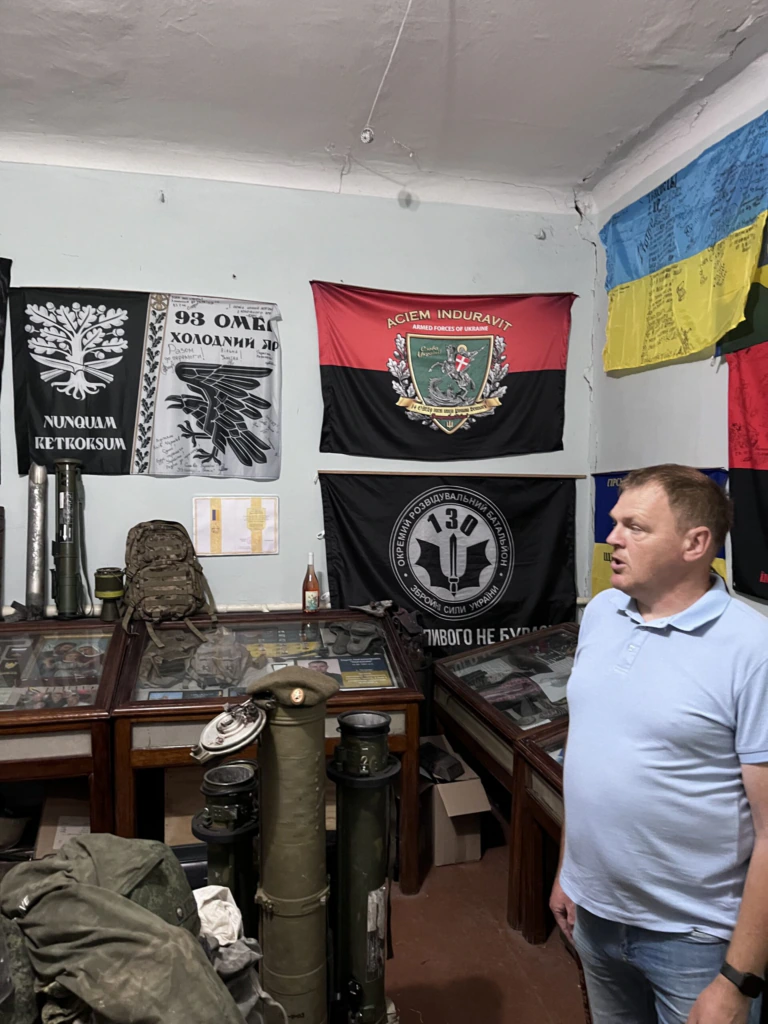
Vitaly Gedz, the curator of the museum in Makariv, a small town an hour’s drive west of Ukrainian capital Kyiv, moves through various exhibits collected during Russia’s occupation of 2022.
Some army food rations, now decomposing in a plastic bag. The broken fin of an Iranian-made Shaheed drone, thousands of which are launched across Ukraine by the Russian military every day, and now being deployed in the Gulf too.
“Our museum has existed for over 50 years,” says Gedz. “Today it has over 1,500 exhibits. Until 2022, the main goal was the history of the Makariv community; the older an exhibit was, the better. But the events of February to March 2022 have significantly changed things.”
The museum’s current goal is to capture the events of the Russia-Ukraine war. Makariv made headlines in 2022 after Russian armed forces destroyed most of the settlement’s infrastructure and killed up to 238 civilians during a full-scale invasion of Ukraine.
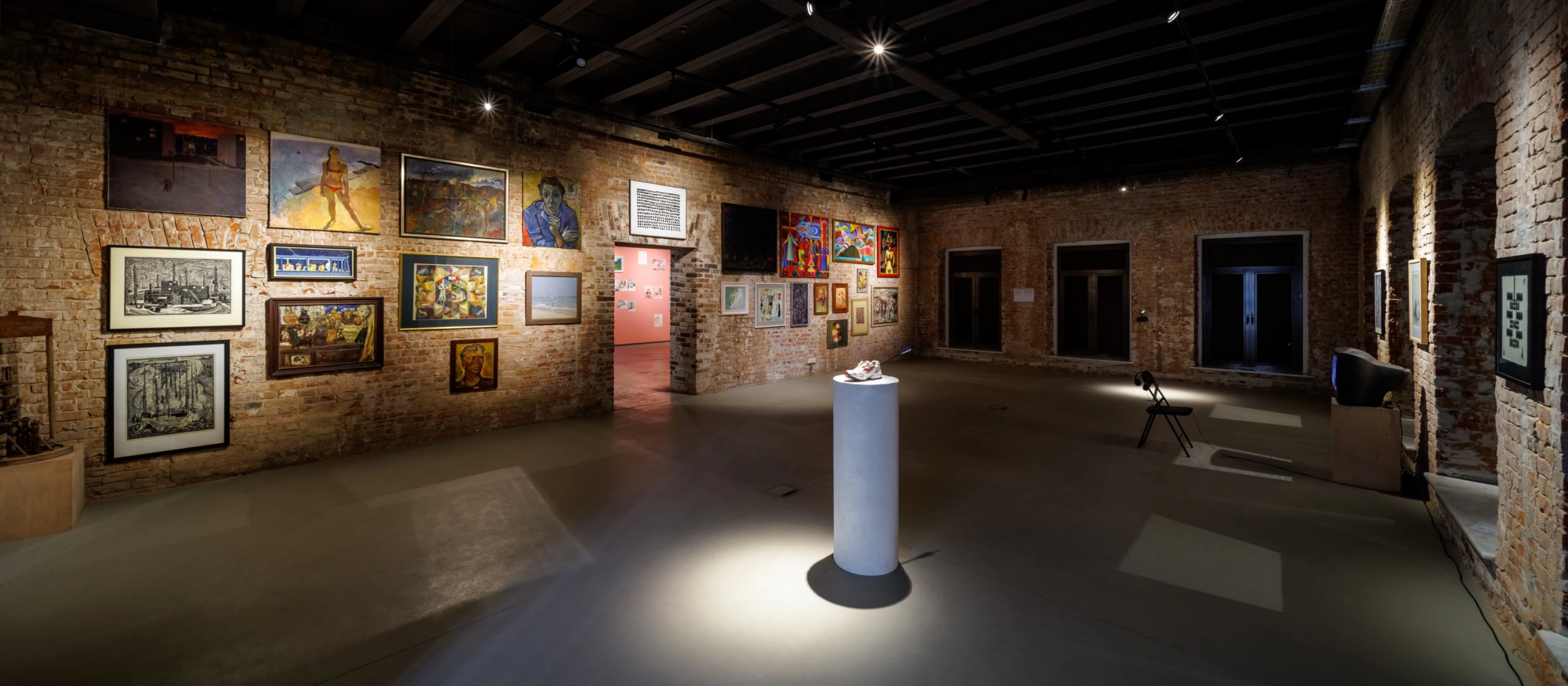
The single-storey museum is housed in the south-east corner of Pans’kyy Park close to the banks of the Zdvyzh River, about a 10-minute walk from the settlement’s main square.
Its historic collections – including those devoted to the town’s historic Jewish population – have taken a back seat to collecting items associated with the war with Russia, shining a light on the ethics of museum practice in live conflict zones.
Advertisement
Such collection practices pose questions about whether institutions serve as a form of commemoration – military or otherwise – or to bear witness to the atrocities of the invasion.
The museum’s priority is commemorating the lives of those who died defending Makariv in 2022, according to Gedz, and gathering material in relation to this. He says that explosions have exposed some archaeological curiosities, while discoveries have also been made as a result of soldiers digging trenches or building defensive structures.
“Therefore, over the past year and a half, our museum has been inundated with archaeological exhibits, which have allowed us to assert that the first people appeared in the Makariv region some 6,000 years ago,” he says.
Makariv has struggled to attract the funding needed to carry out vital repairs. It lacks properly housed archives because last March, a Russian shell exploded 25 metres from the museum and damaged the building’s windows, doors and roof, according to Gedz.
German cultural institution the Goethe-Institut has funded repairs to the doors and windows, but the roof remains unrepaired, and partially open to the elements. As such, exhibits sensitive to damp and cold are no longer kept on site.
The museum is fundraising to complete the repairs, although financial support for small museums in Ukraine is scarce – particularly due to what locals claim is misrepresentation by the media.
Advertisement
“For some reason, Makariv was bypassed in the press,” says Gedz. “They wrote about Makariv twice – ‘it was occupied and then liberated’. But in fact, everyone who is involved in the history of Makariv knows it was attacked by the Russians but was not taken. It was only 10% occupied, but it was very badly destroyed.”
Many other museums across Ukraine have been gathering material related to the conflict. These include the War Museum in Kyiv. Its deputy director general for research, Dmytro Hainetdinov, says the museum has been collecting artefacts, documenting testimony and creating a photo archive, including of live events.
This strategy saw the museum’s director, Yurii Savchuk, visit Kursk during the Ukrainian incursion in 2024 with a photographer, then staging an exhibition of the resulting pictures. The museum now has 19,000 artefacts relating to the full-scale invasion.
“These artefacts are not only just objects of history… they are evidence of the war realities,” says Hainetdinov. “This is our way to tell the story of the current war, around the world. We understand that if the world knows about our current situation and our history, it means that we can explain more to global society – and we can consolidate support for Ukraine.”
The institution has also been taking an active role in helping local museums document their destruction and preserve their collections.
Advertisement
Culture under fire
“It’s important to save these objects for history,” says Hainetdinov. “Despite Putin’s statements in the beginning – that they don’t attack civilian targets – in every town we visited, we saw horrible destruction everywhere. And museums and cultural sites were not excluded. They can be hit by precision weapons.
“In the Kharkiv region – even in the Lviv region in the west of Ukraine – several museums were either damaged or completely ruined. We preserve everything that we collect and in several cases, Ukrainian law enforcement institutions examined artefacts from our collection.”
On a more local level, the museum in Makariv also has an important role to play in documenting the events of the occupation of 2022. “None of the authorised bodies in Ukraine have fully conducted an investigation into the crimes – of the murder of civilians,” says Gedz.
“First, the local police collected evidence about crimes, then it was transferred to the SBU [the Ukrainian security services]. After three years with the SBU, it was returned to the police.
“Only now are the police starting to investigate and collect evidence again. Moreover, many people who could testify are no longer alive. But the police are working, and the first thing they do is go to the museum.”
Rob Sharp is a freelance journalist. Thank you to Elena Orap for Ukrainian to English translation
Supporting museums in Ukraine
Museum Futures was launched in November last year as part of a grants programme to help museums confront the challenges posed by Russia’s war in Ukraine. The initiative was developed by Ribbon International, a not-for-profit platform supporting historic and contemporary Ukrainian culture.
The Museum Futures initiative is a collaboration with Ukrainian cultural institution Mystetskyi Arsenal, and Art Arsenal Community, an organisation created by the organisation’s employees in 2022 to promote sustainable activities across the cultural sector.
Ribbon International recently announced that it had increased the funding for Museum Futures from $150,000 to $180,000. Grants were awarded to 10 institutions, ranging from $10,500 to $13,500.
Other supporters of culture in Ukraine have included the EU, which operates the Team Europe initiative for Cultural Heritage in Ukraine programme; and the Smithsonian Institution’s Ukrainian Cultural Heritage Protection Initiative, run in conjunction with the Kosciuszko Foundation, which promotes cultural exchanges between the US and Poland.