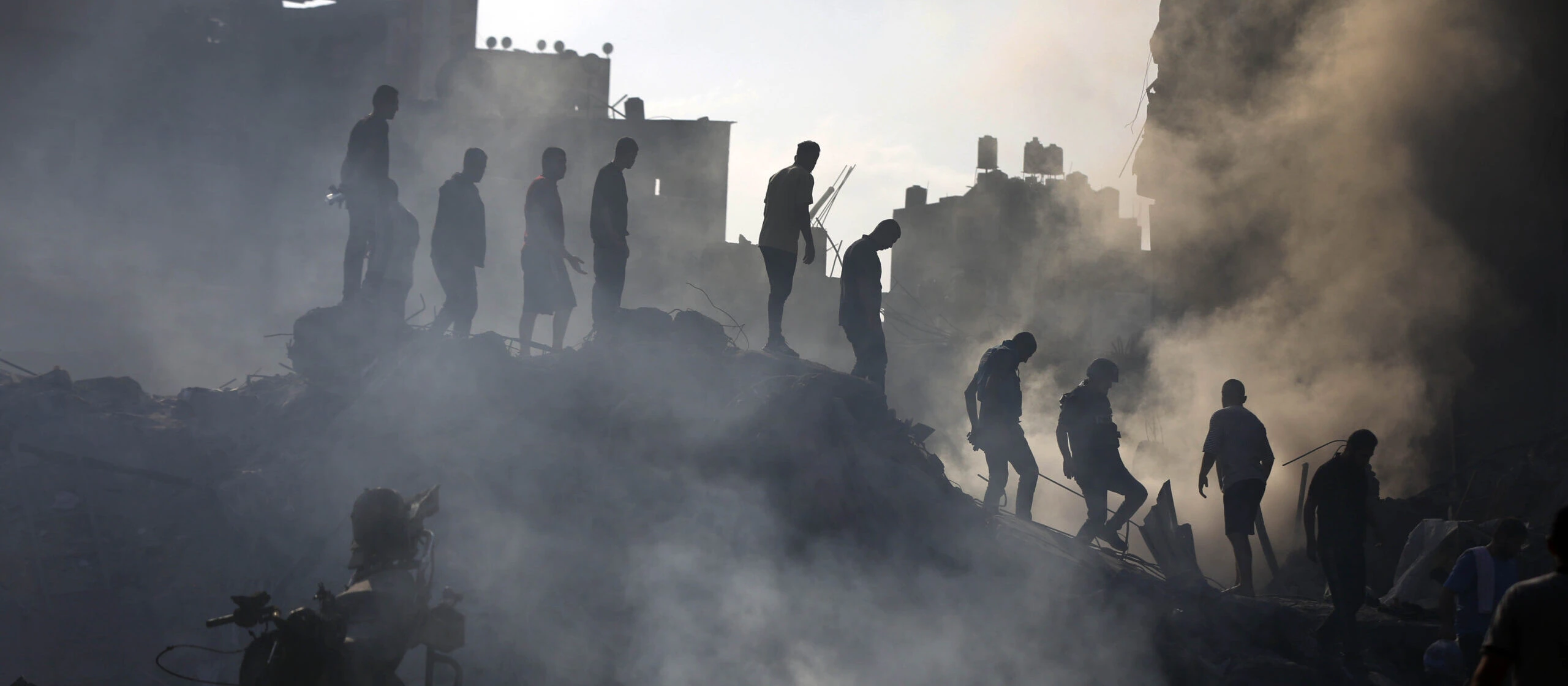
On 10 October 2025, a ceasefire was declared in Gaza after two years of intense warfare between Israel and Hamas militants.
Details have since begun to emerge about the destruction to cultural heritage during the conflict, as well as the international effort to document the extent of this damage and loss from afar at a time when international journalists and independent experts were unable to enter the Palestinian territory.
The devastating human cost of the conflict must be acknowledged first and foremost. Almost 1,200 Israeli casualties were reported in the initial attack by Hamas on 7 October 2023, and upwards of 70,000 Palestinian deaths have been recorded at the time of writing, including those of more than 20,000 children.
Some international bodies say Israeli policies and actions in Gaza have met the legal threshold for genocide, an accusation the state strongly rejects.
Cultural landscape in ruins
In addition to this horrific toll, international observers say much of the cultural landscape in Gaza now lies in ruins.
Advertisement
A strategic gateway port between Asia and Africa, the 26-mile-long strip is rich in cultural and archaeological heritage that dates back thousands of years, spanning major civilisations from the Philistines to the Ottoman Turks.
A recent report by Pen America, a US non-profit that defends free expression for writers, details the “grievous loss to the cultural heritage of humanity” that has happened as a result of the conflict (see box below).
Published in September 2025, just before the ceasefire, the report alleges that Israel indiscriminately and, in many cases, intentionally bombed sites of cultural, religious and archaeological significance, in breach of international law.
The Israeli military denies these accusations, citing the “unprecedented intermingling of Hamas within the civilian infrastructure” as the reason for such attacks, and says it “does not aim to cause excessive damage to civilian infrastructure and strikes only out of military necessity”.
The Pen report outlines the impact of the war on 36 cultural, historical, religious and educational institutions and sites. It also provides evidence for three instances of book burnings and two cases of reported looting of archaeological artefacts.
The report says: “This erasure by the government of Israel and the Israeli military is an assault on the dignity, identity and free expression of Palestinians.
Advertisement
“The violations of international law committed by the Israeli government and military must be fully investigated, including by independent investigators, and the perpetrators held to account.”
One initiative that has been working to monitor the state of cultural heritage in Gaza is the Endangered Archaeology in the Middle East & North Africa (Eamena) project, which was established in 2015 in response to the Isis invasion of Syria and Iraq.
The project is led by the University of Oxford, working in collaboration with local and national heritage authorities in the partner countries, which receives support from the charitable fund Arcadia, as well as the British Council’s Cultural Protection Fund.
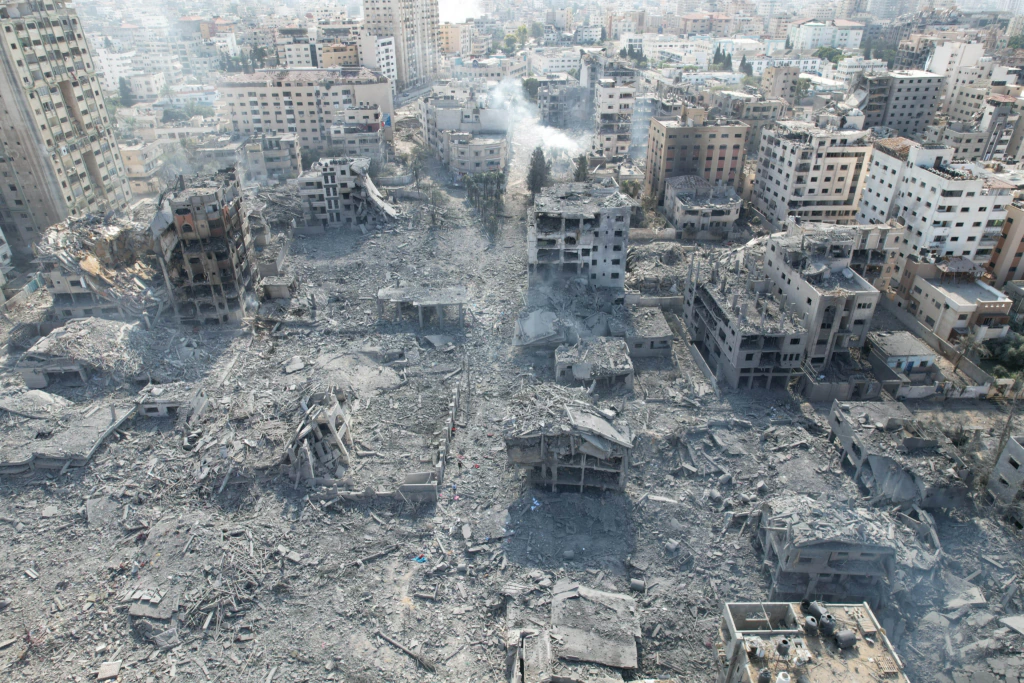
It conducts remote sensing using satellite imagery to identify archaeological and cultural sites and record their condition, storing the data online in an open-source database.
The scale of destruction to the cultural landscape of Gaza is far worse than any other conflict documented by Eamena, says Michael Fradley, a landscape archaeologist at the University of Oxford.
Advertisement
“Of all the conflicts that we’ve monitored, this is on a different scale,” he says. “Entire neighbourhoods have been levelled in a way that we haven’t seen in other very devastating conflicts elsewhere.”
A report published by Eamena at the beginning of 2025 estimated that at least 50% of the listed heritage sites in the Gaza Strip had been damaged.
“From what we know of the scale of military operations and demolitions this year, this figure may now be significantly higher,” says Fradley.
Assessment remains difficult
On-the-ground assessment and verification remains difficult, however. “We hope to update our report on the overall scale of damage in the near future, as well as supporting emergency training for heritage practitioners on the ground,” says Fradley.
“The latter is made difficult by continued instability and movement restrictions on the ground.”
Furthermore, it is not clear how the protection or restoration of heritage will figure in long-term reconstruction plans for Gaza.
Fradley says: “There is concern with all the discussion of this being a huge real-estate opportunity, and with some of the Gulf cities being a possible model, that there will be little room for heritage in a landscape with so many heritage sites, and with so much unexcavated archaeological deposits below ground.”
There is determination among Palestinians, however, that Gaza’s cultural heritage should be a priority in the post-conflict phase. The Palestinian Ministry of Tourism and Antiquities, which has jurisdiction over the West Bank, has been working in partnership with Eamena to monitor the situation in Gaza.
“There is concern, with all the discussion of this being a huge real-estate opportunity, and with some of the Gulf cities being a possible model, that there will be little room for heritage”
The ministry’s director, Jehad Yasien, says: “[Cultural heritage] is a priority. It’s not equal to the priority of having shelter for people and health and education, but we have managed to consider this work as a priority.”
West Bank authorities and international partners are now working together on a plan to restore what can be salvaged of Gaza’s heritage.
“Most of the museums have been destroyed,” says Yasien. “In the past two years, we were not able to do much for them except just moving some artefacts from one place to another.
“But now, the Ministry of Tourism and Antiquities and the Ministry of Learning, with all partners, in cooperation with Unesco and the World Bank, are preparing a detailed and comprehensive damage assessment for the museums: how much it will cost, how we could rebuild them, restore them and have them back to work.”
The rebuilding process is expected to take at least 10 years. The most pressing priority is to safeguard collections, says Yasien. “There is an urgent need to do the first aid and a kind of inventory for the museum collections and to move them to a safer place,” he says. “Then we can start working in the museums.”
In addition to playing a role in reconstruction, the documentation of cultural heritage loss provides a vital record of what happened during the two-year conflict, in the hope that one day the Israeli military may be held accountable.
“Many people didn’t know that Gaza was so rich in cultural heritage,” says Yasien. “I say it is a massacre of cultural heritage for no reason, because cultural heritage was not part of this conflict.”
Destruction of Gaza’s heritage
Great Omari Mosque
The largest and oldest mosque in the Gaza Strip was built in the seventh century CE. In addition to its religious significance, the Great Omari Mosque was one of the most important heritage landmarks in Gaza. The mosque’s library, dating to at least the 13th century, contained a significant collection of rare books. The building was largely destroyed in a strike on 4 December 2023.
Hammam al-Samra
An active bathhouse from the Ottoman era, the Hammam al-Samra was in the Al-Zaytoun neighbourhood of Gaza City’s old town. Restored in 2022, it was more than 750 years old and an important cultural heritage site and tourist attraction. It was destroyed by Israeli airstrikes on 26 December 2023.
Qasr al-Pasha
The two-storey fort in Gaza City was built in the mid-13th century. In 2010, Qasr al-Pasha was turned into a museum that housed hundreds of ancient objects and several unique sarcophagi. An airstrike on 11 December 2023 destroyed its buildings, the walls, courtyard and gardens. According to Pen America, people familiar with Gaza’s heritage did not think the site would be attacked because of its cultural importance.
Manuscripts centre
Adjacent to Qasr al-Pasha, the manuscripts centre was dedicated to the preservation and digitisation of materials from the Omari Mosque library, and supported by several donors, including the British Library. The historic dome of Dar al-Saada, the building housing the centre, had recently been restored with funding partly from the British Council. The centre and its equipment appear to have been destroyed during multiple airstrikes.
Al-Qarara Museum
The museum, which opened in 2016 north of Khan Yunis, was home to 3,500 archaeological, historical and folklore artefacts, some dating from 4,000 BCE. Al-Qarara Museum was damaged in October 2023 as a result of nearby shelling, and suffered further damage in August 2024 when the Israel Defense Forces conducted an operation in the area. It is not clear how much of the collection has been preserved.
Rashad al-Shawwa Cultural Centre
Gaza City’s Rashad al-Shawwa Cultural Centre, a contemporary architectural landmark designed by Syrian architect Saad Mahfouz, was one of Gaza’s central cultural institutions. Completed in 1988, it included a large theatre hall for events and performances, meeting halls, a gallery, a printing press and a library. Its destruction was reported by the Gaza municipality during a temporary ceasefire between Israel and Hamas in November 2023.
Al-Mathaf hotel and museum
Al-Mathaf hotel and museum hosted a private collection of important cultural heritage and archaeological artefacts collected over three decades by Palestinian businessman Jawdat al-Khoudary. The site was occupied by Israeli forces for months. Al-Khoudary says dozens of artefacts appear to have been looted, with parts of the museum flattened with bulldozers.
Source: All That Is Lost, Pen America, September 2025

Very biased language being used here and in other articles about this topic. There is still an ongoing genocide happening in Gaza by Israel. Even on the day this article was posted, Israeli strikes killed a minimum of 23 Palestinians, several were children. Why are you defending Israel in your reporting?
Will this project include the 6th century synagogue in Gaza City?