The most interesting thing about Museums in the Wake of Empire is not the author Claire Wintle’s stated argument disputing “the dominant scholarly narrative which emphasised the static moribund nature of postwar Britain museum practice with ethnography collections”. She says the situation was the opposite – it was dynamic, scholarly and purposeful.
The most fascinating part, in my view, is that the book reveals something we all know if we are working in museums today that were born of the height of British colonialism. It is that the often unyielding structures of hierarchy, bias and exclusion used to catalogue, interpret and display collections are there precisely because of the museological practices embedded in the period between 1945 and 1980.
And, in this revelation, Wintle makes an incredibly compelling case for why the endeavour to upend these practices is so difficult – the struggle is real.
What I loved most about the book was the rich oral history layered through each chapter. Without this, the book would have become a history lesson in who wrote down what and who published what as retrospective riposte to neo-colonialism.
Instead, she has interviewed a number of seminal figures working in Britain such as John Picton, Shelagh Weir, John Mapondera and Deborah Swallow, all of whom are considered today as key protagonists in the move towards the dismantling of inherited colonial and patriarchal structures in the postwar museum.
A decade in the making
What I am uncertain of is the way the book is structured. As a series of six thematic and discrete essays with titles such as “museum storage” and “deaccessioning collections”, each has a conclusion to qualify Wintle’s argument. Given – by her own critical admission – that the book was over a decade in the making, it does feel like a publication that was waiting for this length of time because of its episodic structure, despite the contemporary framing of each chapter’s title.
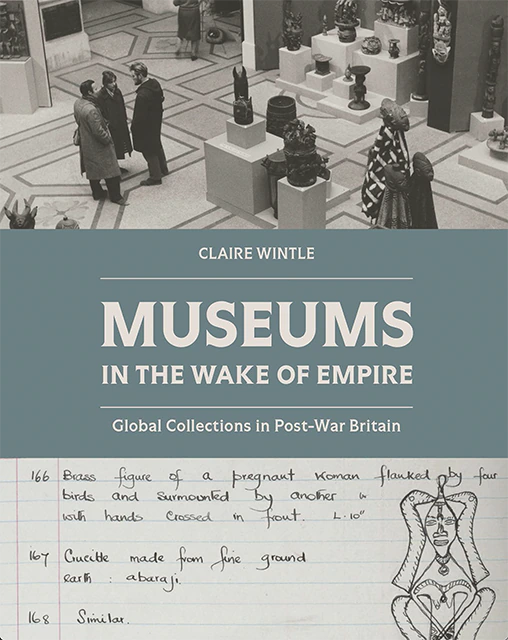
ISBN 978-1913107550
But this format does allow her to move, in a slightly dizzying yet cogent fashion, between the decades to demonstrate a changing professional landscape. At times, I wished the book would anchor on some of the key points she uses in her persuasive arguments.
Advertisement
For example, in chapter five, on documentation, there is an analysis of British anthropologist, professor John Picton, and the late Nigerian scholar Ekpo Eyo’s handwritten and drawn notes of West African sculptures. This really allows us to see that even with the willingness to bring in new voices and perspectives, the colonial script had to be adhered to.
For me, a pivotal chapter is the one on conservation. Until that point, if like me you have spent several years trying to make sense of the present by using the past to reimagine the future museum, the previous chapters are a confirmation of what we know. Yes, the colonial project never died, it just transmuted, seeped into the ether, the bricks and mortar, ways of working and so on.
This chapter elicited so many wows, yikes and eye-rolling from me that I started to read the book as a kind of soap opera. I was gripped, because the characters were gracious, troublesome and complicated.
For example, a museum professional tries to claim glory for new and progressive ways to extend the life of objects accessioned into collections. Wintle’s deep dive into the making, preservation and accessioning of Diné sand artist Fred Stevens’ performance-made sandpainting, Whirling, 1966, demonstrates how asymmetrical the relationship was between indigenous artists and western museums – the Horniman in this case – but also its profoundly entangled nature.
Additionally, in a later chapter’s subsection “exhibiting anti-colonialism”, curator and anthropologist Shelagh Weir makes clear her opposition to external geopolitical lobbying when considering the interpretation for her 1970-72 exhibitions Spinning and Weaving in Palestine and Costumes of Palestine at the Museum of Mankind. It is evidenced with a quote in what can only be imagined was terse correspondence with the then director of the British Museum on the correct use of the attribution Palestine within cultural contexts.
Deeper perspective
I yearned for more of these focused analyses into the dynamics that coloured those burgeoning relationships. A chronology would have been a valid addition and may have allowed another perspective on those interpersonal quandaries that Wintle writes so well about, and which are incredibly instructive towards her argument.
Advertisement
She makes mention of the growth and influence of the Museums Association and Museums Journal, the establishment of the British Welfare state, and what was to become the arts council, plus anti-racist movements that ran parallel to new tendencies in museums. A chronology would have shown how the shift from amateur to professional practices was bound up with seismic changes in postwar British society. But that’s probably for another book.
For me, the real drama lies in the epilogue. Rather than being an afterthought, it is the crux of Wintle’s thinking that “the postwar period contained the potential for a postcolonial practice that might dispute the neutrality of the museum and acknowledge its complicity in colonial histories and legacies”. She writes about the reissued 1970 film You Hide Me, a stunning piece of fugitive filmmaking by Ghanaian academic and filmmaker Nii Kwate Owoo, set in the depths of the British Museum.
Intrigued, I had to watch it and then I had to return to French-Senegalese filmmaker Mati Diop’s arresting film Dahomey, 2023. Diop shoots multiple scenes that observe the intergenerational rift at the heart of the film being played out in modern day Benin between those who welcome the restitution of 26 objects, out of 7,000, from the French government and those who say it is neo-colonialism writ large. As in You Hide Me, the protagonists are resolutely asking for the possessions of their ancestors to be returned in their entirety.
Unexpected perspective
When I started Wintle’s book, I presumed that I would be informed of a historical overview that I already understood – that museums today were built on the neo-colonialist moment of the British postwar period. What I found, though, was something unexpected and absorbing.
If you are a cultural worker trying to either resist the past, embrace it or imagine a different kind of future, this book will tell you why that project to dismantle colonial structures in museums remains so hard.
Advertisement
Ever hopeful, Wintle writes in closing that there is scope for “genuine change”.
Melanie Keen is a cultural leader and strategist. She was the director of the Wellcome Collection from 2019 to 2026