The Henry Moore Foundation recently unveiled the latest addition to its Hertfordshire site – new exhibition spaces and visitor facilities at Perry Green, in the village of Much Hadham. This has coincided with the opening of a substantial exhibition of work by the English sculptor at the Royal Botanic Gardens at Kew.
Nearly 20 years ago, when Hoglands, Moore’s former family home at Perry Green first admitted the public to what became the Henry Moore Studios & Gardens, a similarly high-profile exhibition of his sculptures was held at Kew.
But since that first cluster of openings in 2007, the world has changed dramatically. The dominance of white male artists is no longer the acceptable norm, which presents certain challenges for a wealthy charity, such as the foundation, dedicated since 1977 to promoting the work and legacy of one of the most successful examples. The organisation is also responsible for a very different second site – the Henry Moore Institute in Leeds city centre, which offers a sculpture resource for researchers, students and artists as well as exhibitions.
The foundation’s clever solution to the challenges it faces at Perry Green is to re-emphasise the educational aspects of its activities. In the past, numerous sculpture fellowships, educational activities and research possibilities have benefited lucky applicants and the foundation has now extended its largesse far and wide.
Learning resources at Perry Green, however, were restricted. The improvement of its facilities by extending the extant Sheep Field Barn – as its name suggests, it was a barn near a field of sheep – means it now offers indoor spaces dedicated to making and learning year-round.
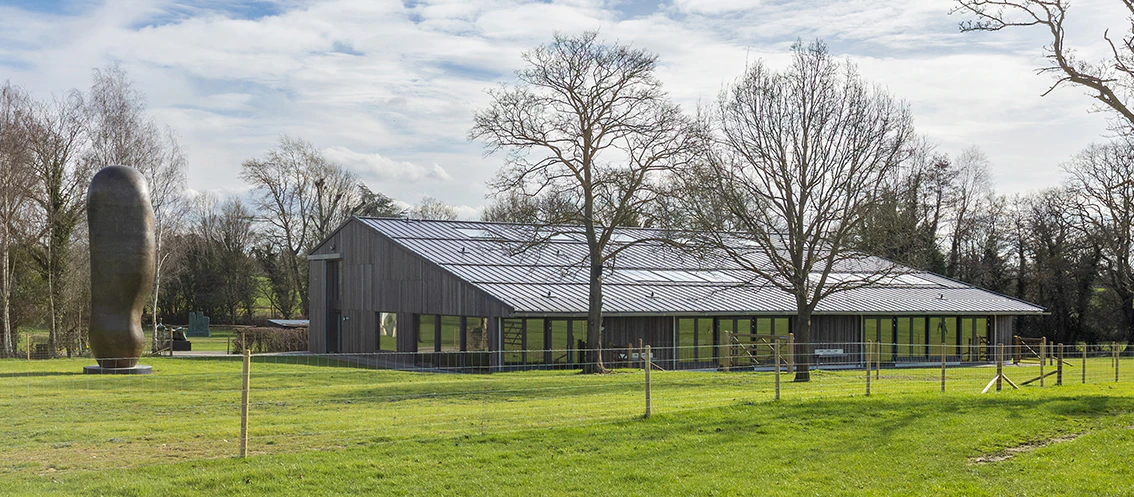
The Sheep Field Barn was one of a number of outbuildings repurposed by Moore (1898-1986) on the Hoglands site during his lifetime. It was originally large, corrugated, utilitarian and unremarkable, providing basic storage facilities for sculpture. In its subsequent reincarnation in 1999, by then under the aegis of the foundation, the simple barn became a gallery building clad with Douglas fir. The exterior was stained black providing a then authentic looking agricultural vernacular recognisable to anyone familiar with farm buildings. Inside were spaces dedicated primarily to promoting Moore’s work.
Advertisement
Focus on learning and engagement
Sheep Field Barn was already a gallery space, but this project gave us the opportunity to rethink how it could better support learning and engagement. From the outset we were guided by Henry Moore’s ethos, his belief in the importance of accessibility, curiosity and the relationship between art, people and landscape.
The barn’s simple, agricultural character remains central to the experience, lending itself to a more informal, flexible way of using the space. We’ve created an environment that can support a wide range of activity, from school workshops and family sessions to talks and community use, alongside a permanent display on Moore and exhibition programme.
As head of visitor engagement, it was important to me that learning engagement was at the heart of the brief. We wanted a space where visitors feel comfortable to explore, ask questions and spend time with sculpture in a hands-on, meaningful way. The design supports this through clear, accessible interpretation, generous open space for making and discussion, and an overall sense of informality that encourages participation.
The barn’s setting in the sculpture fields is key. Views out to the landscape are deliberately framed, keeping Moore’s work constantly in sight and reinforcing his idea that sculpture should be experienced in the open air.
Interventions have been light-touch, with robust, sustainable materials that sit well in the existing structure. Environmental improvements mean the space can now be used year-round, making it a reliable home for our learning programme.
It’s a space that feels relaxed and welcoming, somewhere to gather, learn and look again.
Nick Bullions is the head of operations and visitor engagement, Henry Moore Studios & Gardens
Exhibitions broadened awareness of what was an extensive output beyond the reclining figure; Anita Bennett’s exhibition of Moore’s textiles, I recall, was a particular success. More recently, the programme had been extended a little wider to include other makers such as the exhibition This Living Hand: Edmund de Waal presents Henry Moore, in 2021.
In the current iteration, designed by architect DSDHA, the harsh silhouette has been softened by a newly extended catslide roof that draws the eye down to the surrounding countryside, and the exterior cladding is now a grey Silver Spruce (reclaimed from a barn in Yorkshire), which visually seems an immediately more harmonious choice.
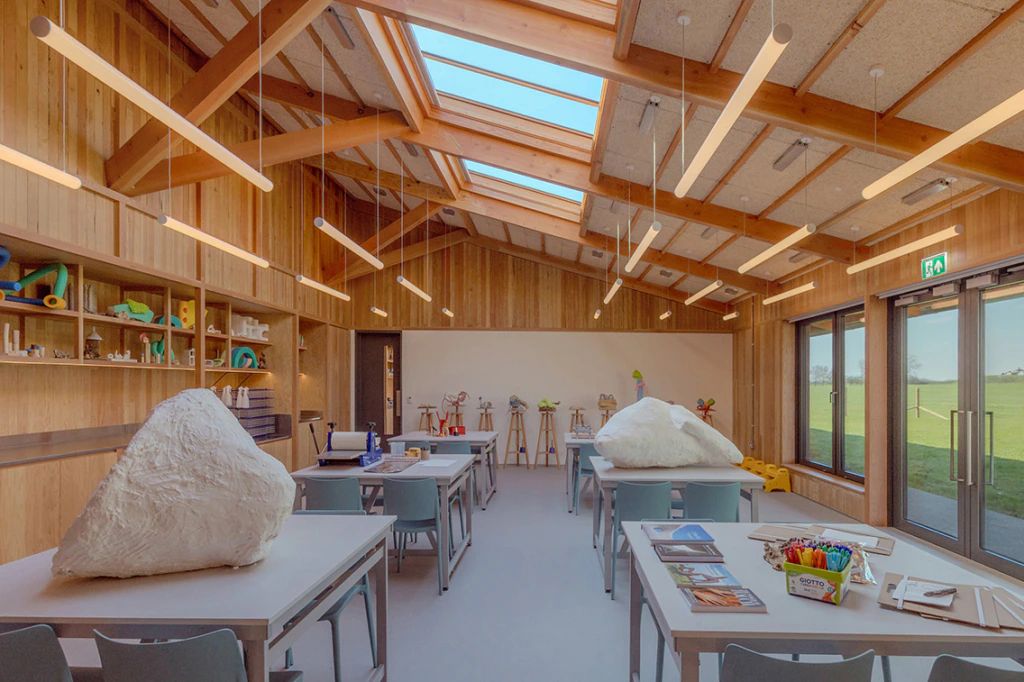
The black fir has been cleaned up and repurposed inside, lining the suite of top-lit rooms aimed at schools and groups, providing wet and dry studios as well as a separate lunchroom.
The spaces are simply and beautifully designed, practical and well-equipped, yet also warm and inviting. Modern standards of insulation, discreet solar panels and a ground-source heat pump mean the new facilities have minimal environmental impact.
Organised groups using the new learning facilities come for free, which would ensure their success even if they were not as lovely.
Advertisement
Improvements to the fabric of the former barn have been extended throughout the rest of the building, enabling a sustainable and stable museum environment.
Moore clarity
The light-filled main exhibition space now illustrates the narrative of Moore’s development from a humble start in Castleford to international renown, combining his recognisable tropes alongside his use of some delightfully surprising materials and forms.
It is all very nicely done – informative and clear, laudatory without being bombastic, comprehensive but not overwhelming. One improvement would be non-reflective glass on display cases – on a bright day it is almost impossible to see the smaller maquettes inside.
The current display is semi-permanent – meaning some works will still occasionally come and go for other projects, loans, etc. – but it is largely anticipated to remain in situ for about four to five years. It meets the demand for a survey of Moore’s art and life, but it seems to me a shame to sacrifice the dynamic programme of the past.
Upstairs, a smaller display area will host changing exhibitions of, presumably, small-scale works. Here, the foundation has returned to the well-known topic of Moore’s wartime Shelter Drawings, which exist in such large numbers that there are always some that one has never seen.
Advertisement
Admission for a family is £58 (not a complete fleecing but also not cheap). At least the charges are annual should you return regularly.
Projects by DSDHA do not scream the architects’ presence. Indeed, so successful is its philosophy to do more with less by exploring the potential of retrofitting and revivifying existing buildings that you may not fully realise the considerable impact the firm has had on the urban environment. The Economist Plaza in St James’s, London (renamed Smithson Plaza), for example, is typical of its approach. Following rigorous research, DSDHA subtly upgraded the brutalist 1960s architecture of Alison and Peter Smithson with a sensitive, sustainable design to suit current demands. The plaza is much improved but you can’t quite see the extensive changes that have taken place.
An ostensibly metropolitan practice, DSDHA has now brought its values to the rural idyll of Perry Green and the headquarters of the Henry Moore Foundation with the transformed Sheep Field Barn. In the countryside, the need for minimal environmental impact seems more vital, and the sustainable credentials of the project cannot be doubted. Visually, the results here – both inside and out – are also impressive. By extending one side of the building outwards, DSDHA has created a surprising amount of extra useful space, seemingly without imposing on the surrounding area.
Will Sheep Field Barn get the crowds flocking like Hoglands did in 2007? We’ll have to wait and see.
Stephen Feeke is an independent scholar and curator of sculpture
Project data
Cost
£5m
Main funder
Henry Moore Foundation
Lead designer, architect
DSDHA
Exhibition design (3D)
Gatti Routh Architects
Exhibition graphics design (2D)
Wolfe Hall
Lighting design
Henry Moore Foundation
Art conservation
Henry Moore Foundation
Structural engineer/design
Webb Yates
Mechanical, electrical and plumbing engineer/design
Harley Haddow
Principal designer
Baily Garner
Quantity surveyor
Stockdale
Planning consultant
Turley
Main contractor
Rooff
Ground-source heat pumps
Nicholls Boreholes
Accessibility and inclusion consultant
Access=Design
Ecological consultant
TMA Environmental Consultants
Admission
Adult, £23; over 65s, £21; students and under-25s, £13; universal credit, £1