How well do you think you know the work of Jane Austen? Do you know what Darcy’s house in Derbyshire is called? Or which character Josh O’Connor plays in the 2020 film adaptation of Emma?
What if I asked about the name of Darcy’s housekeeper who shows Elizabeth Bennet round? Or the name of the maidservant in the Woodhouse household?
The Willis Museum & Sainsbury Gallery in Basingstoke, Hampshire has directed its focus onto these typically invisible characters, in its exhibition Beyond the Bonnets: Working Women in Jane Austen’s Novels, curated by Kathleen Palmer.
The exhibition coincides with the recent 250th birthday of the novelist, who was born nearby in Steventon, Hampshire.
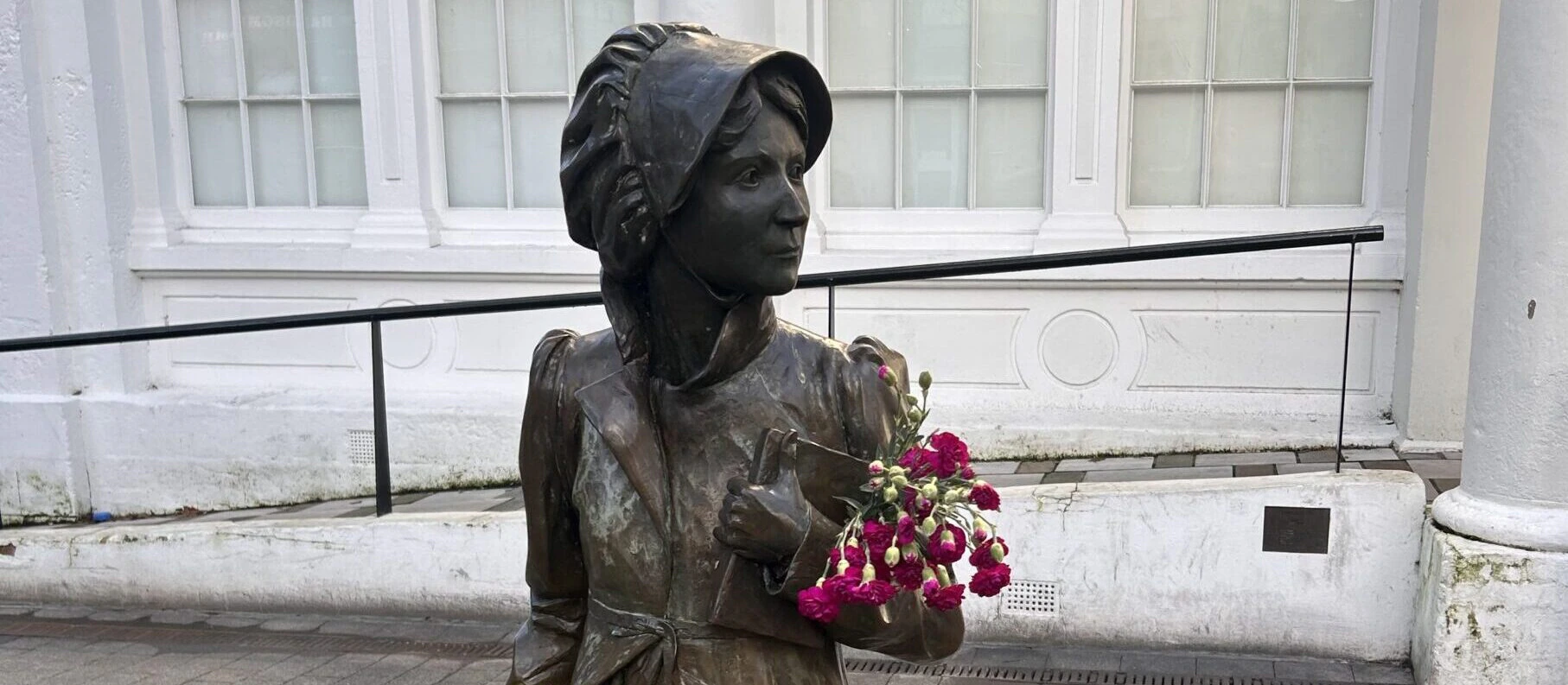
The Willis Museum is housed in a neo-classical building, with chandeliers hanging from the ceiling and an impressive staircase, an apt site for a Regency-era exhibition. Out front stands a bronze statue of Jane Austen, whose admirers have thrust bouquets of flowers into her metallic hands.
Beyond the Bonnets occupies the ground floor of the museum, weaving together excerpts from Austen’s novels, historical records of real working women, and material artefacts from the time period. A medley of string music plays over the speakers.
Advertisement
Pastel-coloured boards give summaries of the various sectors of employment: “the governess”; “the housekeeper”; “the wet-nurse”; “the lady’s maid” and so on. The text is generously sized, and easy to understand, although the information provided can feel overly simplistic at times.
The exhibition flourishes when it succeeds in uniting aspects of Austen’s novels with biography, as in the catty comment Austen wrote in a letter to her sister about a washer-woman: “She does not look as if anything she touched would ever be clean, but who knows?”, or a moving tribute to Susanna Sackree, Austen’s brother’s servant who worked for the family for over 58 years. Sackree had a portrait painted, which is striking given that servants at that time were ordinarily expected to be neither seen nor heard.
The exhibition also spotlights women who history might otherwise have forgotten, like Ann Farmer, of whom a former employer wrote: “I part with a servant whose name is Ann Farmer, she said she should go tomorrow to Alvesford to offer herself to Mrs Baker. I trouble you with this letter to inform you that she is not capable of undertaking your place and if she should make use of my name it is entirely without any authority from me”.
The spite underpinning this letter, dated 10 October 1787, is still potent almost 240 years later.
Another stand-out is the section that spotlights the lady’s maids responsible for the upkeep of the era’s elaborate dresses and styles, now so familiar to modern audiences thanks to the popularity of period drama.
The superficial beauty of the period had an uglier underbelly to it, dependent on human resource and labour that often went unnoticed or under-rewarded.
Advertisement
Perhaps that is where the exhibition could have probed even deeper, to unpack the power imbalances between employers and employees; the brutal fiscal realities for the majority of women who were neither landed nor entitled to a hereditary income, and so needed to work in some capacity to survive; and the precariousness of being a female domestic employee in the Regency period.
But overall, Beyond the Bonnets is a refreshing exploration of a familiar corpus of work, examining it from a different angle, yet with the same good humour and piercing gaze that Austen herself turned on the Regency era as a writer 200 years ago.
Entry to the exhibition is free