Arrghaa! Shiver me timbers! Walk the plank and splice the main brace me hearties!
We’ve all heard the phrases, put on the silly accents, and some of us have even dressed up, but what do we really know about the perennial favourite of maritime museums and Hollywood blockbusters?
Why do pirates – from Blackbeard, to Captain Hook in JM Barrie’s book Peter Pan, to Captain Jack Sparrow in Pirates of the Caribbean movie – continue to capture people’s imagination? And how do we separate the myth from reality?
To find out, I was press-ganged by Museums Journal to leave the safety of Historic Dockyard Chatham and head to Greenwich for Pirates, an exhibition co-curated by the National Maritime Museum and the National Maritime Museum Cornwall.
All aboard
The National Maritime Museum, alongside the Royal Observatory, Cutty Sark, and Queen’s House, make up Royal Museums Greenwich (RMG). Set between architect Christopher Wren’s magnificent Greenwich Hospital and Greenwich Royal Park, the location is idyllic.
Advertisement
I visited on a sunny day, with the park and museum bustling. Entry to the main museum is free, but the Pirates exhibition is ticketed (see box).
Pirates is in the temporary exhibition gallery in the bowels of the Sammy Ofer Wing, below the cafe, shop and ticket desk. You can enter by stairs or lift, with accessible toilets at the entrance and near the gallery.
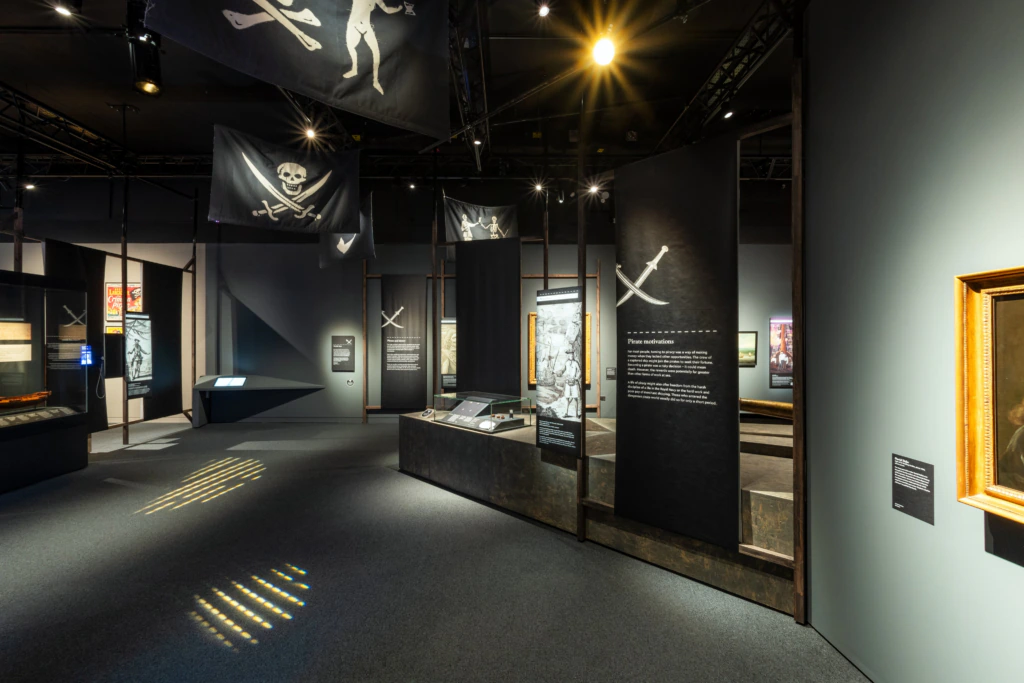
Pirates as a theme is ambitious. The introduction promises that the exhibition will “reveal the harsh realities of life as a pirate and explore how our enduring image of these compelling characters has been shaped by popular culture”.
The familiarity of pirate folklore makes it an appealing premise, but also sets the bar incredibly high for an audience used to blockbuster movies and video games. This exhibition needs to pack a punch.
The exhibition is divided thematically and visitors follow a single route through the space, divided by temporary walling. The sleek design is by Design Map and Royal Museums Greenwich’s team, and the space is evocatively dark, with well-lit panels and objects. It makes good use of models, artefacts and paintings from RMG’s vast collections.
Advertisement
The first section explores pirates in popular culture, beginning with Robert Louis Stevenson’s novel Treasure Island through a giant book and impressive projection of the island.
It then traces pirates in print, stage and screen with illustrations and costumes from works such as Gilbert & Sullivan’s comic opera The Pirates of Penzance.
The iconic pirate look is traced through Howard Pyle’s 1921 Book of Pirates, actor Orlando Bloom’s Pirates of the Caribbean costume, cartoon character Captain Pugwash, fashion designer Vivienne Westwood’s Pirate Ensemble, the 1980s New Romantics pop movement and video games.
A projection listing pirate films by year, with a few clips, felt lacking in footage. I heard a parent say to their child, “Oh, The Goonies, you’ll love this”, followed by an audible sigh from both when a clip wasn’t included. Still, licensing film content is costly and complex.
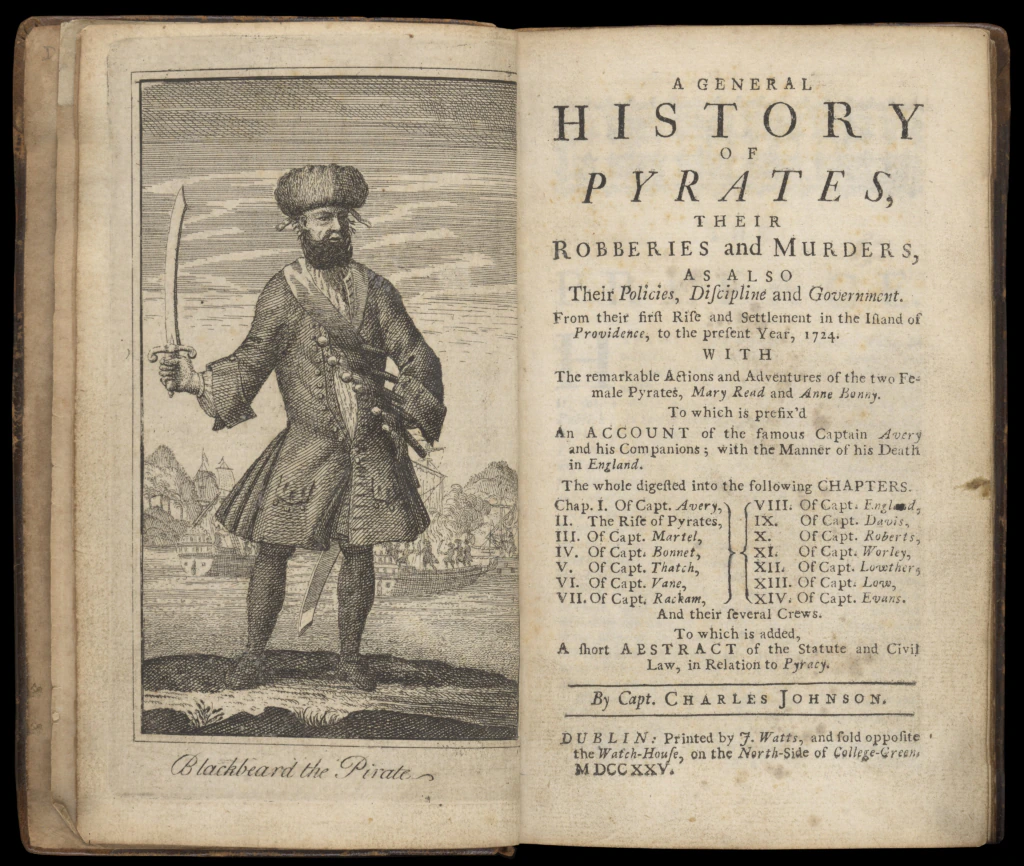
After investigating modern pirate pop culture, the exhibition shifts to real pirates, beginning with the 1724 book, A General History of Pyrates, by Captain Johnson.
Advertisement
The likelihood that Johnson was in fact newspaper publisher Nathaniel Mist illustrates that popular fascination and mystery were as much a part of the “Golden Age of Piracy”, something that is still true today.
The next section provides context on real pirates such as William Kidd, Mary Read, Anne Bonny, and Blackbeard. It features original paintings, weapons, models, a gruesome replica gibbet cage and important loans, such as Kidd’s 1695 Letter of Marque, a licence from the king to be a privateer, usually held at the National Archives.
A recreated ship’s cabin with projections shows daily life at sea, including the fact that the notorious pirate Black Bart made his crew go to bed at 8pm, which amused several children.
To many people, pirates are familiar protagonists of a lost maritime world, where sailors walked and talked differently to landlubbers. This idea runs through the exhibition, where a maritime lexicon is signposted with pop-out boxes encouraging you to “talk like a pirate” as well as “fact or fiction” boxes to test pirate myths.
The exhibition’s mischievous wit and storytelling, paired with academic authority, reflect the curatorial work of the late Robert Blyth, who died in October 2024. As senior curator at the National Maritime Museum for many years, Blyth is greatly missed by friends and colleagues.
Charting new territory
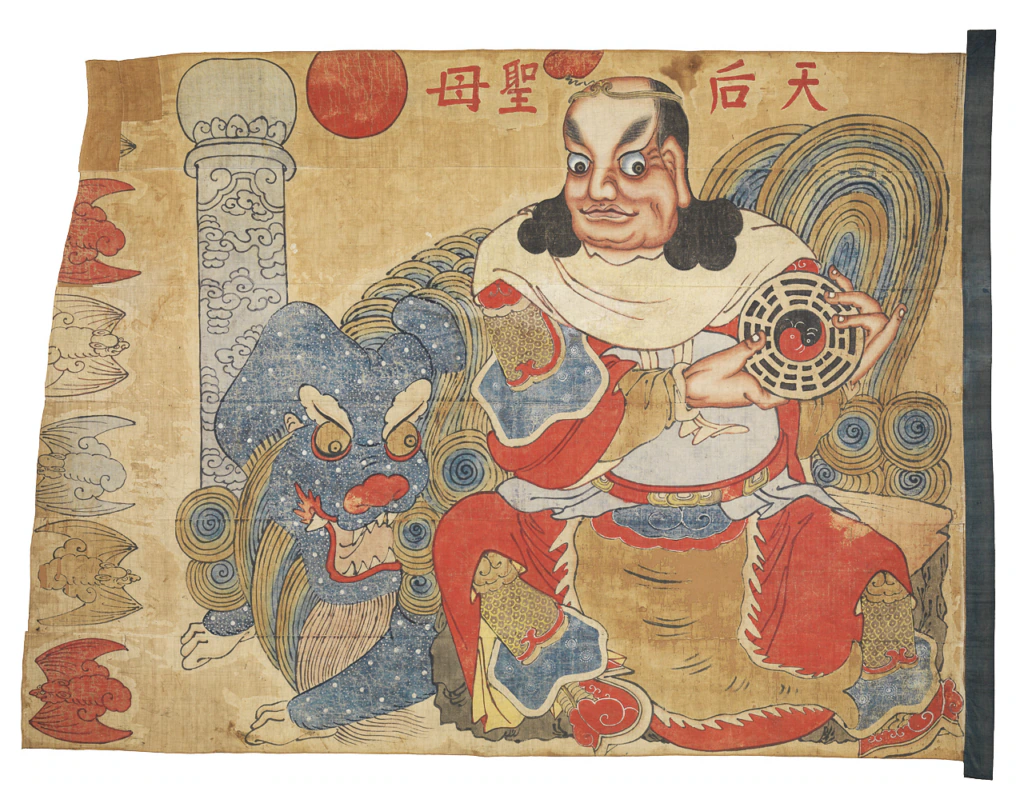
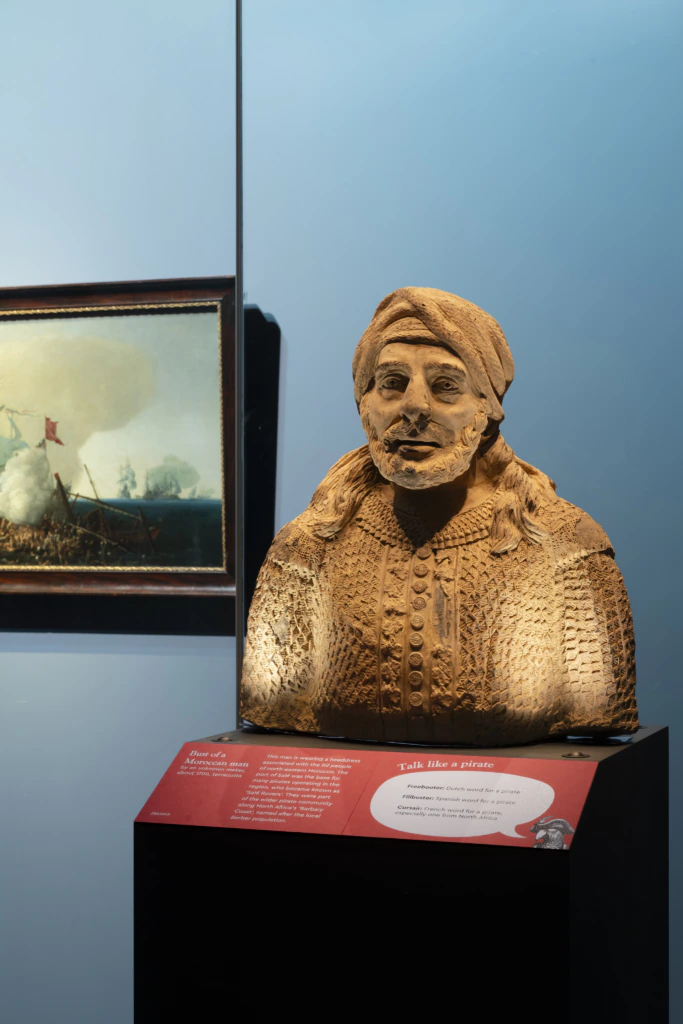
Blyth’s erudite contribution is clear in the section on Mediterranean/North African, and Chinese piracy, which accounts for a third of the exhibition. This section offers some of the most fascinating objects and stories, especially for those more familiar with the Atlantic-Caribbean pirate narrative in western culture.
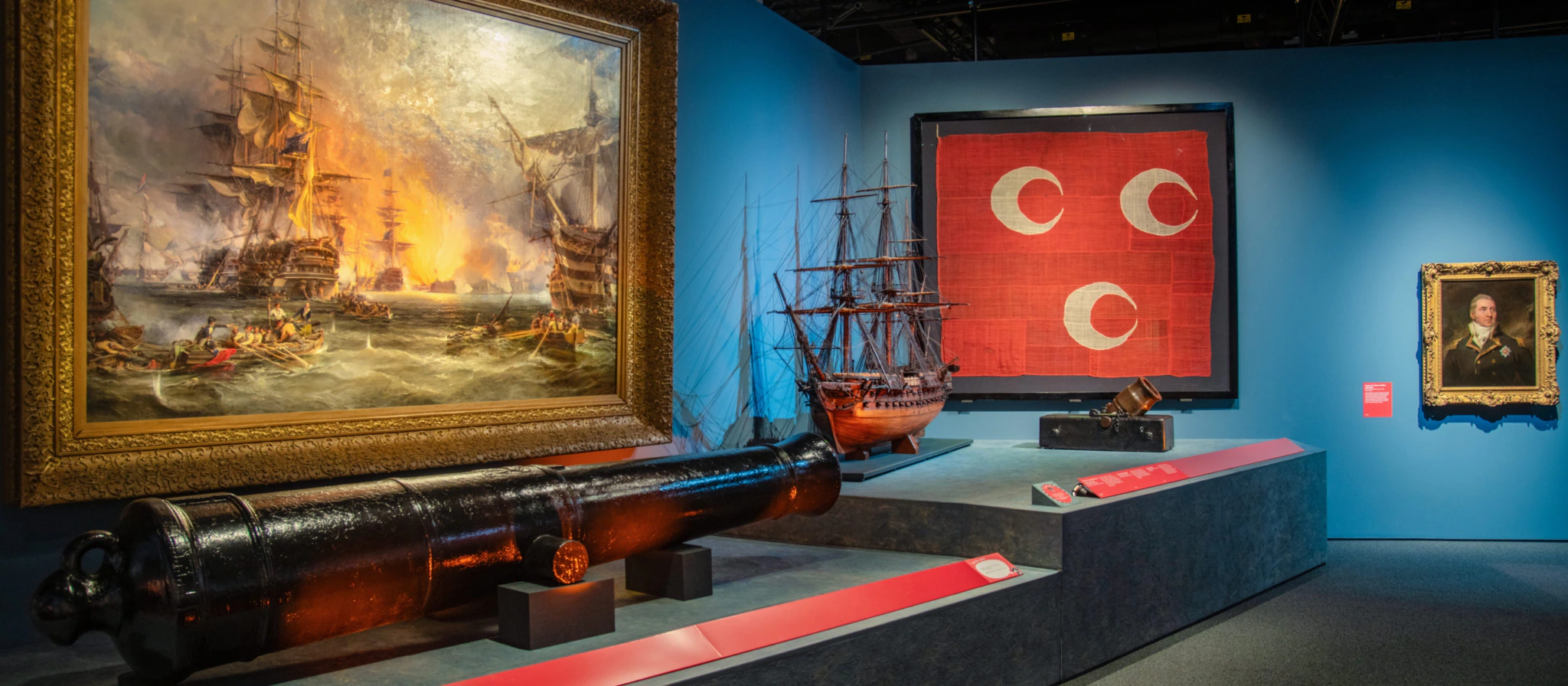
Events outlined here include the suppression of North African Barbary pirates by a British-led naval assault on Algiers resulting in thousands of casualties; the story of Chinese pirate Zheng Ye Sao, born in 1775, who commanded 80,000 men before she retired peacefully; and a star object in this section is a rare blue-dyed cotton flag from a Chinese pirate ship, seized by HMS Nessus in 1926.
The exhibition counters a Eurocentric, male-dominated focus by featuring diverse voices. Small screens with subtitles and BSL include experts such as Alexis McDavid from the National Museum Jamaica on how piracy connects to narratives of disenfranchisement and slavery, and academic Rebecca Simon discussing female pirates. Queering Piracy by EM Parry examines the pirate as a “gender-outlaw”, blending sailor craft, nautical tattoos, and folk art in a collaborative artwork.
The exhibition concludes with a section on modern piracy, featuring a map of global pirate activity (2022-25) alongside an AK47 and a poster of the 2013 film Captain Phillips. While informative, this section could have been larger given piracy’s ongoing relevance.
As a maritime history curator, I found the exhibition rewarding and insightful, with important objects and interactive screens that deepened my exploration. It fulfilled its promise to reveal the harsh realities of pirate life and how popular culture has shaped our image of them.
But am I the target audience for an exhibition that is presumably intended to drive visitor numbers? I’m not sure this exhibition could sustain those visitors with children expecting the fun summer holiday blockbuster exhibition that the marketing visuals might have implied.
The light-hearted pop-out boxes that had call-to-actions like “Can you find a picture of a parrot?” were fun for the younger kids, but overall it would have benefited from the addition of pirate video games that you could play, especially as Assassin’s Creed Black Flag and vital X-box controller were tantalisingly out of reach behind glass.
But I promised myself I would be allowed to watch the Goonies once I got home, as long as I was in bed by 8pm.
Nick Ball is the collections, galleries and interpretation manager at Chatham Historic Dockyard Trust
Project data
Cost
Undisclosed
Main funder
Royal Museums Greenwich (RMG)
Exhibition and graphic design
RMG Design Studio; Designmap
Lighting design
Record Lighting
Digital media
RMG
Project management and collection services
RMG
Exhibition build
The White Wall Company (for RMG); Parc Signs (for National Maritime Museum Cornwall)
Graphic production
Omni Colour
Transport
Constantine; Crown Fine Art
Framing
Thomas Proctor Framing
Quantity surveying
Fraser Randall
Showcase installation
Showcase Services
Film licensing
Caroline Raffe
Exhibition ends
4 January
Admission
Adult, £15; student £11.25; child £7.50 with 20% discount for MA members