This is an ambitious, exciting and urgent exhibition. Co-curated by Glynn Vivian Art Gallery’s exhibitions officer Katy Freer and University of Bristol art history lecturer Zehra Jumabhoy, it brings together more than 120 artworks from Wales, England, America and South Asia. The exhibition stretches across time, history and geography, asking big questions about colonialism and identity.
Right from the start, something shifted for me. The introduction panel argues that Wales is “England’s first colony”, making you think about how Wales itself was colonised, and how that shapes the way a nation sees others. It’s not just about Wales’s role in the former empire, but about how being colonised influences identity.
In a conversation I had with Freer, she summed up the exhibition’s key aims – to start conversations about the connections between Wales, India and Pakistan; to bring Welsh and South Asian contemporary artists together; and to explore the lesser-known historical and cultural ties between Wales and the Indian subcontinent.
The show is spread across five galleries, each with its own theme from Historical Encounters to Myths of Nation. Walking into the central atrium, I was struck by Nikhil Chopra’s multimedia artwork, From Land to Fire.
A massive charcoal and copper-toned landscape covers one wall while the artist’s voice fills the space. This is done through a film in which he takes the role of Richard Glynn Vivian, the gallery’s founder and a colonial traveller who once sketched “exotic India”.
Advertisement
Join us in Cardiff or online for MA Conference 2025
Just weeks left to book!
Our conference theme this year focuses on perthyn, the Welsh word meaning to belong.
Join us in person or online from 6-9 October to discuss how ideas of community, solidarity and friendship bring people together in our museums to make them such special and engaging places.
Prices start from just £55.
Chopra challenges that colonial gaze and mixes it with Swansea’s own changing industrial landscape. His work blurs body and land, making drawing an act of ownership, resistance, and reclamation of space.
Upstairs, the Historical Encounters: Tigers and Battles gallery is heavy with the weight of colonial violence, but also beauty.
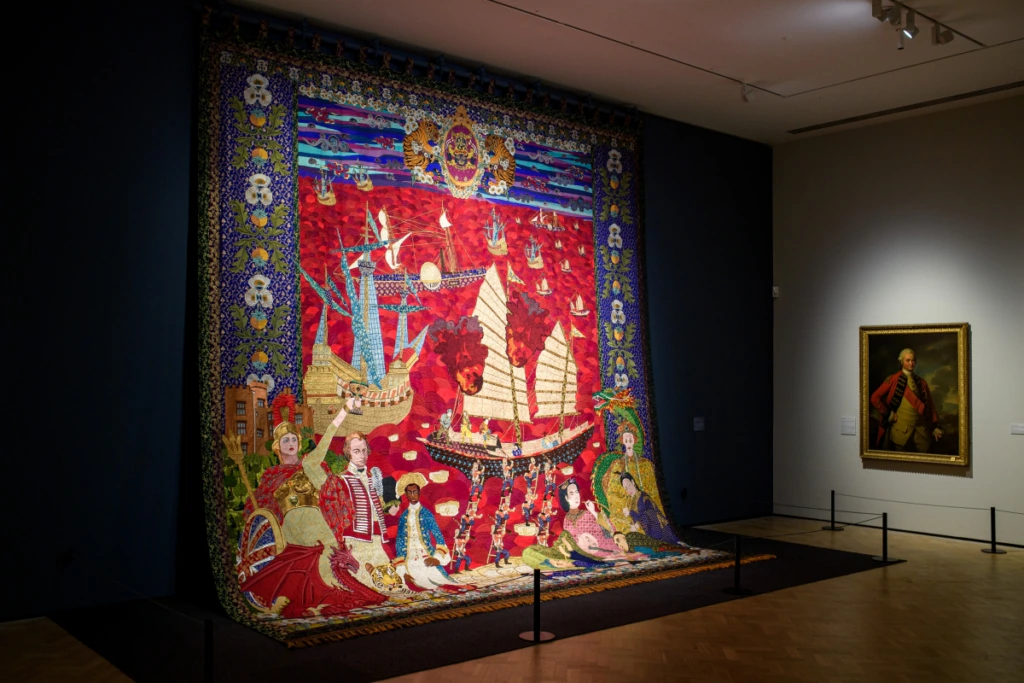
Robert Clive, also known as “Clive of India” because of his role as British governor of the Bengal Presidency where he lay the foundations of the British East India Company’s rule in Bengal, looms large in a portrait tucked into a corner. It’s as if he is being made to watch while the works surrounding him slowly dismantle his legacy.
Rich tapestry of life
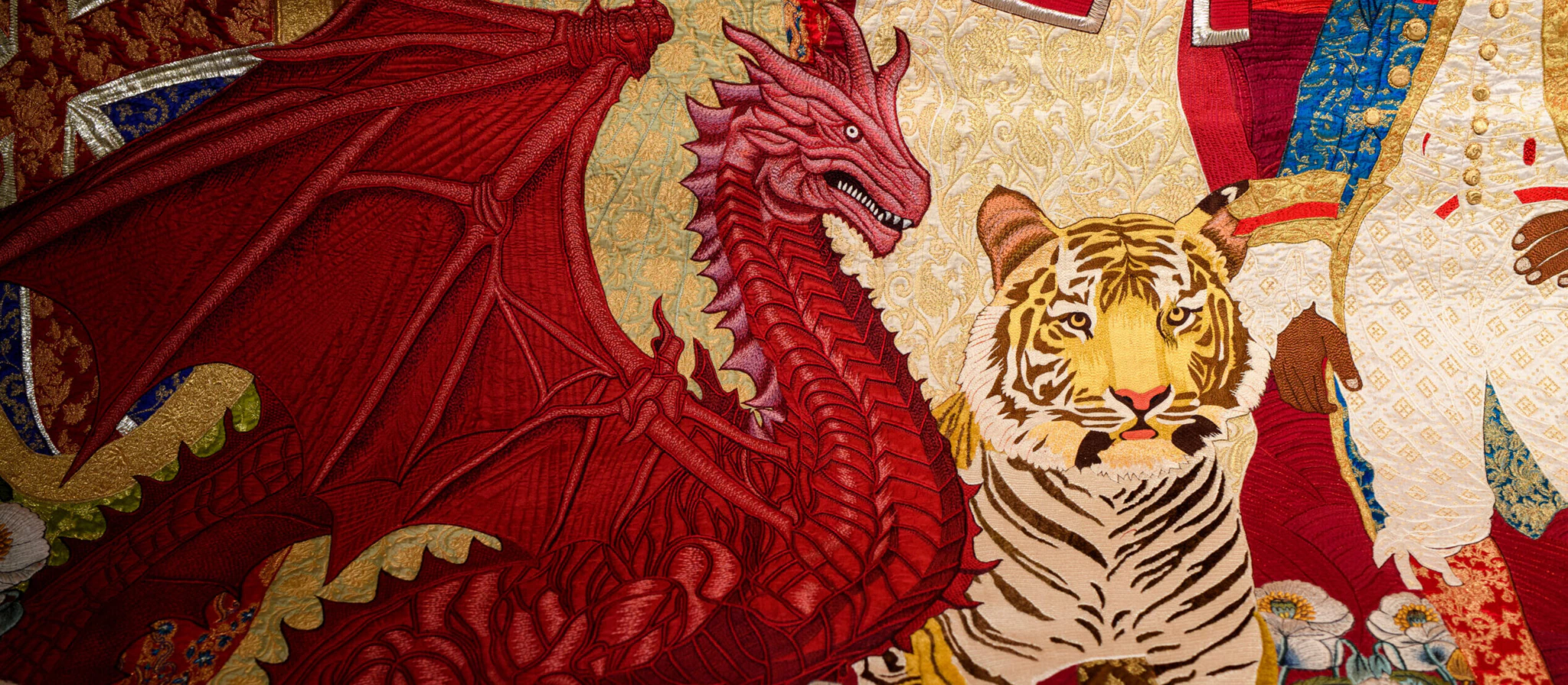
Artist Adeela Suleman’s embroidered tapestry stands out. It is a rich, intricate piece that reckons with empire’s violence. Tigers, dragons and opium blossoms surround Clive, symbolising extraction, resistance and cost. It is both devastating and beautiful.
Daniel Trivedi’s Tiger in the Castle photos respond to Powis Castle, a place holding colonial loot including treasures from the 18th-century ruler of the Kingdom of Mysore, Tipu Sultan, also known as the “Tiger of Mysore”. Trivedi uses the tiger as a symbol of resistance and satire, turning imperial imagery on its head.
Advertisement
Nearby, Shahzia Sikander’s animation The Last Post and her artwork The Explosion of the Company Man mock East India Company officials. She depicts her Clive-like figure exploding in a powerful critique of colonial arrogance.
Opposite, two drawings hang in the gallery; one by the 19th-century painter JMW Turner of the Fortress of Seringapatam from the Cullaly Deedy Gate, the other a Turner-style view of Powis Castle by JT Willmore from the Glynn Vivian’s own collection, where Tipu Sultan’s looted possessions now reside. Their placement side-by-side links colonial violence with cultural theft, allowing historical and contemporary responses to speak to each other.
There’s something ironic about how Clive and Turner still hold status here, but the works around them slowly dismantle that reverence. It’s not about erasing them, it’s about shifting the gaze.
The gallery titled Threshold Time: Bridges & Borders was full of beauty but also asked visitors to face hard truths. Welsh and South Asian artists such as Liaqat Rasul, Peter Finnermore and Reena Saini Kallati explore borders not just as geography but as emotional and cultural spaces. The gallery draws parallels between Welsh cultural suppression and South Asian colonisation.
There are moments of collaboration too, though some references, such as Owen Jones’s book about design, Grammar of Ornament, and the Gwalia in Khasia travelogue by Nigel Jenkins might benefit from more explicit explanations, otherwise visitors might wonder if they should already know this history or perhaps this space is here to help them understand it for the first time?
Small sculptural objects sit at the centre of the room, embodying the fragility and intimacy of home. These works capture “hiraeth”, the Welsh word and concept of longing for a lost home or time, and resonate with other artists in the show, including Iwan Bala, Tansveer, and Aphra Shemza. They speak to migration, living between worlds and the complexity of identity today.
Advertisement
In Myths of Nation: Wo(men) & Mothers, the female body becomes a symbol of nationhood, trauma and resistance. Nalini Malani’s Excavated Images uses her grandmother’s quilt covers during the Partition of India in 1947 to portray tortured female forms and the pain of nationalism.
Pushpamala N’s Motherland asks a haunting question: “If the body nation is a woman, does the woman herself have no nation?”
Opposite, Paul Davies’s fractured red figure Mother Wales shows cultural trauma, environmental decay and loss of language. Bushra Waqas Khan’s stitched maquettes on Pakistani affidavit paper deepen this conversation, raising urgent questions about who owns identity.
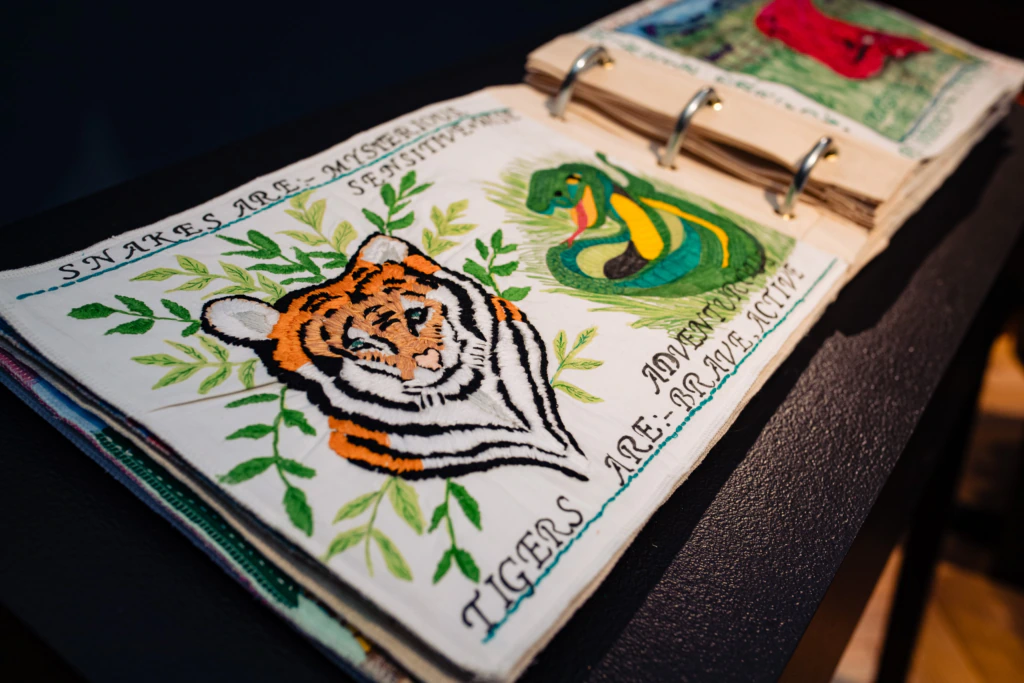
The last gallery, Historical Encounters: The Dragon, offers a softer, more communal space. Visitors are invited to interact with a textile dragon and an archival book made by the Glynn Vivian Threads group with Adeela Suleman and Menna Buss. Turning the book’s pages with gloves was a small but strong reminder that this community-made work matters just as much as the other art in the gallery.
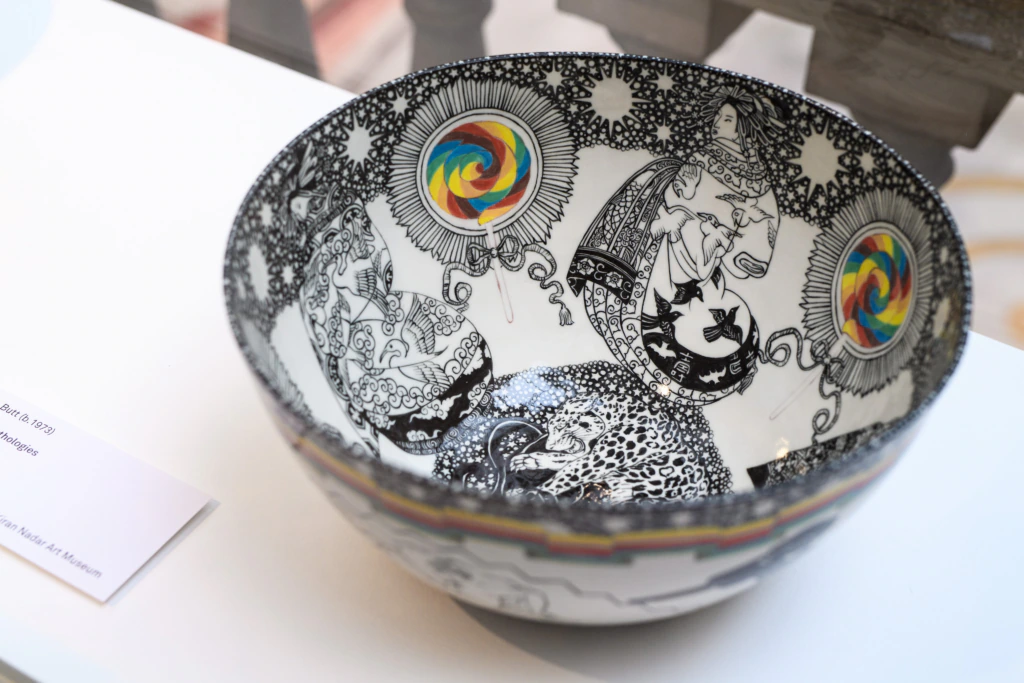
The tension between the Welsh red dragon and the English white dragon reflects the exhibition’s bigger themes of identity, resistance and survival. But here, it feels like a step towards more care, collaboration and co-creation.
Tigers and Dragons left me holding a lot of tension: between histories told and those still hidden, between beauty and violence, between personal and collective identity. The show asked more questions than it answered, inviting me to sit with that uncertainty. Its layered mix of past and present, local and global, history through the lens of contemporary art, reminds me that reckoning with empire is never simple or neat, but it is necessary.
Pain and peace
The exhibition powerfully shows how Welsh identity connects with Indian, Pakistani and Bangladeshi heritage. It holds space for both the pain of empire and unexpected solidarities. It frames Wales as both a participant in the former empire and a subject of colonisation.
That said, there were some issues that took away from the overall impact. The show assumed some prior knowledge of Wales’s role in the former British empire, which might leave many visitors behind. The texts leaned on academic language, making it harder to engage at times. And while QR codes offered extra context, there was limited wifi in the gallery.
But beyond that, Tigers and Dragons is a powerful exhibition. I left feeling more connected, not just to Wales and South Asia’s shared histories but to the process of learning, unlearning and reclaiming.
And after speaking with Freer the co-curator, it struck me even more clearly: this show isn’t just important, it’s brave, ambitious, generous and unafraid to ask difficult questions. It punches above its weight, making space for new conversations, new connections, and the kind of storytelling we need more of.
Anisha Parmar is a multi-disciplinary artist, cultural practitioner and trustee of Derby Museums
Project data
Cost
Undisclosed
Main funders
Arts Council of Wales; Weston Loan Programme with Art Fund; CELF (National Contemporary Art Gallery for Wales); Swansea Council
Exhibition design and installation
In house
Exhibition ends
2 November
Admission
Free
I am not sure in what context Anisha Parmar regards the artist Turner as “revered”.
“Opposite, two drawings hang in the gallery; one by the 19th-century painter JMW Turner of the Fortress of Seringapatam from the Cullaly Deedy Gate, the other a Turner-style view of Powis Castle by JT Willmore from the Glynn Vivian’s own collection, where Tipu Sultan’s looted possessions now reside. Their placement side-by-side links colonial violence with cultural theft, allowing historical and contemporary responses to speak to each other. There’s something ironic about how Clive and Turner still hold status here, but the works around them slowly dismantle that reverence. It’s not about erasing them, it’s about shifting the gaze.”
Turner would have been commissioned to paint this subject by wealthy collectors to mark what they regarded as a symbol of British colonial power (he worked from secondary images which is uncharacteristic of his working methods). As a jobbing artist whose authorship would have been highly valued at the time, we cannot be certain of his own political views. Insofar as he held any political views as far as we are aware, he produced ‘Slave Ship’, a mark of his strictly abolitionist view. So my thought is given the enormous contribution Turner made to the world of painting (he left a great number of his paintings and drawings to the British public) In this 250th celebration of his contribution to British art this minor example of this contribution seems mean spirited. Finally, as a painter myself, his contribution to the art form is acknowledged the world over. Perhaps he was mercenary (as all artists appear to be at some point in their careers if they are to survive) but this does not warrant his disregard in my view.