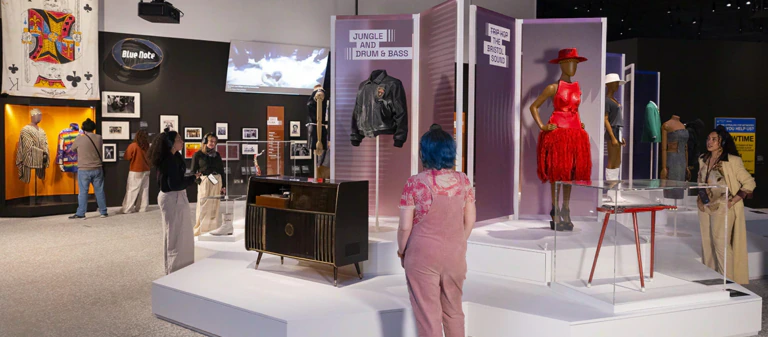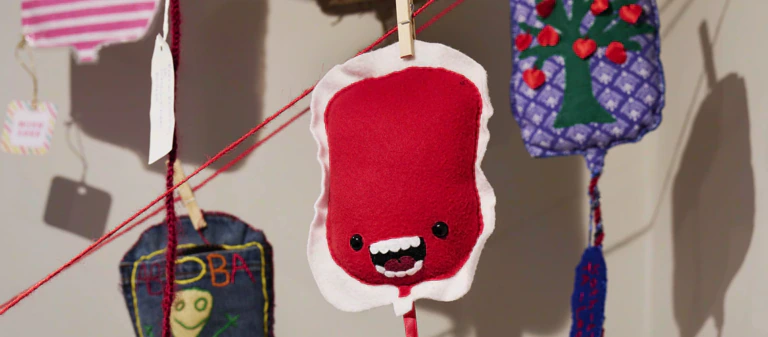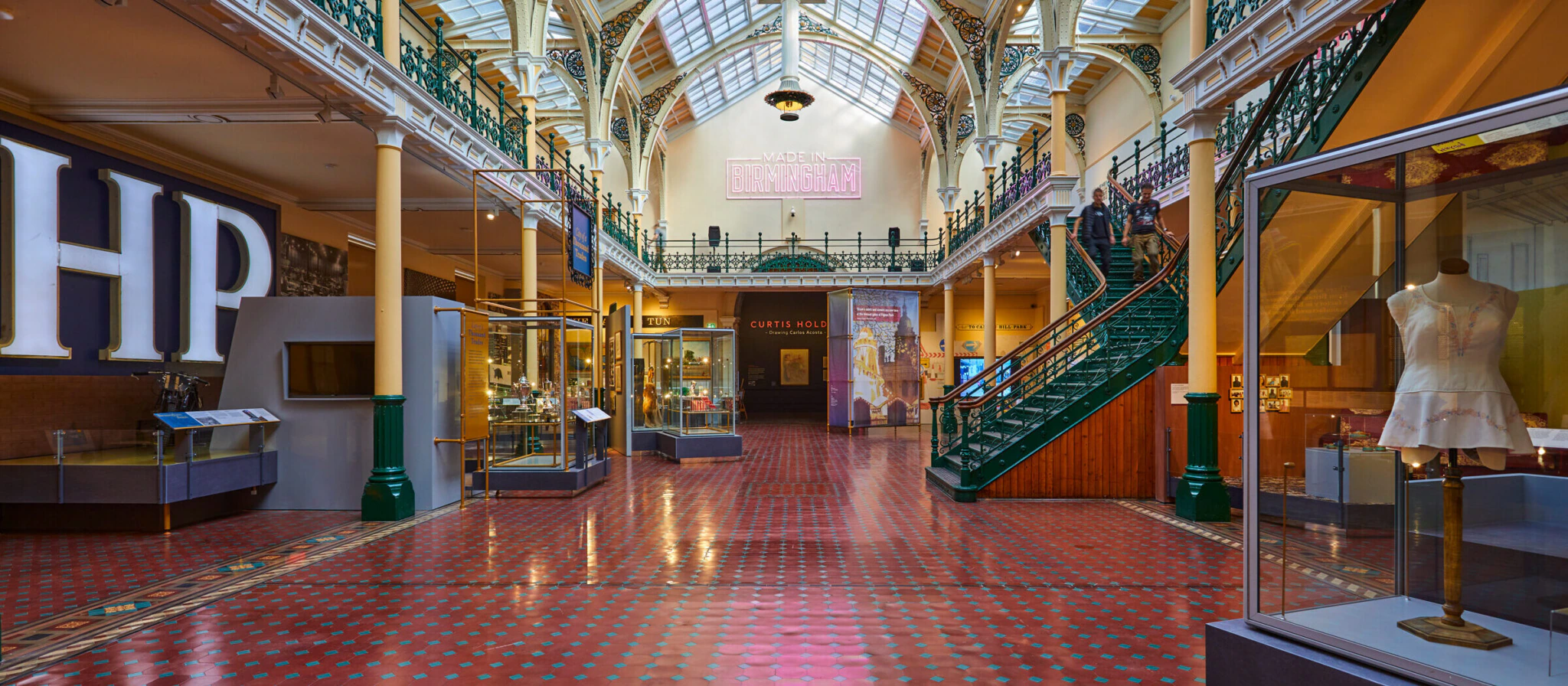
The aim of the first phase of the relaunch and reopening of Birmingham Museum & Art Gallery is to bring the city’s personality to life. About 30% of the public spaces have reopened, and more will follow in a phased redevelopment programme.
The Welcome to Birmingham and Spotlight gallery areas offer a vibrant greeting to visitors as they come out of the new access lifts. Acting as the orientation point, this space also situates the past and present human face of the institution and illustrates its financial situation.
For instance, the 19th-century newspaper proprietor John Feeney is introduced as a key early benefactor, followed by information on the financial sphere in which museums and galleries operate in today, alongside an invitation to visitors to add support.
Birmingham Museum and Art Gallery (Bmag) originally opened to the public in 1885 and, in common with other major regional institutions of Victorian origin, has had to address how such buildings and their collections can continue to be fit for purpose: both literally, with the introduction of new heating, electrics, lifts and roofing, and in terms of what they represent as 21st-century cultural institutions.
This relaunch introduces visitor participation and feedback as part of its displays policy and future plans. As such, it represents a fundamental reassessment of the instructive educational role of our public museums and art galleries.
Advertisement
Labelling is in many guises and includes, for example, the words of an object’s owner. There are also free audio handsets, which offer a curatorial welcome and visiting options. While some demarcated areas for art have been retained, elsewhere paintings, drawings, sculpture and decorative arts have been integrated into wider contextual displays, such as Made in Birmingham, and Wild City.
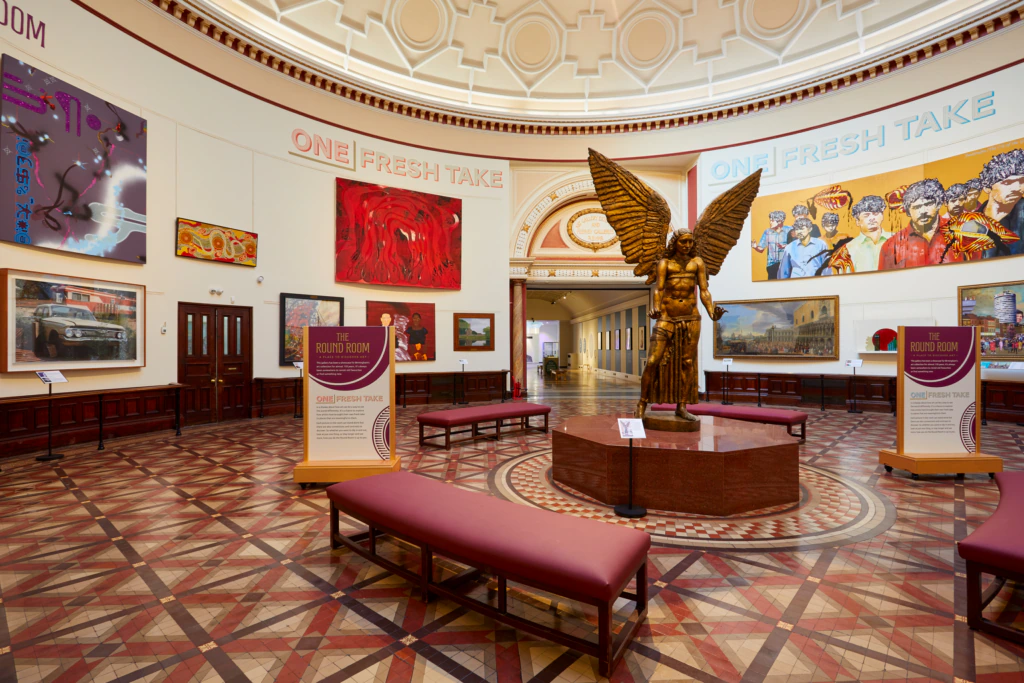
In terms of art, the decision to keep “firm favourites” on display is evident. Examples include artist Jacob Epstein’s bronze sculpture Lucifer (1945), and Dominicans in Feathers (1880-87), a painting of penguins by Henry Stacy Marks.
The wider collection
Some visitors may wonder where they can find the rest of the considerable art collection, which includes works of national and international importance.
Notably, Birmingham has paintings by Italian Renaissance painters Simone Martini and Giovanni Bellini; post-impressionist painter Édouard Vuillard; the English post-impressionist Camden Town Group artists, including those by Walter Sickert, to name but a few. None of these are currently on display – but they are accessible via the website. (Birmingham is in year two of the digital project Dynamic Collections, with a completion date of 2032.)
An assortment of French bronzes looked abandoned in a vestibule area at the top of the stairs. A large number of works, however, from Birmingham’s pre-eminent collections of pre-Raphaelite associated artists were on display in the Gas Hall, as part of Victorian Radicals (ended 5 January).
Advertisement
The Gas Hall is one of the largest exhibition spaces in England outside London and the exhibition was visually mesmeric, both in content and display. It successfully combined sensitively attuned scholarship with Birmingham’s new message – the visitor’s voice – here supported by an adjacent lounge area, Looking to the Future.
Circular problems
The Round Room, reserved for paintings, continues to present a challenge for displaying two-dimensional art, in terms of lighting and visitor’s visual accessibility.
However, the One Fresh Take display does indeed offer a new take on regional art collecting. It includes local artists, some less known and others with big reputations, such as Lubaina Himid, alongside received ideas of art-history “greats” such as David Cox, the 19th-century English landscape painter and op artist Bridget Riley who developed her striking style from the 1960s onwards.
A new Contemporary Voices Gallery has been introduced immediately adjacent to the tea rooms. This large, rectangular space with near-black walls and well-thought-out lighting creates a perfect setting for Curtis Holder: Drawing Carlos Acosta. There is a film, which brings the act of drawing to life and is alongside easels and art material for visitors to use.
Advertisement
Printed quotes from the artist lead visitors to the other side of the room, where there is a display of pre-Raphaelite artist Edward Burne-Jones’s drawings from the collection. These serve both as contextual references, and to underline the message that public collections are there to inspire all.
An adjacent exhibition space, the narrow Balcony Gallery, remains problematic both in terms of access and display options.
At the time of visiting, temporary exhibition Deviance & Difference (ended on 8 December), curated by Osman Yousefzada, featured thought-provoking paintings and works on paper from the collection, as well as artworks by Birmingham City University’s School of Art graduates. A reference to the significance of the school’s earlier historic importance would have been fitting.
New media’s role in contemporary art is now represented at the Pixel Studio, with digital works and immersive experiences by artists and producers from across the Midlands.
The Bridge Gallery featured the quietly reflective exhibition Modern Muse, a series of photographs celebrating the identities and experiences of young South Asian women from Birmingham and the West Midlands, by photographic artist Arpita Shah.
The clever use of diffused lighting here helped to slow the progress of visitors in what might otherwise have become a corridor rather than a gallery in its own right.
Made in Birmingham is the key display in the Industrial Gallery. These vast Victorian spaces always present a challenge. While the conventional museum showcases still make an appearance, so does the unexpected touch of the urban, such as the interactive wall montages, maps and pink neon signage.
The variety of text and labels, colourful printed ephemera, objects and paintings is all suggestive of a lively changing, industrious metropolis, and works well in establishing visually stimulating, humorous and at times thought-provoking displays.
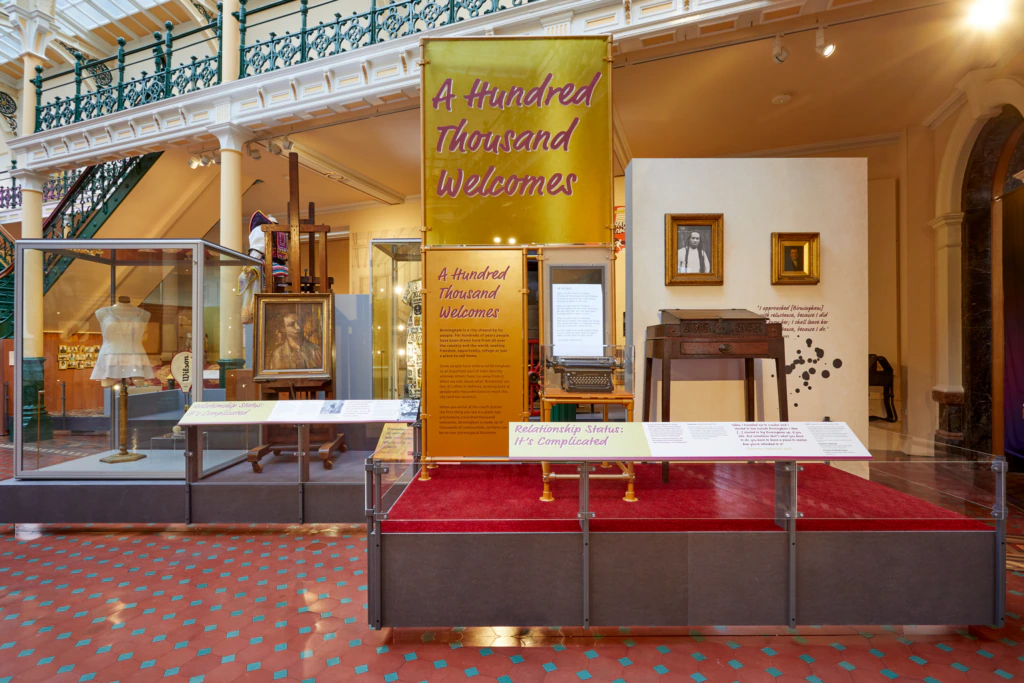
Who, for instance, would expect to see an old-fashioned typewriter typing out the poem On the Road by the late British-Rastafari dub poet Benjamin Zephaniah, or a painted black cat appearing on a display stand in Making Home?
Lived experiences
Several displays are divided into sub-themes. A Hundred Thousand Welcomes, City of a Thousand Trades, and It’ll be Nice when it’s Finished, combine people’s lived experiences and achievements, past and present.
These include social, health and wellbeing linked ecological issues – alongside creative city natives, such as Burne-Jones, Zephaniah and early 20th century Vorticist artist David Bomberg – with selected objects and art from the collections.
The new display Wild City, offers two new galleries that respond to current climatic and ecological issues, as well as the connection that Birmingham’s inhabitants have with nature.
This is a far cry from stuffed animal cases, with its sense of “learning can be fun” expressed by foot-print labels, murals, interactive walls and a designated Nature’s Library book and seating area.
The Wildlife Photographer of the Year exhibition, situated in the Waterhall meant a trek outside, but otherwise complemented this experience.
“The museum is always changing – tell us what you think?” reads a wall label. Such a new and refreshing beginning bodes well for future reopenings.
Angela Summerfield is an artist and author, and formerly a senior curator at the Royal Academy of Arts, London
Project data
Cost
Undisclosed
Main funders
UK Government Museums Estate and Development Fund (MEND) through Arts Council England; FCC Communities Foundation; DCMS/Wolfson Museums and Galleries Improvement Fund; Friends of Birmingham Museums & Art Gallery
2D design
Design Penguin
3D design
Simon Fenn Museum & Exhibition Design
Graphics
The Big Ink Tank
Fabrication
MJM Bespoke Fabrications; Design Craft Exhibitions
Strip out
Umberslade
Wall cladding
V&D Interiors
Lighting
ERCO Lighting; Casambi Technologies; Basis Lighting; Neon Cow; Illusion Signs Display cases Click Netherfield Mounts Artefacts Conservation Services; Apex Plastics; duRose Animations Audionation UK; Atom Graphics Audiovisual supply and install Titan Film and Events; Pro Display; Solutions Audio; Visual; Giraffe Audio; Black Box Audio Visual; NexNix; Signagelive Timber Davies Timber Painting Kingsbridge Exhibitions Wildlife Photographer of the Year, until 20 April (adults £11) Admission Free