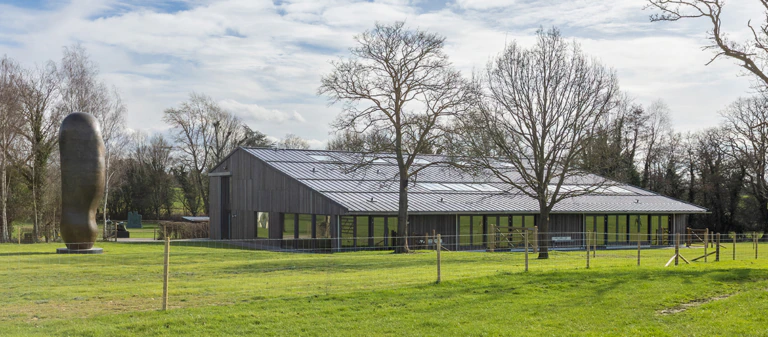
The Museum of Innovation opened in July at the Ulster Transport Museum, just outside Belfast. Located at the foot of the hill in the Land, Sea and Sky galleries, the new exhibition focuses on seven innovators from the 19th and 20th centuries who were either born or based in what is now Northern Ireland.
Pioneering aviator Lillian Bland; professor Frank Pantridge, dubbed the “father of emergency medicine” for inventing the portable defibrillator; James Martin, designer of the aircraft ejector seat; and Harry Ferguson, of Massey Ferguson tractor fame, all feature.
It also includes inventor John Dunlop, who was based in Belfast when he created the pneumatic tyre, and notable businessmen John DeLorean and the Short Brothers who had substantial industrial premises in the country.
The Ulster Transport Museum has long been popular with anyone who
has a keen interest in planes, trains and automobiles, but the new show aims to widen its appeal. It is part of a long-term plan to use the transport and industrial collections held by National Museums NI (NMNI) as means for science, technology, engineering and mathematics (Stem) learning and skills development.
The museum’s curator, Clare Ablett, is “especially looking forward to sharing these powerful stories with young people to perhaps inspire them to become the next generation of innovators and inventors”.
William Blair, the director of collections at NMNI, says the Museum of Innovation “represents new thinking at the Ulster Transport Museum” and it shows – the exhibition differs to the rest of the wider museum; it’s fresh, colourful and minimalist.
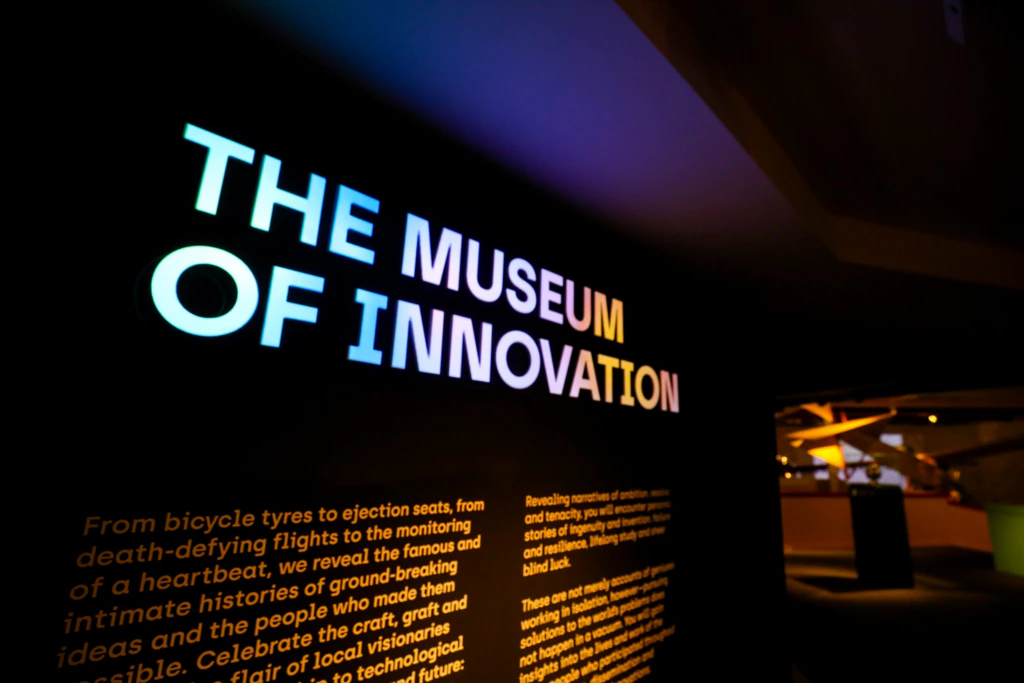
Entry is through a futuristic-looking tunnel, and it was only on leaving that
I noticed some ankle-level interpretation stating that the tunnel was actually the casing for a jet engine built by the aircraft manufacturer, Bombardier in Belfast. Ruing the fact that my excitable inner child missed out on this information on the way in, I was still impressed at the imaginative design.
Advertisement
Driving ambition
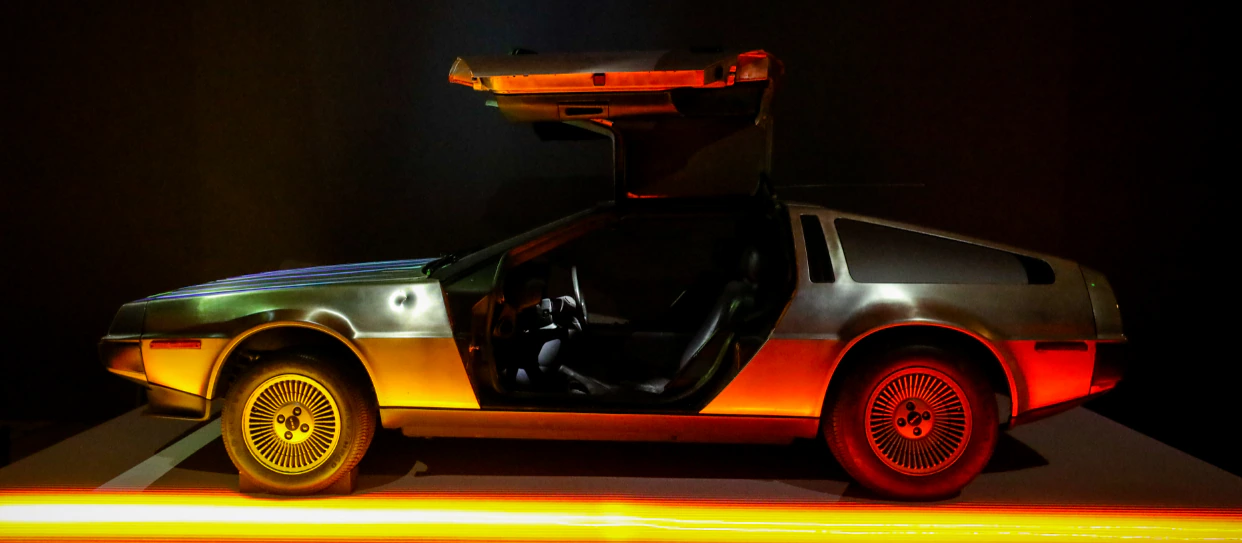
Aside from the vibrant colours, the eye is immediately drawn to the large vehicles on display including an ambulance (a great vehicle with which to demonstrate the invention of the portable defibrillator), a DeLorean DMC-12 whose car doors open like wings, a Massey Ferguson tractor (on display for the first time) and even a plane suspended from the ceiling. In the background the noise from an audiovisual carries throughout the space. Spotlights are used to draw attention to interpretation, but at times I found this frustrating with my shadow, and those of other visitors, often obscuring text.
The exhibition addresses each innovator in turn. Large numerals from one to seven are the obvious indicators for each but the subtle colour-coding of sections – red for Short Brothers, green for Harry Ferguson, blue for Frank Pantridge – helps divide the exhibition clearly as well. And despite being on split levels, the layout is easy to navigate with ramps throughout. Text is dotted about at various heights from adult eye-level to waist- and knee-level.
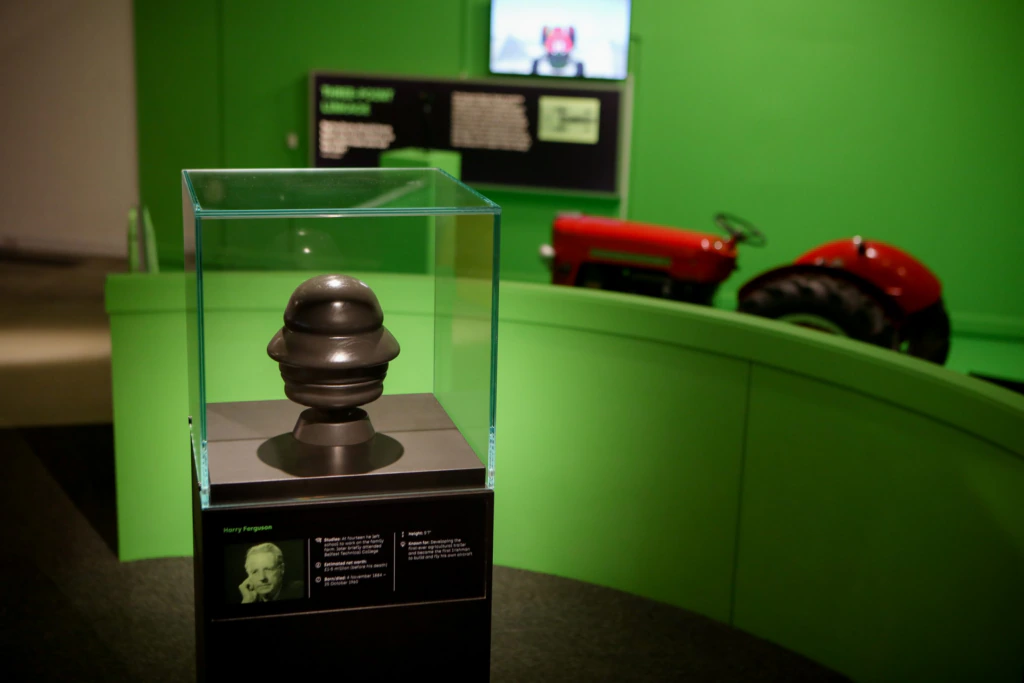
The focus of the Museum of Innovation is to celebrate the individuals behind the inventions on display, but their faces do not take centre stage. In their place is what can only be described as a circular bust of their facial profile (see p35) that no matter what angle you gaze on it, the outline is the same. With no clear indication of what they were I was initially confused, but once I realised their purpose, they became a focus of attention and are engaging artworks.
Recognising the facial profile in the bust was easier for some innovators than others; DeLorean, a colourful character who achieved public notoriety, was instantly recognisable. The plinth of each bust features a biography, including details of that inventor’s personal life and work. Alongside their inventions is an outline of their use in the past, present and future. For example, the “future” text accompanying the first British fixed-wing Vertical Take Off and Landing (VTOL) aircraft, the SC.1 that was produced by the Short Brothers, speculates on the use of VTOL research in the development of flying cars in a market estimated to be worth £1.1tn by 2040.
Advertisement
Interaction stations
Interactives are evenly spaced and varied. A heartbeat sensor accompanies the Pantridge section along with a screen counting in real time the estimated number of lives saved by his portable defibrillator. At the press of
a button labelled “Eject” a series of strip lights mimic the acceleration of Martin’s ejector seat.
Clever use of green as the colour scheme for the Harry Ferguson section means that it doubles as the background for green-screen technology, whisking away those sitting on the Massey Ferguson tractor onto a nearby screen flying over different landscapes. The resounding laughter and signage asking people to form a queue are testament to its popularity.
A striking audiovisual show illuminates a DeLorean DMC-12 and, unlike the ejector seat section, comes with a warning of flashing lights. The voiceover and lightshow highlight innovative and distinctive aspects of the car’s design and construction.
Whether DeLorean and his DMC-12 warrant inclusion in an exhibition on successful innovators is another question. The car performed poorly and the Belfast factory went into receivership in 1982 with half the vehicles remaining unsold. Later that year DeLorean was arrested on drug trafficking charges.
But there is little doubt about the popularity of the gull-winged DMC-12. Its status as a cult classic was secured when it featured in the Back to the Futurefilms. References to the hit movies are unavoidable with a quote from the trilogy’s main character Marty McFly and a more subtle nod at the end of the show. As the car speeds away, a speedometer appears and as it hits 88mph (the speed at which the car jumps through time), it ends.
By celebrating inventions from the perspective of the people behind them, the Museum of Innovation is a welcome attempt to widen the appeal of the National Museums NI’s transport collection. There is still plenty of technical information for those interested in planes, trains and automobiles, but this new personal and, more importantly, relatable element should help people of all ages connect with the collection in ways that they may not have before.
Project data
Cost
£150,000
Main funder
Department for Communities
Exhibition design and build
Wignall & Moore
Graphic design
Gaggeroworks
Spun head fabrication
David O’Neill
Audiovisual installation
Immersive-me
Animation
Andrius Vizbaras; Seb Camilleri
Copywriting
Eley Williams
Graphic production
Alexander Boyd
Screen printing
Spectrum Art
Metalwork supply and fabrication
RMC Designco
Admission
Adult £8.44; child £5.16