From its inception, the Vagina Museum has defied the model of the traditional museum. Launched in 2017 through a series of pop-up exhibitions and events around the UK, the project achieved viral success with a crowdfunding campaign that raised almost £50,000 from more than 1,000 supporters to open the world’s first “bricks and mortar” Vagina Museum.
True to its promise, the Vagina Museum now stands in a cobbled alley of London’s Camden Market – an intimate space with exposed brick walls that reflects its DIY roots as well as its appeal to the zeitgeist.
Contrary to the norm in the sector, the grassroots museum had an online audience before it even had a building. With more than 70,000 followers on Instagram and almost 40,000 on Twitter, the museum has carved out a space for itself in the conversation on gender and sexual health. Its identity exists beyond the four walls of the museum, with a distinct and confident purpose that speaks through every element of its brand.
Founder Florence Schechter has described the Vagina Museum’s personality as “really personable, very independent and rebellious”, so I was curious to see how this was translated in the physical space. Like myself, many of its visitors might interact with the museum online before they experience it in real life. I half-expected to simply walk into a three-dimensional model of its Instagram page.
The opening exhibition, Muff Busters: Vagina Myths and How to Fight Them, stays true to its unapologetic spirit. But compared with its early online presence, the tone of voice throughout the exhibition is more informative than provocative – a decision that reflects an attempt to make the space as inclusive as possible, welcoming its early adopters as well as community groups, healthcare professionals, older and younger people, school visits, or those who just happen to be passing by.
It’s an important shift in tone that leaves room to be more playful or serious, according to the subject matter. A glossary is provided at the entrance to help you navigate the terminology. When more than 50% of people can’t locate the vagina on a diagram (YouGov, 2019), a museum that bears its name has a lot of explaining to do.
Creative constraints
The opening panel lays out the context for the museum and defines its social purpose – to end the stigma and shame around the gynaecological anatomy. A series of nine panels then guides you through commonly held myths about the vagina, from the idea that periods are unhygienic to patriarchal narratives about the clitoris, and misconceptions around contraception and pregnancy.
The exhibition is heavy on words rather than objects or displays, reflecting the challenges of launching a museum that is not built around a collection. The museum is also only 65 sq m, which includes the entrance and gift shop. Add to that the constraints of curating a temporary exhibition in a Grade II-listed building – with only eight weeks to put it all together – and the options for display demand creative solutions.
“A traditional hang would never work,” says Sarah Creed, the curator at the Vagina Museum. “We can’t drill into the floor and I can’t house objects in a traditional sense, like loans or fine artworks, because there are no environmental controls. In a traditional museum, words are there to uplift or contextualise an object. I have to create the object through words.”
This approach suits the museum’s ethos, designed to challenge patriarchal norms through every layer of its practice. A museum without objects offers an alternative perspective to an often-paternalistic emphasis on “caring” for objects, rooted in the evolution of museums from the cabinets of curiosity of male collectors.
The few objects in Muff Busters are all thoughtfully placed. A three-dimensional diagram of the vulva on Perspex illustrates the first myth, explaining that “vulva” is actually the correct term for what most people think when they hear “vagina”.
The Perspex model, created by Creed and printed by Stylographics, requires you to peer into a series of panels with a diagram pointing to the individual parts of the vulva, that form a whole only when you look directly through. It forces the viewer to take a good look and, in one swoop, achieves one of the museums central aims – to simply educate audiences about the gynaecological anatomy.
Busting myths
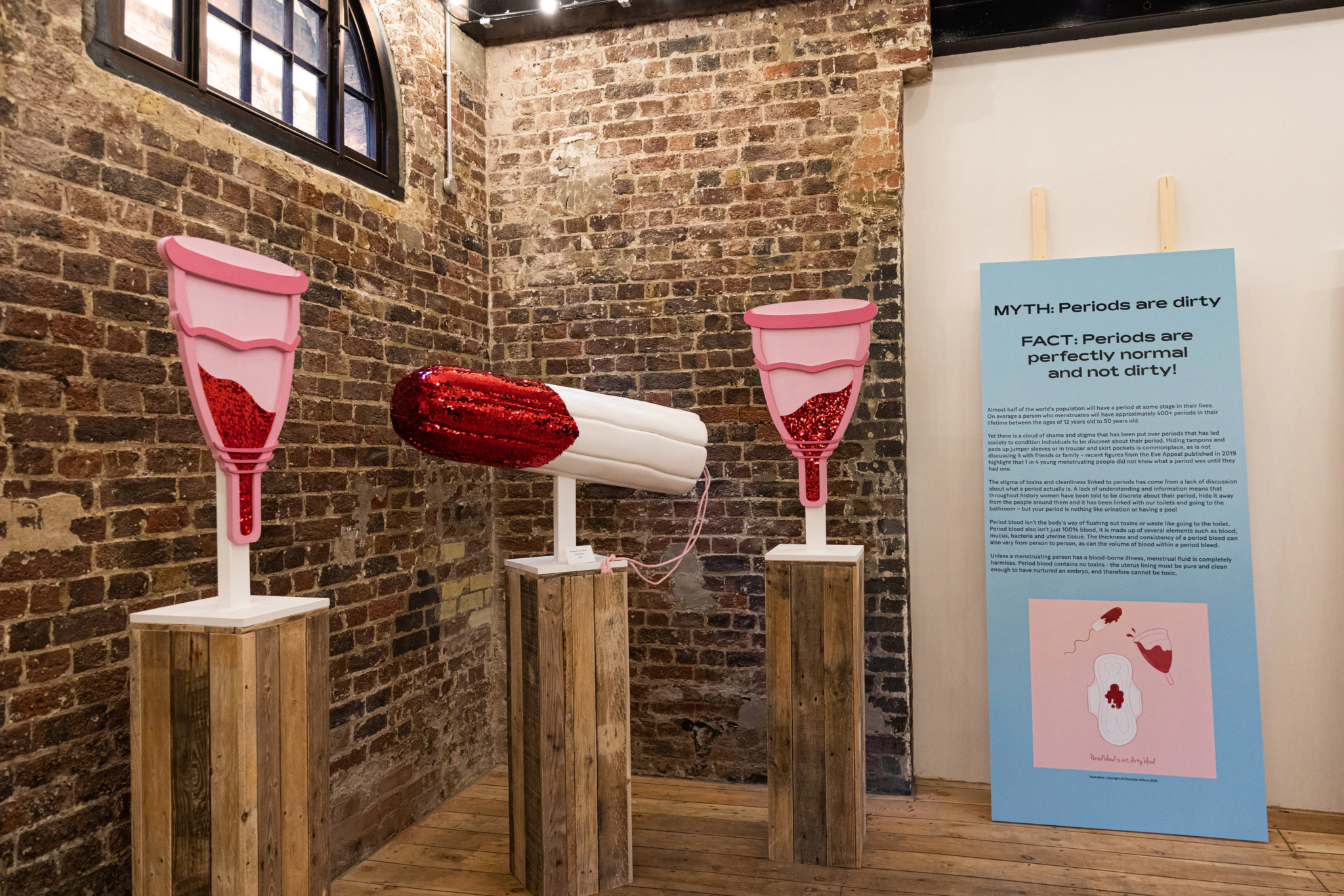
A few steps away, an installation by prop maker Sam Dawood displays over-sized menstrual cups and a tampon (or “glampon”), sparkling unapologetically with red glitter in defiance of the myth written beside it: periods are dirty. These occasional visual cues bring the lengthy captions to life and capture the personality of a museum that can be fun, while also creating a safe space for tackling serious issues.
Cutting across a host of social issues including gender identity, health, sexuality, religion and culture, the Vagina Museum’s theme creates an appeal to a broad audience – even those not yet converted. The next challenge is to see how it will narrow its focus in future exhibitions to explore sensitive themes such as female genital mutilation or menopause, which affect people across cultures and generations.
On its website, the Vagina Museum promises to “challenge heteronormative and cisnormative behaviour”, and promote “intersectional, feminist and trans-inclusive values”. While this marks its commitment to inclusive practice, some might question whether these words should be added to its glossary to define the terms for an audience unfamiliar with its politics.
The Vagina Museum goes further than many museums in avoiding assumptions about specialist knowledge; still, it needs to strike a balance between speaking the language of its loyal audience and remaining accessible to people willing to learn.
Its events and public programmes are an opportunity to transform the museum into a space for conversations that connect the exhibitions to people’s lives. The gift shop serves a similar purpose. It is also fantastic – offering a curated selection of stationery, branded souvenirs such as badges and guitar picks, and a satisfying array of books that capture the relevance of the museum today.
The items on the shelves provide a deeper insight into what the museum stands for, with texts on transgender activism, race and gender, as well as fictional books on sexuality. Prioritising independent designers and makers rather than big brands, it’s a space to discover new artists, activists and authors, while contributing to the work of the museum.
The Vagina Museum’s success points to the demand for a space like this – it attracted 5,000 visitors on its opening weekend in November and 62,000 visitors in its first three months. Reaching audiences across the world before it even had a physical building, the Vagina Museum is an example of what the museum of the future could look like – a place for learning, debate and experiences that extend beyond four walls.
Project data
- Cost Undisclosed
- Main funders Crowdfunded
- Exhibition design Vagina Museum
- Graphics Vagina Museum
- Perspex model printing Stylographics
- Glampon Sam Dawood
- Exhibition Muff Busters: Vagina Myths and How to Fight Them, until 29 March
- Admission Free
Project data
Cost
Undisclosed
Main funders
Crowdfunded
Exhibition design
Vagina Museum
Graphic design
Vagina Museum
Perspex model printing
Stylographics
Glampon
Sam Dawood
Exhibition
Muff Busters: Vagina Myths and How to Fight Them, until 29 March 2020
Admission
Free