The royal burial of the Anglo-Saxon King Rædwald of East Anglia at Sutton Hoo, which was discovered in 1939 and dates to the seventh century, is one of the most significant archaeological finds ever. It is England’s Valley of the Kings, with Rædwald cast as Tutankhamun.
But because this extraordinarily rich ship burial was unearthed on the eve of world war two, the site – though thoroughly researched and open to the public since the 1990s – fell under the radar and suffered from a lack of investment.
Historically, Sutton Hoo has comprised an exhibition space – opened in 2002 with a visitor centre – followed by a route around the burial mounds, but the two have always felt disconnected. This was accentuated by the richness of the findings that visitors saw reconstructions of, contrasted with the rather underwhelming mounds that followed, which often had to be viewed in wet conditions.
One can’t help the weather, but what the National Trust has been able to do with this £4m renovation is entirely expand the experience. Sutton Hoo now incorporates layered stories, proper context, new walking routes to the mounds and an innovative exhibition with voices of Anglo-Saxon people preparing the burial ceremony of the much-loved Rædwald.
Digging deep
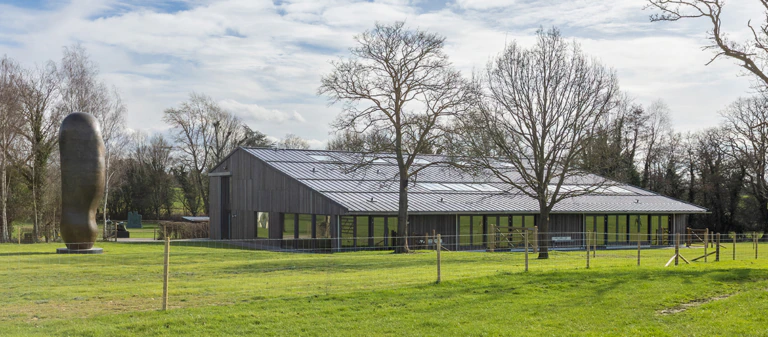
On entering Sutton Hoo, visitors are greeted with an oversized metal representation of the helmet, which was found in the burial and acts as a symbol of the site. It’s an appropriate start that orientates you nicely.
The sculpture isn’t new, but what’s next is: metal ribs of the king’s burial boat reproduced to scale at 27 metres long. It immediately brings home just what an enormous effort it would have been to drag the boat all the way up the hill from the River Deben for the burial, exemplifying the importance of the person the site is oriented around.
The recommended route from here is to follow the wheelchair-accessible path to Tranmer House, the 1930s residence of the well-travelled landowner Edith Pretty. The house stands on top of one of two hoos – or promontories – and looks over the peculiarly bumpy estate that Pretty identified as significantly unusual.
In 1938, Pretty employed a local archaeologist, Basil Brown, to investigate the largest mound, and in 1939 he found a rivet, which was the first indication of the treasure that lay there.
With the redevelopment, Tranmer House is now open to the public for the first time and its ground-floor rooms tell the history of the dig. The Sutton Hoo team has done a splendid job with this display.
Visitors walk into the beautifully restored 1930s drawing room, which is oak-panelled with candle lightbulbs, and has authentic furniture, places to sit and a wealth of exciting interpretation. An attention-grabbing projection shows headlines from 1939 about the discovery, and information panels explain the dig history, the discovery of King Rædwald’s helmet and what a challenge it was to reconstruct.
There is also information on Pretty, timelines, charismatic interviews that were done in the 60s with archaeologists involved, and that first rivet Brown found. There are multiple points of entry into the history of this site and a wealth of information, all presented fabulously.
The sitting room in comparison is sparse. Looking out towards the mounds, visitors are encouraged to sit and read short biographies of the archaeologists and researchers involved in the ongoing examination of Sutton Hoo. While you take in the view, you listen to audio recordings of these archaeologists talking about different aspects of the site. It’s a simple but effective treatment, which pads out the story and significance of this burial ground.
The third room in the house looks at the work of two photographers who documented the excavation – this, again, brings the excitement of such a find to life.
Stepping back in time
What’s really appealing about the whole redevelopment is that although Nissen Richards Studio’s exhibition design is visually alluring, it is also unusually rewarding in its depth of information. If you just want to drift through, it is a pleasure to do so without having to take in much detail, but on the other end of the spectrum, there is ample detailed material for those who want to get stuck in.
Leaving Pretty’s house, visitors embark on a walk to the mounds. There’s a wheelchair-accessible route through the woods, or two others, one through the wild Suffolk heathland valley in between the two hoos, the other along the river. Instead of riddling this Area of Outstanding Natural Beauty with signposts, the trust uses roaming volunteers to direct visitors and answer questions.
At the mounds, the king’s burial ship is indicated with metal ends added to the exterior of the royal burial mound. Here, volunteers shed light on the history of the site and surrounding mounds. This autumn, there will also be a sensitively designed 17-metre-high tower, clad in burnt larch, built with three viewing platforms, with the lowest one wheelchair-accessible. This will give visitors a much better overview of the topography of the estate and how weirdly hummocky it is.
A point to make at this juncture is that it is incredible that Sutton Hoo survived. Not only did the burial occur around 1,400 years ago, Tudor robbers attempted to steal the contents but missed the burial chamber by a metre or so. And because of the bumpy terrain these invaluable burial mounds were used as a second world war tank training ground. Farmland sits a matter of metres away on the boundary of Pretty’s estate, too, so it’s just fluke that her land contained the king’s chamber.
The route then heads back to the entrance area, where there’s a decent-sized cafe and a rather unoriginal National Trust shop, with visitors reaching the culmination of the Sutton Hoo experience: the exhibition hall.
Hoo’s waking up
It’s here that we learn about the contents of the find itself. The interpretation has been completely reimagined. Formerly, there was the reconstruction helmet, a few drab exhibition panels about the dig and the treasure (not separated as they now are), and some of the browned finds from the original dig.
Now, gleaming with originality, lovely graphics, film and interactives, this space rethinks Sutton Hoo not as a static find, but as a lived experience, and visitors find themselves in the build-up to honouring one of the great kings of their time.
The story is told through seven characters – Rædwald’s queen, the wise woman, the master craftsman, the slave girl, the Anglo-Saxon warrior, the poet and the trader – who give context to the period. The Anglo-Saxons had no written culture, but what does exist is their contribution to visual culture, with the intricate and highly crafted items on display exemplifying just how sophisticated they were. And they were also well travelled – garnets in Rædwald’s helmet came all the way from Sri Lanka.
With a colour theme of black and red, this exhibition space is populated with lightbox panels of interpretation, which are easy on the eye. Reconstructions of the finds – a cauldron, a huge drinking horn and a belt – are placed appropriately in relation to the storytelling characters.
There is a dressing-up opportunity and an Anglo-Saxon boardgame you can play. Visitors can also touch blunted blades through the different stages of swordmaking and there’s a really fun video of professional Anglo-Saxon battle re-enactors from Leeds Armouries fighting, with added slow motion.
In the centre of the exhibition is a labelled plan of the burial that you walk over. The king’s reconstructed possessions – his intricate helmet, belt, scabbard, iron standard and shield – convey the gravitas of this great East Anglian monarch in a visually concise and appealing way. Frustratingly, all the original objects remain on display at the British Museum in London, but the replicas provide a good enough picture.
What’s evident about this redevelopment is not only the care that’s gone into it, but also that Sutton Hoo has finally been done justice. It reveals a time that was previously thought of as dark, insular and uncultured as a hugely sophisticated, exploratory and vibrant period.
And in many ways the light that Sutton Hoo has shed on the Anglo-Saxon era is reflected in the technicolour with which the National Trust now tells this phenomenal story, even if the original 1,400-year-old artefacts have stayed in London.
Project data
- Cost £4m
- Main funders National Lottery Heritage Fund; New Anglia Local Enterprise Partnership through the Growing Places Fund; National Trust members, supporters and donors
- Architect Nissen Richards Studio
- Exhibition design Nissen Richards Studio
- Main building contractor Vinci
- Exhibition installation The Hub
- Exhibition mounts Dauphin; Colin Bowles
- Display cases Armour Systems
- Graphics installation Displayways
- Graphic design Nissen Richards Studio
- Interpretation Nissen Richards Studio
- Exterior concrete interpretation Greyframe
- Interactives Nissen Richards Studio
- Audiovisual Sysco; Elbow Productions
- Film Elbow Productions
- Lighting Arup
- Ship sculpture Shaun Hodgson Engineering
- Viewing tower Shaun Hodgson Engineering
- Furniture TT Solutions
- Admission Adult £13.50; child £6.75
Focus on Landscape
The Sutton Hoo landscape and its habitats are a huge part of our story. The acid soils that dissolved the ship timbers and the body of the king, are those same soils that now support rare heathland habitats and wildlife.
The landscape of the hoo – or hill – is the very reason the burial grounds are in this location. Sited as they are on the hoo prominently overlooking the Deben estuary, the highway of the time, they would have sent out a clear message of power and dominance over this landscape, as traders and river users passed.
The sound of wading birds and waterfowl on the estuary is the same now as 1,400 years ago. The project aims to make more of the landscape, enabling people to understand its significance not only as the backdrop to the renowned Anglo-Saxon story, but also to the site’s importance today as a place of rare and internationally designated wildlife habitats.
Its prominence, overlooking Woodbridge, is a key viewpoint in the Suffolk Coast & Heaths Area of Outstanding Natural Beauty. The paths, including the stunning new river-view walk and the route to the ship-drag, together with the new ship sculpture and the soon-to-be-completed viewing tower, all enable visitors to better understand and connect to the landscape and what would have been required to drag a mighty ship from the river to the top of the valley side.
The ship dissolved in the acid soil, the original treasures too are not here, but are on display for the nation at the British Museum. However, this small part of Suffolk’s beautiful coastal landscape tells the story in a way that is deeply profound and rooted in place.
Nick Collinson is the general manager, Suffolk & Essex Coast, at the National Trust