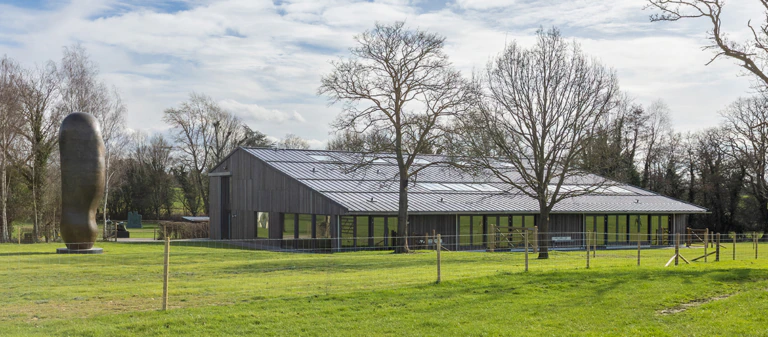
Although the Scottish Maritime Museum (SMM) in Irvine is on the opposite side of the country to the North Sea, it is still perhaps a fitting last stop for Age of Oil, a touring exhibition featuring the work of artist Sue Jane Taylor alongside objects relating to the oil industry. The show began in 2017 at the National Museum of Scotland, Edinburgh, and went on to the University of Aberdeen.
The oil industry is in flux, much of it given over to the decommissioning of the huge Murchison and Brent platforms. So housing the exhibition in a museum building that was originally part of the Alexander Stephen Shipyard at Linthouse in Govan has some resonance.
That said, the SMM could have made more of the exhibition. Although guides and prints are displayed on a table at the entrance to the museum, there is no obvious signage to lead you into the gallery space until you are at the door.
The exhibition itself has lots of information to help visitors understand the artist’s intentions. Excerpts from Taylor’s diaries shed light on objects, which range from a makeshift teacup-carrying device to a helicopter passenger survival suit, which she describes wearing while strapped in for two hours on a flight to the rigs after a sea-survival training course.
Extreme environment
The suit, encased in glass in the centre of the space, is the first thing that strikes you as you enter the show, a reminder of the dangers of the job and a precursor to a display case dedicated to the Piper Alpha explosions, which killed 167 workers in 1988 – indeed, Taylor was the artist who sculpted a memorial to the disaster in Aberdeen.
Small details bring the horror of this event to life: a Casio watch belonging to Roy Carey, who survived by jumping into the sea, allows the artist to tell the story of how it was cut from Carey’s wrist after his hands swelled up.
John Paterson, a deck foreman who worked on Murchison for 28 years, speaks in one of a series of videos on the decommissioning process: “Murchison is just a hunk of metal, it’s the people that are important.” And it is these industry workers who are at the heart of the display, depicted in Taylor’s mixed-media portraits and films.
Aptly for an exhibition that opened on International Women’s Day – 8 March, Taylor’s films manage to find the handful of women who populate this overridingly male environment. On the Brent platform, named after the golden and black Brent goose, we meet Linda Nyike, an on-site drilling engineer, Clair Slater, a stewardess known affectionately as Mother Goose, and Ciara MacGarry, an environment specialist whose job it is to make sure the old platforms comply with environmental legislation.
But, like much of this frustratingly slight exhibition, the films give us a glimpse of what it is like to live on these vast structures at sea, while only hinting at the toll it takes on those working in such extreme conditions.
Mention of the “200-mile stare” – looking across the open expanse of sea and thinking of home, and shots of Adam Shearer, who spent 34 years working on Murchison, shutting down the decommissioned platform before boarding a helicopter back to the mainland for last time, have a poignant edge to them, but don’t drill deeper into the emotional impact of life on the rigs.
Conflicted feelings
Taylor, who grew up in the north-east of Scotland during the oil boom, has extraordinary access, and the exhibition, which covers a decade of her work,
gives some fascinating insights into the industry. But anyone drawn in by the title looking for an overt political commentary will be disappointed.
Greenpeace is mentioned once in a diary entry and the environmental impact
of the industry is not explicitly critiqued at all in the work or objects on display at Irvine.
Rather, the exhibition chronicles the beginning of the end of the industry, from decommissioning to the quest for renewable energy. Taylor’s colour etching of a wind turbine destined for the Beatrice Offshore Windfarm, which she visited as it was being constructed, suggests a possible future direction, with her diary entry stating: “Memories flooded in from visits over 20 years ago when this was an oil fabrication yard. Now, over 100 men were being employed here to work on wind and sea-power contracts.”
Other graphite and watercolour works depict the Wello Penguin, a wave-energy converter machine, and the Pelamis, another wave-conversion project that ran out of funding. Perhaps the most resonant of the works on display is a sketch of the topside of the Brent Delta platform, lifted from its position in the North Sea and transported to a site in Hartlepool, where it was dismantled and largely recycled.
Her sketch of the massive metal structure, stranded by the roadside, which also features in her film about decommissioning the platform, is other-worldly, and the accompanying diary entry hints at the artist’s conflicting feelings about her subject: “It was a complexity of nature’s fragility mixed in with human industrial invasion.”
The decommissioning process also created problems for the curators, which is acknowledged in the book accompanying the exhibition: “The scale and location of the industry presents a major issue. It is simply too large to collect everything.”
Objects such as the driller’s telephone, the “pipeline pig” used to clean the oil pipes and the last barrel of export crude from Murchison benefit from Taylor’s sketches, films and diary entries to give them context.
Seeing her mixed-media work of Aberdeen Harbour, the “oil capital of Europe”, or of the Brent platform, you get an understanding of the size of the decommissioning programme, with around 470 offshore installations due to be decommissioned by 2040. But, the exhibition informs us, an estimated 20bn barrels of oil are still to be recovered from the North Sea, suggesting that although this tour is coming to an end, the age of oil is not over yet.
Patrick Steel is a freelance journalist and filmmaker
Project data
- Cost £3,000
- Main funder Scottish Maritime Museum
- Exhibition design Scottish Maritime Museum
- Graphic design National Museums Scotland (panels and captions); Euan McKenzie (additional captions for objects and artwork)
- Interpretation National Museums Scotland; Sue Jane Taylor; Nicola Scott (Scottish Maritime Museum)
- Lighting Scottish Maritime Museum
- Display cases Scottish Maritime Museum
- Exhibition ends 7 July
- Admission Adult £8.50; concession £6.50