Edinburgh is a city where the historic and contemporary can sit uneasily at times, causing passionate debates and campaigns for and against building projects at the heart of this Unesco world heritage site. Fortunately, the Collective Gallery, which opened in November 2018 on Calton Hill, is a harmonious melding of old and new, offering a much-needed reason, other than the stunning views, for visitors and residents to ascend this landmark.
Collective is a not-for-profit visual-arts organisation founded in 1984 to offer a platform for the work of emerging artists at a critical stage in their careers. Crucially, along with the Fruitmarket Gallery, it brought a much-needed contemporary feel to the heart of a city that is largely celebrated for 18th- and 19th-century architecture.
The gallery was on Cockburn Street in the Old Town, where it felt swamped by cafes and tourist shops. As a result of eight years of fundraising and close collaboration with Edinburgh City Council and other organisations, the gallery, under the guiding hand of the director Kate Gray, now has a permanent home in the buildings that once made up the City Observatory, the architect William Henry Playfair’s testament to the science of the Scottish enlightenment.
The once-dilapidated observatory and the Transit House, as well as architect Robert Morham’s City Dome, which was built later, have been sensitively renovated to provide modern spaces that offer history and character for the art installations within. The City Observatory still houses a number of telescopes and instruments, as well as the library and a shop selling designs by local artists, while the City Dome is now purely a space for art.
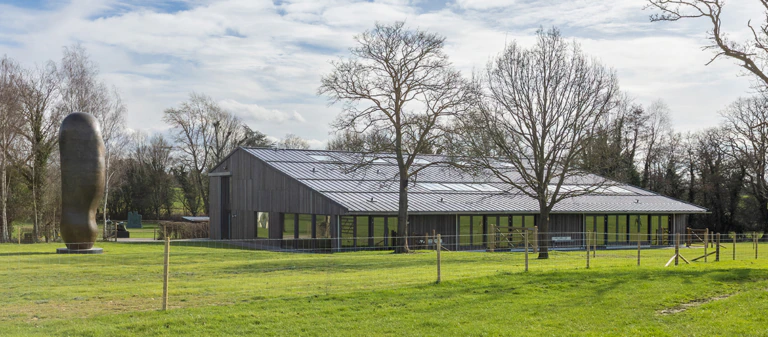
The Transit House has become a hub for the gallery’s learning activities. Alongside these reimagined spaces stand two new buildings: the Hillside, an art space that, as its name suggests, is cut into the hillside, and the Lookout restaurant, which offers terrific local produce and breathtaking views through its glass walls.
Compelling installations
The gallery opened with three specially commissioned installations: South African multimedia artist Dineo Seshee Bopape’s When Spirituality Was a Baby, Scottish artist James Hutchinson’s Rumours of a New Planet and Klaus Weber’s The Nonument.
Bopape’s absorbing work, which draws on afro-diasporic spiritual practices, takes commonplace materials in raw and sculptural states, and lays them out in the City Dome to create what feels like a complex but accessible exploration of personal and public ritual, time, cosmology and earth magic.
Visitors are invited to carefully wind their way through materials as they burn out, dry, move and interact with each other and the environment. Here, in this former temple to western enlightenment science, there is a sense that scientific materialism and magical thinking are not as distinct as many would have us believe.
The first part, The Manenberg Tornado, was inspired by a series of botanical drawings made by the astronomer John Herschel and his wife Margaret Stewart when they lived in Cape Town in the 1830s.
Hutchinson travelled to South Africa to retrace one of the couple’s journeys, and the result was a series of 26 botanical drawings based on the flora there. The works examine the effects of time, redevelopment and conservation on the landscape and plant life.
In the second part, One Drop of Water Contains as Much Electricity as Would Make a Thunderstorm, Hutchinson follows a journey from Dieppe in France to Florence in Italy made by the geologist Jessica Duncan in the first half of the 19th century. As part of his own excursion, Hutchinson collected rock samples from each location, which are displayed here in the library.
A beautifully produced book combines travelogue, personal fiction and a series of theoretical texts. And a drawing from all angles of the contemporary Italian artist Michelangelo Pistolleto’s sculpture Dietro-Front, at the gates of Florence, slowly turns one full circle over the three months of the exhibition.
Finally, The Sightseers, an audioguide to Calton Hill, was inspired by the astronomers Thomas Henderson (1789-1844) and Thomas Anderson (1853-1932), who made significant discoveries despite having visual impairments, as well as the work of the astronomer, publisher and tireless advocate of accessible mapping for the blind, James Gall (1784–1874).
The Sightseers, made in collaboration with Lothian Blind Ramblers, is a refreshing exploration of the ways in which descriptive language can offer rich alternatives to the purely visual. It is one of a number of artist-made Observer’s Walks recordings, which are available to download from the Collective website. These include the artist Patrick Staff’s fascinating melding of the botany and ecology of the hill with its long history as a site of nocturnal, particularly queer, human encounters.
Boon for the city
In the Hillside, The Nonument by the German artist Weber is a critical look at the notion of public monuments and their use and meaning in the 21st century. This colourful proposed monument, Fagman, is designed to sit on top of the Playfair monument at the south-east corner of the site. It consists of a snowman, crowned with a broken bottle, smoking a cigarette.
Fagman is a colourful satirical counterpoint to the grey monuments to dead, white men (as well as to “Edinburgh’s Disgrace” – the unfinished national monument) that dominate the top of Calton Hill and, with the castle and Arthur’s Seat, the Edinburgh skyline.
Collective Gallery is a great boon for the city and, much like the artworks it houses, aims to elucidate the history of the site, while offering surprises and challenges for 21st-century audiences. It will be fascinating to trace how narratives and ideas develop as the gallery contributes both to the multiple histories and the future of this monumental hill.
Sally-Anne Huxtable is the principal curator of modern and contemporary design at National Museums Scotland, Edinburgh
We hope that visiting Collective will render strict definitions immaterial and instead celebrate the porous walls between disciplines. Every visitor is invited to look more closely – at art, science, history and the city surrounding us. From this perspective, though the field of vision has expanded, our new home remains, first and foremost, an observatory.
Collective is a not-for-profit visual-arts organisation founded in 1984 to offer a platform for the work of emerging artists at a critical stage in their careers. Crucially, along with the Fruitmarket Gallery, it brought a much-needed contemporary feel to the heart of a city that is largely celebrated for 18th- and 19th-century architecture.
The gallery was on Cockburn Street in the Old Town, where it felt swamped by cafes and tourist shops. As a result of eight years of fundraising and close collaboration with Edinburgh City Council and other organisations, the gallery, under the guiding hand of the director Kate Gray, now has a permanent home in the buildings that once made up the City Observatory, the architect William Henry Playfair’s testament to the science of the Scottish enlightenment.
The once-dilapidated observatory and the Transit House, as well as architect Robert Morham’s City Dome, which was built later, have been sensitively renovated to provide modern spaces that offer history and character for the art installations within. The City Observatory still houses a number of telescopes and instruments, as well as the library and a shop selling designs by local artists, while the City Dome is now purely a space for art.
The Transit House has become a hub for the gallery’s learning activities. Alongside these reimagined spaces stand two new buildings: the Hillside, an art space that, as its name suggests, is cut into the hillside, and the Lookout restaurant, which offers terrific local produce and breathtaking views through its glass walls.
Compelling installations
The gallery opened with three specially commissioned installations: South African multimedia artist Dineo Seshee Bopape’s When Spirituality Was a Baby, Scottish artist James Hutchinson’s Rumours of a New Planet and Klaus Weber’s The Nonument.
Bopape’s absorbing work, which draws on afro-diasporic spiritual practices, takes commonplace materials in raw and sculptural states, and lays them out in the City Dome to create what feels like a complex but accessible exploration of personal and public ritual, time, cosmology and earth magic.
Visitors are invited to carefully wind their way through materials as they burn out, dry, move and interact with each other and the environment. Here, in this former temple to western enlightenment science, there is a sense that scientific materialism and magical thinking are not as distinct as many would have us believe.
In the library of the observatory building, Glasgow-based artist and academic Hutchinson’s three-part installation also explores the history of the site, drawing on the lives and work of historical figures connected to the hill.
Hutchinson travelled to South Africa to retrace one of the couple’s journeys, and the result was a series of 26 botanical drawings based on the flora there. The works examine the effects of time, redevelopment and conservation on the landscape and plant life.
In the second part, One Drop of Water Contains as Much Electricity as Would Make a Thunderstorm, Hutchinson follows a journey from Dieppe in France to Florence in Italy made by the geologist Jessica Duncan in the first half of the 19th century. As part of his own excursion, Hutchinson collected rock samples from each location, which are displayed here in the library.
A beautifully produced book combines travelogue, personal fiction and a series of theoretical texts. And a drawing from all angles of the contemporary Italian artist Michelangelo Pistolleto’s sculpture Dietro-Front, at the gates of Florence, slowly turns one full circle over the three months of the exhibition.
Finally, The Sightseers, an audioguide to Calton Hill, was inspired by the astronomers Thomas Henderson (1789-1844) and Thomas Anderson (1853-1932), who made significant discoveries despite having visual impairments, as well as the work of the astronomer, publisher and tireless advocate of accessible mapping for the blind, James Gall (1784–1874).
The Sightseers, made in collaboration with Lothian Blind Ramblers, is a refreshing exploration of the ways in which descriptive language can offer rich alternatives to the purely visual. It is one of a number of artist-made Observer’s Walks recordings, which are available to download from the Collective website. These include the artist Patrick Staff’s fascinating melding of the botany and ecology of the hill with its long history as a site of nocturnal, particularly queer, human encounters.
Boon for the city
In the Hillside, The Nonument by the German artist Weber is a critical look at the notion of public monuments and their use and meaning in the 21st century. This colourful proposed monument, Fagman, is designed to sit on top of the Playfair monument at the south-east corner of the site. It consists of a snowman, crowned with a broken bottle, smoking a cigarette.
Fagman is a colourful satirical counterpoint to the grey monuments to dead, white men (as well as to “Edinburgh’s Disgrace” – the unfinished national monument) that dominate the top of Calton Hill and, with the castle and Arthur’s Seat, the Edinburgh skyline.
Collective Gallery is a great boon for the city and, much like the artworks it houses, aims to elucidate the history of the site, while offering surprises and challenges for 21st-century audiences. It will be fascinating to trace how narratives and ideas develop as the gallery contributes both to the multiple histories and the future of this monumental hill.
Sally-Anne Huxtable is the principal curator of modern and contemporary design at National Museums Scotland, Edinburgh
Project data
- Cost £4.5m
- Main funders National Lottery Heritage Fund; City of Edinburgh Council; Creative Scotland; Collective; Edinburgh World Heritage
- Architects Collective Architecture
- Main contractor Esh Border Construction
- Graphic design Graphical House
- Interpretation Collective Gallery
- Lighting Collective Architecture
- Exhibitions end Emmie McLuskey, These Were the Things that Made the Step Familiar, until 10 March; James N Hutchinson Rumours of a New Planet, until 31 March
- Admission Free
Focus on Transformation
There is always a moment towards the end of the television programme Grand Designs when presenter Kevin McCloud finally lowers his raised eyebrows and talks about the completed project. The camera pans back, mood lighting highlights immaculate new furnishings, and we are invited to forget the earlier scenes of wild weather, unforeseen complications and hard graft.
In transforming an early-19th century observatory site into a centre for contemporary art, Collective has faced a few eyebrow-raising moments over the past five years. Yet in many ways our biggest challenge was organisational.
As a small visual-arts charity, what does it mean to become custodians of a jewel in the crown of Edinburgh’s enlightenment heritage? Could we take on that mantle while staying true to our roots and working collaboratively with artists to show their work?
Collective is not a museum, though it does house a rather magnificent Fraunhofer-Repsold transit telescope, installed in 1831. Nor is it simply an art gallery, instead containing a cluster of old and new buildings within a walled garden, only some of which are used to display art. Definitions are impossible to dodge so we settled on “centre for contemporary art”, at least allowing some room for multiplicity.
Eric Hildrew is the head of communications at Collective