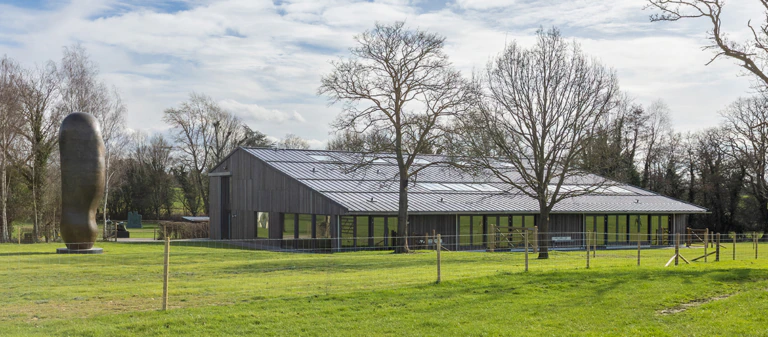
The importance of Bethlem: Museum of the Mind in Beckenham, Kent, cannot be overstated. Four years after a major redevelopment, supported by the National Lottery Heritage Fund, the venue remains an exemplary person-centred exploration of Bethlem’s 800-year history as a hospital for mental illness.
The displays, which draw inspiration from museums across Europe, expertly interweave historical and contemporary narratives. The museum is now a widely visited role model for mental-health awareness and a tranquil space for an examination of the human condition in all its fragility and resilience.
Alongside the permanent displays, Bethlem’s current temporary exhibition takes Robert Burton’s classic work, The Anatomy of Melancholy, as its starting point. The 17th-century bestselling behemoth – a copy of which is on loan from the Museum Dr Guislain in Belgium – must be in the top 10 most influential books that almost no one today has read entirely.
My main hope in visiting the show was that it would allow me to access Burton’s humour and insight without actually opening his encyclopaedic compendium. Spoiler alert: it doesn’t. Burton himself would be unsympathetic. “If you like not my writing, go read something else,” he wrote.
The 17th-century concept of melancholy can’t be mapped onto a single modern condition. Instead, it is one of the four ancient Greek temperaments, framing an individual’s personality and appearance across a range of social, religious and medical dimensions.
Melancholy was not a disorder to Burton – its sufferers had “a deep reach, excellent apprehension, judicious, wise and witty”, but the condition could tip into physical or mental ill health. Burton said: “I write of melancholy, by being busy to avoid melancholy” and his vast “project of self-healing” continued through many editions.
Rather than attempt Burton-lite, Bethlem introduces the book by displaying a beautiful 1652 edition and uses his six contributing factors to melancholy as the exhibition’s sequence of themes.
Twenty-three artworks are selected to represent sickness, solitude, jealousy, disappointment in love, insanity and religious melancholy. They include watercolours by one of the hospital’s ex-residents, the artist Richard Dadd. His Sketch to Illustrate the Passions – Agony – Raving Madness deftly demonstrates Burton’s verse: “See the Madman rage downright/With furious looks, a ghastly sight.”
Bethlem’s art collection began as the project of two psychiatrists who worked in the Maudsley hospital, south London, in the 1930s – Eric Guttmann (a refugee from Nazi Germany) and Walter Maclay. They gathered works by patients with art experience and occasionally introduced mescaline to art classes to recreate a hallucinogenic experience.
They also bought work by the painter Charles Sims whose style transformed after a breakdown in the 1920s, Russian ballet dancer Vaslav Nijinsky who made drawings during his battle with schizophrenia in 1919, and English artist Louis Wain, also schizophrenic, who drew anthropomorphic cats.
The religious melancholy section has an astonishing ink on calico work, Women and Checkered Staircase, 1946, by east London artist Madge Gill.
An identical exhibition could have been promoted as treasures from the collection, but Gale felt that a reflective interrogation based on Burton’s categories would prove more engaging. He’s right: every work becomes intriguing in this context. Paintings I would have walked past or disliked stylistically, I viewed carefully to find out more, long after I’d compiled enough material for this review.
The displays, which draw inspiration from museums across Europe, expertly interweave historical and contemporary narratives. The museum is now a widely visited role model for mental-health awareness and a tranquil space for an examination of the human condition in all its fragility and resilience.
Alongside the permanent displays, Bethlem’s current temporary exhibition takes Robert Burton’s classic work, The Anatomy of Melancholy, as its starting point. The 17th-century bestselling behemoth – a copy of which is on loan from the Museum Dr Guislain in Belgium – must be in the top 10 most influential books that almost no one today has read entirely.
My main hope in visiting the show was that it would allow me to access Burton’s humour and insight without actually opening his encyclopaedic compendium. Spoiler alert: it doesn’t. Burton himself would be unsympathetic. “If you like not my writing, go read something else,” he wrote.
The 17th-century concept of melancholy can’t be mapped onto a single modern condition. Instead, it is one of the four ancient Greek temperaments, framing an individual’s personality and appearance across a range of social, religious and medical dimensions.
Melancholy was not a disorder to Burton – its sufferers had “a deep reach, excellent apprehension, judicious, wise and witty”, but the condition could tip into physical or mental ill health. Burton said: “I write of melancholy, by being busy to avoid melancholy” and his vast “project of self-healing” continued through many editions.
Rather than attempt Burton-lite, Bethlem introduces the book by displaying a beautiful 1652 edition and uses his six contributing factors to melancholy as the exhibition’s sequence of themes.
Twenty-three artworks are selected to represent sickness, solitude, jealousy, disappointment in love, insanity and religious melancholy. They include watercolours by one of the hospital’s ex-residents, the artist Richard Dadd. His Sketch to Illustrate the Passions – Agony – Raving Madness deftly demonstrates Burton’s verse: “See the Madman rage downright/With furious looks, a ghastly sight.”
As Colin Gale, the director and exhibition curator of Bethlem, reflects in the show’s guidebook, it is our knowledge of Dadd’s lived experience of two decades at Bethlem, and later Broadmoor after murdering his father in 1843, that gives his work great immediacy here.
They also bought work by the painter Charles Sims whose style transformed after a breakdown in the 1920s, Russian ballet dancer Vaslav Nijinsky who made drawings during his battle with schizophrenia in 1919, and English artist Louis Wain, also schizophrenic, who drew anthropomorphic cats.
The right context
The collection experienced wilderness years “kept in a tea chest that … spent time bouncing between attic and cellar”, but Bethlem now uses it as a tool to “celebrate the achievements of people with mental health problems”, which “only constitute one aspect of their artistic experiences”, and displays them without retrospective diagnosis, sensationalism or voyeurism.
The five paintings representing the theme of solitude are affecting. Elise Warriner Pacquette’s 1993 painting The Deadly Blue conveys Burton’s theme in a red and blue figure with taped-over mouth and fearful eyes. Pacquette was inspired by an incident of humiliation during her art degree when she had anorexia nervosa. The canvas is hooked onto an iron frame by taut strings, adding to the sense of strung-out fragility.
This features an MC Escher-like dislocated line of well-dressed women. It is reminiscent of artist Edward Burne-Jones’s The Golden Stairs, but with a more disembodied atmosphere, I had not come across Gill’s self-taught work before and her story of bereavement and immersion in art and spiritualism is extraordinary.
Sharing the pain
Using Burton’s reputation to showcase the art of Bethlem taps into our fascination with the simultaneous wisdom and ludicrousness in historical medical texts. We are usually drawn in by one of these two routes and gain a perspective on current health practices. Which of our treatments will be ridiculed in 400 years and which will be as timeless as Burton’s statements, such as: “What cannot be cured must be endured.”
Bethlem’s care for visitors affected by the displays extends to a list of crisis organisations to contact displayed by the visitor book. It is a reminder that we go nowhere without our personal histories of illness, trauma and grief. The exhibition’s final theme is remedy.
Burton offers only the herbs borage and hellebore to “cheer the heart”, and the artist Tracie Hodge’s 2009 Don’t Just Medicate Me! has a straightforward request, not against the vast array of medicines she names, but to listen and understand as well.
Some of us are simply lucky not to be “torn to pieces by our passions, as so many wild horses” due to our combination of genes and environment. Burton is clear here too: “Now go and brag of thy present happiness … how many sudden accidents may procure thy ruin.”
He – and Bethlem – show that painful private experiences can be shared and that a 17th-century bestseller can provide a time-travelling dose of empathy in our 21st-century lives.
Emma Shepley is a freelance curator
Project data
- Cost £5,000
- Main funders Maudsley Charity/South London and Maudsley Foundation Trust
- Exhibition design In-house
- Graphic design In-house/TT Litho
- Interpretation director Colin Gale; curator Kate Tiernan
- Lighting In-house
- Display cases In-house
- Exhibition ends 27 April
- Admission Free