I can’t lie: I still find it irksome starting an exhibition without something – usually a short text on the wall by the entrance – that gives me a bearing. A few brief sentences perhaps that help swivel my eye and brain, and say “this is your direction of travel for the next 30 minutes”.
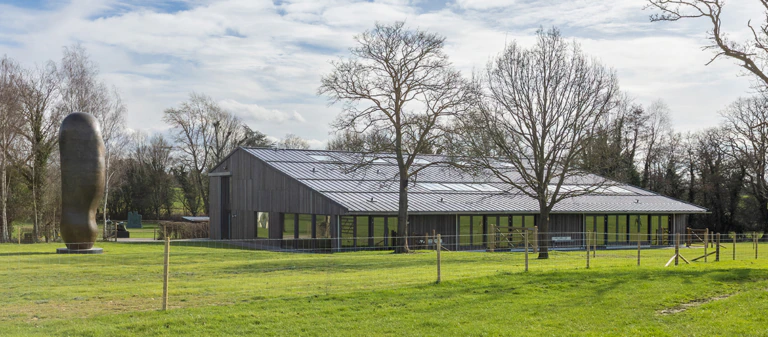
Walking into the Whitworth’s elegant exhibition galleries, the visitor gets no such easy orientation. There is William Kentridge’s name and, yes, there is a free exhibition guide to be picked up and leafed through. But I missed it entirely, and I am so pleased I did.
The drawings in the cases and the books on the tables contain characters, phrases and motifs that later recur in the film projections waiting in the wings, not least glimpses of the South African landscape in which Kentridge grew up. The entire space has a reassuring calmness about it, filled with natural light from the large picture windows.
Putting on a show
Among the characters that visitors encounter is Kentridge himself, sketched and animated on the pages of a Shorter Oxford English Dictionary. “LET THE DRAMA BEGIN…” is written in large type alongside a sketch of him walking, head down, hands in pockets, deep in contemplation.
Drama? What drama? It’s all to come. The light-filled central room is flanked by a succession of installations full of movement, sound and provocation. The Whitworth’s exhibition galleries have never worked so effectively. For any visitor, walking around a blind corner into a new installation is always a small act of faith. Will it be worth it? Will it be dark? Will I get a seat?
Each of the installation spaces in this exhibition is beautifully presented – a combination of pin-sharp technology, painstaking construction and unobtrusive lighting and design. This means I feel comfortably closer to the work and the wealth of ideas.
In another film an army of ants marches randomly across his studio floor. They are as haphazard as the installation itself appears to be, until you realise the ants know exactly where they are going – following an invisible trail of sugar.
However, having finally located the exhibition guide, I realise that each installation has a well-written description, which, for example, manages to explain the rise of the model opera in the declining years of the Chinese Cultural Revolution. But the thought of reading these notes while experiencing Kentridge’s works is surely madness – better to enjoy the journey and read the guide book later.
And a journey it remains. Indeed, one of the installations, The Refusal of Time (2012), is a short stroll away, deeper into the building. The sign says “Exhibition continues” and I watched as a few visitors consider the additional effort and decide against.
What fools! They miss the beating heart of the whole exhibition: a room of five silent projections, in an early cinematic style, that reference the marking of colonial borders across Africa and the race to patent the measurement of time, both during the late-19th century.
Enveloping visitors
Surrounded by film, sound, poetry and machines, your grip on who you are and where you are starts to shift – a sensation echoed throughout this exhibition. At the centre of The Refusal of Time is Breathing Machine, an organ-like contraption that mimics the essential monotony of a factory appliance.
It rattles repeatedly, adding to a series of soundtracks that pervade the entire exhibition. The films on the walls envelop you, culminating in a carnival procession of shadow figures that disappear into a black hole.
But am I so enthralled by this installation that I am in danger of disappearing into a black hole of my own, so to speak? The Refusal of Time is at once baffling and inspiring; disorientating and thrilling – which sums up the whole exhibition.
I’m happy to go with it but, if I tried to be more objective about this experience, would I instead decide that it is pretentious and hollow? Certainly, the accompanying exhibition catalogue has some dizzyingly dense texts but is worth spending time with, not least because of the illustrations.
This exhibition is easy to dismiss, yet my teenage daughters and I spent an hour arguing about it afterwards. Undoubtedly, I’ll be talking about how impressive it was for years to come.
Michael Simpson is the director of visual arts at The Lowry, Salford
Walking into the Whitworth’s elegant exhibition galleries, the visitor gets no such easy orientation. There is William Kentridge’s name and, yes, there is a free exhibition guide to be picked up and leafed through. But I missed it entirely, and I am so pleased I did.
This gloriously satisfying exhibition has the feel of a landscape, to be roamed through and explored, not directed around. It is a landscape that gives you space and time to breathe.
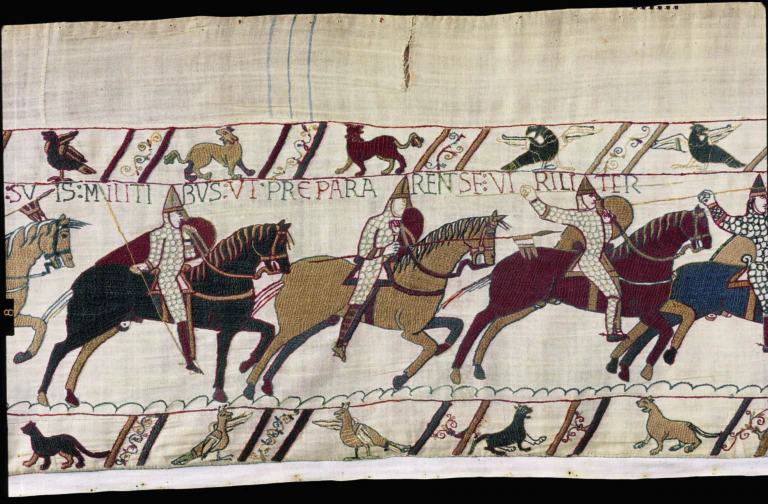
The central gallery – Kentridge’s Tapestry Library – is filled with an array of old-fashioned wooden museum cases and broad tables. On the walls are complex and intriguing hand-woven tapestries that sit particularly well in a building that houses one of the world’s finest textile collections.
The drawings in the cases and the books on the tables contain characters, phrases and motifs that later recur in the film projections waiting in the wings, not least glimpses of the South African landscape in which Kentridge grew up. The entire space has a reassuring calmness about it, filled with natural light from the large picture windows.
Putting on a show
Among the characters that visitors encounter is Kentridge himself, sketched and animated on the pages of a Shorter Oxford English Dictionary. “LET THE DRAMA BEGIN…” is written in large type alongside a sketch of him walking, head down, hands in pockets, deep in contemplation.
Drama? What drama? It’s all to come. The light-filled central room is flanked by a succession of installations full of movement, sound and provocation. The Whitworth’s exhibition galleries have never worked so effectively. For any visitor, walking around a blind corner into a new installation is always a small act of faith. Will it be worth it? Will it be dark? Will I get a seat?
Each of the installation spaces in this exhibition is beautifully presented – a combination of pin-sharp technology, painstaking construction and unobtrusive lighting and design. This means I feel comfortably closer to the work and the wealth of ideas.
The first new room appears to take us into the artist’s studio via a series of playful projections that experiment with time and perception. Kentridge is at the centre of things, almost performing in the role of artist, thinking and making.
There is a sense of urgent creation, for instance in Kentridge’s film Journey to the Moon (2003) – a homage to the revolutionary filmmaker George Méliès and his film Le Voyage dans la Lune (1902) – in which the artist is inspired to turn an everyday coffee pot into a space rocket.
In another film an army of ants marches randomly across his studio floor. They are as haphazard as the installation itself appears to be, until you realise the ants know exactly where they are going – following an invisible trail of sugar.
Themes emerge and repeat in other rooms. Drama and revolution are in the air, not least in O Sentimental Machine (2015), a witty replica of a hotel lobby that acts as a stage for a Leon Trotsky speech.
In truth, I struggled, albeit happily, to work out what was going on here. The labels outside each room are there primarily to acknowledge Kentridge’s team of brilliant collaborators, which includes musicians, choreographers, software designers, video editors, actors and weavers.
However, having finally located the exhibition guide, I realise that each installation has a well-written description, which, for example, manages to explain the rise of the model opera in the declining years of the Chinese Cultural Revolution. But the thought of reading these notes while experiencing Kentridge’s works is surely madness – better to enjoy the journey and read the guide book later.
And a journey it remains. Indeed, one of the installations, The Refusal of Time (2012), is a short stroll away, deeper into the building. The sign says “Exhibition continues” and I watched as a few visitors consider the additional effort and decide against.
What fools! They miss the beating heart of the whole exhibition: a room of five silent projections, in an early cinematic style, that reference the marking of colonial borders across Africa and the race to patent the measurement of time, both during the late-19th century.
Enveloping visitors
Surrounded by film, sound, poetry and machines, your grip on who you are and where you are starts to shift – a sensation echoed throughout this exhibition. At the centre of The Refusal of Time is Breathing Machine, an organ-like contraption that mimics the essential monotony of a factory appliance.
It rattles repeatedly, adding to a series of soundtracks that pervade the entire exhibition. The films on the walls envelop you, culminating in a carnival procession of shadow figures that disappear into a black hole.
But am I so enthralled by this installation that I am in danger of disappearing into a black hole of my own, so to speak? The Refusal of Time is at once baffling and inspiring; disorientating and thrilling – which sums up the whole exhibition.
I’m happy to go with it but, if I tried to be more objective about this experience, would I instead decide that it is pretentious and hollow? Certainly, the accompanying exhibition catalogue has some dizzyingly dense texts but is worth spending time with, not least because of the illustrations.
This exhibition is easy to dismiss, yet my teenage daughters and I spent an hour arguing about it afterwards. Undoubtedly, I’ll be talking about how impressive it was for years to come.
Michael Simpson is the director of visual arts at The Lowry, Salford
Project data
- Cost Undisclosed
- Supporter Jonathan Ruffer Curatorial Research Grant; Gill Crook
- Co-organisers Whitechapel Gallery, London; Louisiana Museum of Modern Art, Humlebaek; Museum der Moderne Salzburg;the Whitworth, University of Manchester
- Exhibition design Sabine Theunissen
- Graphic design The Whitworth
- Interpretation The Whitworth
- AV Lumen
- Lighting The Whitworth
- Display cases The Whitworth
- Rigging DBN Lighting
- Exhibition ends 3 March
- Admission Free