Virginia Woolf’s renowned 1928 novel, Orlando: A Biography, demonstrated just how much can happen on a rampage across 300 years – a hero who becomes a heroine, who loves men and women, whose experiences reflect those of a real-life woman who had same-sex affairs.
Woolf’s character of Orlando extols transformation, and she wrote it in Sussex. So perhaps it’s unremarkable that Charleston, home of the Bloomsbury group of artists and writers, to whom Woolf was attached, underwent its own transition in 2018 – though I wouldn’t say Charleston identifies as trans, more non-binary.
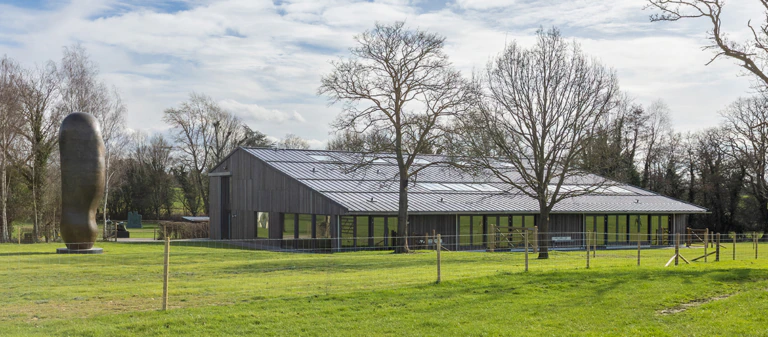
A new 570 sq m gallery extension now juxtaposes the artists Vanessa Bell and Duncan Grant’s softer, hand-painted farmhouse interior. Inside the new gallery, the architectural lines are sharp and modern, which is fitting, considering every inch of the property is occupied by artists equipped with equally sharp agendas. Times change, but the place remains true to itself.
Bell moved into the late 16th-century farmhouse on the recommendation of her sister – Woolf – in 1916. She was joined by her lover, the painter Duncan Grant, who brought his boyfriend, the young writer David Garnett, with him. Bell’s sons, Julian and Quentin, also came along with their dog, Henry.
After living in London’s Bloomsbury area during the interwar period, they all returned to Charleston, including Bell’s husband, Clive, on the eve of the second world war. They would remain at Charleston for the rest of their lives, except for Julian, who was killed in the Spanish civil war in 1937. Grant’s painting of him hangs over Vanessa’s bed head.
It’s a queer old place. A painted acrobat bounces out of a once-broken door. There’s a squiggle on every surface, no lampshade is free of a frieze and no ordinary object appears to have stayed that way for long.
The house is bursting with works by Bell and Grant, their friends, lovers and the artists they admired. Resisting the cold, judgmental exterior world, these artists defied social convention by creating a progressive, self-contained community dedicated to queer living and loving.
Progressive programmes
Back to the present – on arrival, the modernity of the extension is not immediately noticeable as it sensitively preserves the original setting deep in the Sussex Downs. The feeling of this being a country retreat is of historical architectural significance, because Grant and Garnett were conscientious objectors who avoided conscription by working on a local farm. Charleston was a safe haven, occupied by the pacifist artists during both world wars.
Visitors follow the path away from the house and encounter two 18th-century farm buildings, which have been redeveloped by Julian Harrap Architects into an accessible restaurant and events space.
Also looming large is the distinctive new exhibition building designed by Jamie Fobert Architects, the firm that was responsible for the redevelopment of Tate St Ives. The £3m extension allows Charleston to present exhibitions and stay open all year round. It houses three modern galleries and a gift shop.
The writer Jeanette Winterson asserts that Orlando was “far ahead of its time in terms of gender politics and gender progress”. The programme has been curated by Darren Clarke, the Rausing head of collections, research and exhibitions at Charleston, and showcases the promise by the director Nathaniel Hepburn: “Much like the artists who lived here, our programme will be radical, unconventional and international.”
Clarke has put Bell and Grant’s The Famous Women Dinner Service, commissioned in 1932 by the British art historian Kenneth Clark and his wife Jane, on show for the first time in a museum. Tristram Hunt, the director of the Victoria and Albert Museum, London, describes the dinner service as combining “tradition with modernism, practicality with provocation, domesticity with depictions of power”.
Alternatively, you could just call it hilarious. The porcelain portraits of 50 internationally infamous women are the perfect complement to the exhibition Zanele Muholi: Faces and Phases (until 6 January), a selection of 84 remarkable photographic portraits of black South African lesbians and trans men who stare out in defiance of the country’s stigmatisation of LGBTQIA+ people.
Raising visibility
The exhibition Orlando at the Present Time displays historic paintings and artefacts from Charleston’s 6,000-object collection, alongside new and existing works by Sussex artists.
These include the film-maker Paul Kindersley’s response to Cornelius Nuie’s portrait of The Two Sons of Edward, the fourth earl of Dorset, c.1610 – which, incidentally, was one of the works selected by Woolf and her lover Vita Sackville-West to illustrate the first edition of Orlando, which is also on show – and rollicking, reappropriated embroideries by the artist Matt Smith from his Trouble with History series.
The artist Delaine Le Bas’s bricolage of everyday objects splayed across the floor in the far corner of the gallery is noteworthy. In a powerful visual statement, she has casually stuck nude self-portraits, shot on site, to the gallery walls, consciously ignoring the formality of a frame.
In several of the images she is wearing a paper cutout of a naked male torso topped with a mask of the Hindu goddess Kali, destroyer of the (usually male) ego. It’s a direct response to Grant’s paper silhouette of a naked female Spanish dancer that is displayed alongside a photo of him wearing it.
Delaine’s doubly regendered body is left discarded lifeless on the floor, nothing more than a naively painted piece of paper. Its gender – a deliberate construct that’s taken on and off – is only awakened through performance.
As exhibitions celebrating 50 years since the decriminalisation of homosexuality close across the UK, it is time for museums to use their collections to raise the visibility of LGBTQIA+ history.
Charleston could not possibly have ignored its own – it’s at the heart of its story. The venue tells this story exceedingly well. It engages its own Bloomsbury spirit with contemporary local, national and international art that tackles queer experience and gender non-conformity through a modern lens.
Charleston has re-emerged in a new skin, as ready as Orlando ever was to go “from deed to deed, from glory to glory”. But what it must also now focus on is whether or not, a century later, it replicates its original guest list of elite intelligentsia.
There didn’t appear to be any other queers on the tour I attended, or people of colour. But it’s early days yet and there’s time for the nature of the audience to transition. Who knows what might happen next.
E-J Scott is a dress historian and queer cultural producer who curated the Museum of Transology, which runs at Brighton Museum & Art Gallery until May 2019
Project data
- Cost £8m
- Main funders Heritage Lottery Fund; Arts Council England
- Architects Julian Harrap Architects; Jamie Fobert Architects
- Landscaping Tom Stuart Smith
- Main contractor Durtnell
- Interpretation Charleston
- Display cases ClickNetherfield
- Film Paul Kindersley; Belmacz Gallery
- AV Wayne McGregor; Royal Opera House; Sally Potter
- Admission Adult £11; Child £5.50