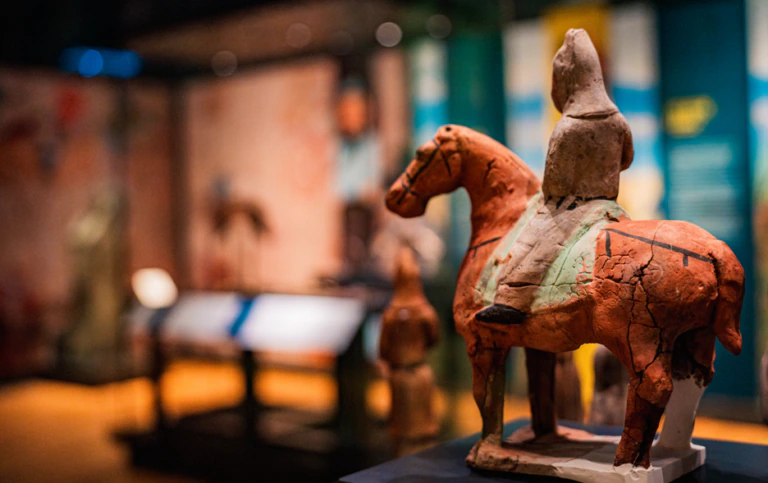
Animal and human remains, magical objects, medieval manuscripts and silk ectoplasm, supposedly exuded by a 20th-century medium, all make up this enlightening exhibition about the history of magic.
Spellbound: Magic, Ritual & Witchcraft at the Ashmolean Museum in Oxford (until 6 January 2019) tells the fascinating story of magic over eight centuries via a vast array of curios, as well as everyday items, prints, paintings, contemporary art installations and jewellery.
A broad selection of about 200 exhibits – including several new art commissions in tapestry, sculpture, video and sound – are on display, with numerous loans from Oxford museums and libraries, as well as institutions across the UK. Noticeably, though, the exhibition largely focuses on western Europe and the UK, with only occasional objects from non-European cultures.
The path through the exhibition is straightforward, with an introductory space followed by three main rooms, each evoking a different mood. The opening text intriguingly invites visitors to consider the “magical thinking” – such as superstitious beliefs – firmly linking the predominantly historical content with our – sometimes odd – contemporary concerns and behaviours.
In the introductory room a tiny glass-stoppered bottle is displayed alone in a freestanding case. It was collected in the early 20th century, along with an accompanying story that a witch had been caught inside and that opening the bottle would release “a peck o’ trouble”. The bottle has never been opened and visitors are immediately encouraged to ponder their own beliefs: could a witch be trapped in the bottle? Why would someone think it was? Would you dare to open it?
Superstition is brought directly into play with a ladder fixed diagonally across the entrance to the exhibition. Should you walk under it or around it? Every visitor is forced to confront their own superstitions with this graphic exhibit. After a start like this, it’s hard to not have one’s curiosity piqued.
Medieval beliefs
The theme in the first room is “how to live well in a complex world”. Its mood is created through dim lighting and the output from a medieval jukebox, an interactive exhibit playing music inspired by magical talismans, which ensures a constant background hum of new-age sound. Medieval magical beliefs, including astrology and ritual magic, are presented alongside a wall of love padlocks removed from a bridge in Leeds.
The theme of the second room is “protection against magic”. The centrepiece is a display of objects found embedded in buildings, at least some of which – such as animal hearts pierced with nails – were placed there as protective charms.
These are displayed around and inside a towering black structure designed to evoke the chimneys in which some of the objects were once hidden. Interpretation is displayed on the walls away from the exhibits, encouraging visitors to decide for themselves the possible identifications and magical meanings of objects ranging from a dead cat to train timetables.
At one end of the room is the installation Concealed Shield by contemporary artist Katherine Dawson. This creepy, unsettling work evokes the sounds and sights that exist on the edge of consciousness. This work makes explicit the sensation already created by the design of the rest of the space: in this room we are invited to explore the magic of the physical home, but also our own psychological reactions to it.
The last room is utterly different in character. It focuses almost entirely on witchcraft, specifically on the supposed witches, witch-hunts and trials of the 16th and 17th centuries. This is a brightly-lit gallery space, with two installations in the centre of the room, but one dominates – an audio dramatisation of documents from 17th-century witchcraft cases in East Anglia.
The sound permeates the room, and with the combination of the starkly presented exhibits and reported testimonies of women, this delivers the strongest emotional punch of the show.
The question of why people turned to magical thinking – and still do – is less obvious here than elsewhere in the show. The interpretation informs visitors that 100,000 people were killed in witch-hunts between 1400 and 1800, but the underlying sociological causes for the persecution and slaughter of so many people, most of them women, are barely raised, which I found troubling.
However, a feminist angle is introduced by the contemporary artist Annie Cattrell with her work Verocity, which is composed of branded wooden domestic objects with various magical symbols.
Memorable experience
The show also includes numerous fine-art prints depicting women as witches, as well as a replica of scales that were used to weigh the accused. (A witch would supposedly weigh much less than a normal not-guilty person.)
The items on display and the way they are presented invites visitors to contemplate the horror of the events, but I think greater interpretative engagement with the issue would have been useful.
The perception of women, and their relation to beliefs in witchcraft, would have given more context to the brutal images and stories on display, particularly, because of our age- old search for scapegoats, but also because the depiction of women is an issue that has profound contemporary relevance.
The exhibition is well designed and displayed with a range of mounting techniques used to show objects individually and in carefully assembled groups.
The impressive breadth of items shows that a belief in something beyond the here and now has had a long and powerful pull on the human psyche.
But a deeper exploration of the sociology behind the belief in and use of magic, ritual and witchcraft would have contributed to a richer experience and understanding of the exhibition. Nonetheless, the varied moods evoked throughout make it a memorable experience, and the power of the objects alone leaves visitors with much to contemplate.
Katie Birkwood is the rare books and special collections librarian at the Royal College of Physicians, London
Project data
Cost Undisclosed
Main funders Wellcome Trust; Bagri Foundation; University of East Anglia
Exhibition design Stanton Williams; Ashmolean
Graphic design Ashmolean Interpretation Ashmolean Audiovisual Ashmolean Lighting Ashmolean
Display cases Ashmolean
Exhibition ends 6 January 2019
Admission Adult peak £12.25; Adult off-peak £9; Concessions peak £11.25; Concessions off-peak £8