The newly reopened D-Day Story in Portsmouth has a deft tagline: “The epic made personal, the personal made epic.” The museum, which reopened at the end of March following a £4m redevelopment supported by the Heritage Lottery Fund, has shifted its emphasis from facts and figures to the human stories behind the allied invasion of Normandy, codenamed Operation Overlord by allied forces.
It has also distilled its narrative, stripping away much of the general world war two material it displayed before. What remains is a wealth of locally sourced information, reflecting Portsmouth’s vital role as the main port from which allied troops departed to France. All the objects displayed have a story behind them or a direct link to the events that took place.
Alongside this interpretive rethink, the museum’s 1980s building has undergone a complete overhaul, with a new facade, interior, cafe and learning room. Located in a squat, red-brick building overlooking the city’s harbour, the museum looked decidedly dated in pre-renovation pictures, but a new glass facade and open-plan atrium give it a contemporary feel. All the steps in the building have been replaced with wide, gently sloping ramps, a wheelchair-friendly layout that gives the entrance hall a sense of flow.
A special mention must go to the museum’s ingenious new branding: at first glance its logo, a large black “D” superimposed on a yellow background, looks like it has been rendered violently in two by a gunshot or explosion. It takes a few seconds for the brain to realise that it depicts the two opposing coastlines of Britain and France, and that those small dots aren’t debris from a blast but thousands of tiny ships swarming around the shorelines of each country. It’s a clever visual trick that should please visitors.
Everyday heroes
The exhibition has been divided into three sections: Preparation; D-Day and the Battle of Normandy; and Legacy and the Overlord Embroidery. Visitors enter through a short corridor punctuated by the sound of contemporaneous news bulletins about the allied invasion, effectively setting the scene for what comes next.
First up there’s a brief introduction to some of the main players behind Operation Overlord – the prime minister Winston Churchill, the allied land forces commander Field Marshal Bernard Montgomery (whose beret is one of the museum’s most popular exhibits), the American commander of the supreme headquarters allied expeditionary force General Dwight Eisenhower, among others. But this is the only time those big names are mentioned as primary billing goes to the people on the ground – soldiers, RAF men, Wrens – as well as the residents of Portsmouth, whose lives were disrupted by the massive war machine being built around them.
Trinkets on display tell of the friendships struck up between troops and locals, such as a little girl’s coat sewn with 89 badges that she collected from the allied troops stationed in the city.
From there, the exhibition moves on to the more logistical side of the preparations, taking visitors through the problem-solving, training and reconnaissance involved in planning a ground invasion of such magnitude. The museum does a good job of capturing the madcap ingenuity of some of the equipment – there’s an original model of a Hobarts Funny, a tank surrounded by inflatable canvas so it could be floated to shore incognito.
The interpretation avoids weighing visitors down with technical detail, but I did feel that, in parts, a little more information could have been provided for those who wished to delve deeper. For example, the extraordinary mulberry harbours – huge floating pontoons that enabled the allies to land on the beaches of Normandy rather than a French port, as the Germans were expecting – were a crucial part of the D-Day story, but only get a brief mention.
Large military equipment, including a rare beach armoured recovery vehicle, is displayed sparingly throughout and doesn’t overpower the exhibition floor. The museum shows a thoughtful approach to accessibility: beautifully detailed brass models allow visually impaired visitors to explore large vehicles by touch. The gallery also features a series of problem-solving interactive games that should appeal to younger visitors, who can guess which tank to use on various terrains, or try to stack wooden blocks on a boat without making it capsize.
The main event
The venue has also added some memorable new commissions. A diorama of the Atlantic Wall defences – made of fibreglass coated in brass resin – gives visitors an ominous view of what a D-Day soldier would have seen approaching the shore: Czech hedgehogs (anti-tank obstacles), steep sand dunes, and rows of barbed wire. It’s both an educational tool and a piece of art in its own right.
The exhibition moves on to the main event, the beach landings of 6 June 1944 and the subsequent Battle of Normandy. Along the way, it skilfully heightens the tension: visitors pass through a military tent the night before battle, featuring projections of soldiers praying and sharing their thoughts and fears. We then enter the largest exhibition room, where a landing craft with its ramp down forms a dramatic centrepiece. A light projection shows a row of men sitting aboard the craft, waiting to disembark, while sound effects set the scene of the battlefield. These are used judiciously and don’t feel intrusive in the rest of the gallery space. The intense atmosphere is enhanced by low lighting and a dark greyish-blue colour scheme.
There are more clever design features here – the display cases are arranged in a haphazard pattern that, on closer inspection, follows a map of the Normandy coastline with its five landing beaches. Each beach gets its own case, complete with objects and stories linked to that location. This gives visitors an easily digestible view of the geography of the landings. Personal stories are again drawn out – a homemade 21st birthday card is a moving reminder of the youth of the men in the landing craft.
The next room features a specially commissioned mural featuring a field hospital surrounded by distinctive bocage camouflage netting. Machine guns and other weapons are displayed on one wall, with medical equipment on the opposing one, creating a visual link between the two. This display feels sanitised and does not quite capture the brutal carnage of the landings (5,000 allied troops died on the beaches on D-Day alone), although it is understandably hard for a family-friendly venue to be too graphic.
Star attraction
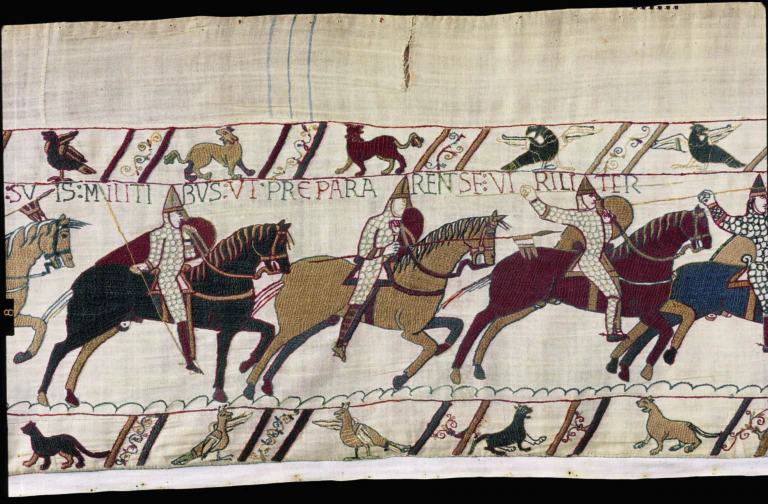
After leaving this space, there’s a change in tone: visitors cross the entrance hall and enter a circular room that houses the museum’s other star attraction, the Overlord Embroidery. Inspired by the Bayeux tapestry – which shows the events leading up to the Norman takeover of England – the 83-metre, hand-stitched embroidery piece was created in the 1970s by the artist Sandra Lawrence and a team of needleworkers for the 30th anniversary of D-Day. New lighting and more accessible interpretation panels have been added to the existing display case, making it easy to follow the genesis of this incredible artwork.
Alongside the embroidery, the gallery explores the legacy of the landings, showing clips of veterans and objects relating to grief and loss. A bright room in the centre of the circular building tells how the embroidery was created and gives visitors a chance to craft their own designs. It is a gentle way of rounding off the exhibition and transporting visitors back to the present day.
Occasionally, I felt some parts of the story were missing in the exhibition: we do hear a little about how the French responded to the invasion and we see identity cards belonging to German soldiers, which were taken from their dead bodies by allied troops – a tricky subject that’s worth exploring further. But it would have been good to hear their perspectives in more detail.
But these are minor niggles. The museum offers an engrossing account of an epic wartime story, and its decision to focus on the human angle has paid off. Visitors leave not with a sense of military bombast, but with a poignant impression of ordinary lives upended by extraordinary times.
Project data
Cost £5m
Main funders Heritage Lottery Fund; Portsmouth City Council
Exhibition design Studio MB
Graphic design Studio MB
It has also distilled its narrative, stripping away much of the general world war two material it displayed before. What remains is a wealth of locally sourced information, reflecting Portsmouth’s vital role as the main port from which allied troops departed to France. All the objects displayed have a story behind them or a direct link to the events that took place.
Alongside this interpretive rethink, the museum’s 1980s building has undergone a complete overhaul, with a new facade, interior, cafe and learning room. Located in a squat, red-brick building overlooking the city’s harbour, the museum looked decidedly dated in pre-renovation pictures, but a new glass facade and open-plan atrium give it a contemporary feel. All the steps in the building have been replaced with wide, gently sloping ramps, a wheelchair-friendly layout that gives the entrance hall a sense of flow.
A special mention must go to the museum’s ingenious new branding: at first glance its logo, a large black “D” superimposed on a yellow background, looks like it has been rendered violently in two by a gunshot or explosion. It takes a few seconds for the brain to realise that it depicts the two opposing coastlines of Britain and France, and that those small dots aren’t debris from a blast but thousands of tiny ships swarming around the shorelines of each country. It’s a clever visual trick that should please visitors.
Everyday heroes
The exhibition has been divided into three sections: Preparation; D-Day and the Battle of Normandy; and Legacy and the Overlord Embroidery. Visitors enter through a short corridor punctuated by the sound of contemporaneous news bulletins about the allied invasion, effectively setting the scene for what comes next.
First up there’s a brief introduction to some of the main players behind Operation Overlord – the prime minister Winston Churchill, the allied land forces commander Field Marshal Bernard Montgomery (whose beret is one of the museum’s most popular exhibits), the American commander of the supreme headquarters allied expeditionary force General Dwight Eisenhower, among others. But this is the only time those big names are mentioned as primary billing goes to the people on the ground – soldiers, RAF men, Wrens – as well as the residents of Portsmouth, whose lives were disrupted by the massive war machine being built around them.
Trinkets on display tell of the friendships struck up between troops and locals, such as a little girl’s coat sewn with 89 badges that she collected from the allied troops stationed in the city.
From there, the exhibition moves on to the more logistical side of the preparations, taking visitors through the problem-solving, training and reconnaissance involved in planning a ground invasion of such magnitude. The museum does a good job of capturing the madcap ingenuity of some of the equipment – there’s an original model of a Hobarts Funny, a tank surrounded by inflatable canvas so it could be floated to shore incognito.
The interpretation avoids weighing visitors down with technical detail, but I did feel that, in parts, a little more information could have been provided for those who wished to delve deeper. For example, the extraordinary mulberry harbours – huge floating pontoons that enabled the allies to land on the beaches of Normandy rather than a French port, as the Germans were expecting – were a crucial part of the D-Day story, but only get a brief mention.
Large military equipment, including a rare beach armoured recovery vehicle, is displayed sparingly throughout and doesn’t overpower the exhibition floor. The museum shows a thoughtful approach to accessibility: beautifully detailed brass models allow visually impaired visitors to explore large vehicles by touch. The gallery also features a series of problem-solving interactive games that should appeal to younger visitors, who can guess which tank to use on various terrains, or try to stack wooden blocks on a boat without making it capsize.
The main event
The venue has also added some memorable new commissions. A diorama of the Atlantic Wall defences – made of fibreglass coated in brass resin – gives visitors an ominous view of what a D-Day soldier would have seen approaching the shore: Czech hedgehogs (anti-tank obstacles), steep sand dunes, and rows of barbed wire. It’s both an educational tool and a piece of art in its own right.
The exhibition moves on to the main event, the beach landings of 6 June 1944 and the subsequent Battle of Normandy. Along the way, it skilfully heightens the tension: visitors pass through a military tent the night before battle, featuring projections of soldiers praying and sharing their thoughts and fears. We then enter the largest exhibition room, where a landing craft with its ramp down forms a dramatic centrepiece. A light projection shows a row of men sitting aboard the craft, waiting to disembark, while sound effects set the scene of the battlefield. These are used judiciously and don’t feel intrusive in the rest of the gallery space. The intense atmosphere is enhanced by low lighting and a dark greyish-blue colour scheme.
There are more clever design features here – the display cases are arranged in a haphazard pattern that, on closer inspection, follows a map of the Normandy coastline with its five landing beaches. Each beach gets its own case, complete with objects and stories linked to that location. This gives visitors an easily digestible view of the geography of the landings. Personal stories are again drawn out – a homemade 21st birthday card is a moving reminder of the youth of the men in the landing craft.
The next room features a specially commissioned mural featuring a field hospital surrounded by distinctive bocage camouflage netting. Machine guns and other weapons are displayed on one wall, with medical equipment on the opposing one, creating a visual link between the two. This display feels sanitised and does not quite capture the brutal carnage of the landings (5,000 allied troops died on the beaches on D-Day alone), although it is understandably hard for a family-friendly venue to be too graphic.
Star attraction
After leaving this space, there’s a change in tone: visitors cross the entrance hall and enter a circular room that houses the museum’s other star attraction, the Overlord Embroidery. Inspired by the Bayeux tapestry – which shows the events leading up to the Norman takeover of England – the 83-metre, hand-stitched embroidery piece was created in the 1970s by the artist Sandra Lawrence and a team of needleworkers for the 30th anniversary of D-Day. New lighting and more accessible interpretation panels have been added to the existing display case, making it easy to follow the genesis of this incredible artwork.
Alongside the embroidery, the gallery explores the legacy of the landings, showing clips of veterans and objects relating to grief and loss. A bright room in the centre of the circular building tells how the embroidery was created and gives visitors a chance to craft their own designs. It is a gentle way of rounding off the exhibition and transporting visitors back to the present day.
Occasionally, I felt some parts of the story were missing in the exhibition: we do hear a little about how the French responded to the invasion and we see identity cards belonging to German soldiers, which were taken from their dead bodies by allied troops – a tricky subject that’s worth exploring further. But it would have been good to hear their perspectives in more detail.
But these are minor niggles. The museum offers an engrossing account of an epic wartime story, and its decision to focus on the human angle has paid off. Visitors leave not with a sense of military bombast, but with a poignant impression of ordinary lives upended by extraordinary times.
Project data
Cost £5m
Main funders Heritage Lottery Fund; Portsmouth City Council
Exhibition design Studio MB
Graphic design Studio MB
Lighting Studio MB; Nich Smith Lighting
AV content Studio MB; AY-PE
AV hardware Studio MB with Douglas Bolton; Sysco
AV content Studio MB; AY-PE
AV hardware Studio MB with Douglas Bolton; Sysco
Display cases Click Netherfield
Admission Free for MA members
Admission Free for MA members