The International Bomber Command Centre (IBCC), with its mission of being a point of “recognition, reflection and remembrance” of the operations and crews of Bomber Command during world war two, is the culmination of a project that began in 2009. The then Lord-Lieutenant of Lincolnshire, Tony Worth, formed a trust to work towards building a memorial to Bomber Command and to commemorate the role of Lincolnshire, which became known as the “bomber county”, in the war. Sadly, Worth died just seven weeks before the centre opened on 30 January this year.
The first impression of the newly built Chadwick Centre building is of a fitting, if surprisingly modern, memorial to the 55,000 air crew (and those associated with them) who were killed during the conflict. Visitors enter an airy atrium, where large windows give a palpable sense of its geographical context, with views over Lincoln and neighbouring agricultural land. Around 400 sq miles of similar land were used as airfields at the outbreak of war. It is impossible to miss the Spire, a memorial to the Bomber Command crew who lost their lives. It is the tallest war memorial in the UK at 102ft, which is the wing span of a Lancaster bomber.
The visitor centre has all the up-to-date facilities one would expect and is a welcoming space. The experience begins with an informative series of films that introduces the causes of the second world war and the conditions that led to large-scale bombing by both sides in a succinct way. The films make excellent use of archive footage and photographs, and all the narration is subtitled. A welcome realisation is that the centre acknowledges the controversial legacy of Bomber Command and the suffering on both sides of the conflict.
Time to remember
After the films, visitors are encouraged to follow a timeline in the main exhibition space of a bomber crew’s day. The timeline is interesting but text-heavy, and it is easy to be distracted by other content in the room. At several stations, video screens show full-height projections of historical characters – air and ground crew, men and women – who engage visitors in a striking way, using stories of the people who experienced the conflict.
Their striking youth and vitality is what hits home: bomber crew members were usually in their early 20s and many did not return from missions. This is conveyed more effectively through these moving, speaking characters than it ever could be through static archive photographs.
This space is a repository of stories, with more to explore and understand at the touch of a button or turn of a dial. Vintage telephones play oral history recordings, while audio handsets with further oral histories are found beneath object displays. The centre has a remit to tell the stories of all those involved in Bomber Command during the war and, if anything, it is perhaps a little too effective, as all the narratives vie for visitor attention.
While the quantity and quality of recorded histories is impressive, it is unlikely that many people will have the patience to engage with the full breadth of them, especially since listening to an audio handset – only one per station – can be an isolating experience. Several audiovisual presentations in this space compete to be heard despite some directional speakers and sensor activation, and visitors sensitive to noise might struggle here.
At regular intervals, the gallery fades into darkness and a spectacular AV display begins. This uses a large screen for the main presentation, but integrates the other screens, lighting effects on the ceiling and an impressive surround-sound system. The rumbling of bomber engines and explosions create a dramatic atmosphere, but could frighten younger visitors.
Glancing up, you might see the silhouettes of bombers above shortly before the room is cast in the glow of the flames of a burning city. This is an immersive experience, with emotional learning at its heart. It brings home the terrifying reality of the bombing raids. At other times, the large screen displays a graphic of all the bombing raids in Europe, condensed into 10 minutes. The resulting constellation of bright dots, each one representing a real raid, is perhaps the most moving installation and conveys the scale of Bomber Command operations.
Commanding questions
The needs of children have also been considered in this space: there is an interactive touchscreen that allows them to put together a bomber crew, as well as a traditional jigsaw of a plane. They will also enjoy the vintage telephones and video displays.
Upstairs there is a gallery about the home front. This is a smaller space with fewer interactives, but it still presents compelling stories. It has a more traditional exhibition format, which is a bit of an anti-climax after the immersive experience downstairs. But it makes excellent use of video in telling the stories of characters such as a conscripted female factory worker and a ground crew apprentice. A magnetic guessing game about wartime slang is a good family talking point.
In the final section, in a mezzanine space, interpretation panels reflect on memorialising Bomber Command, noting how the legacy has been controversial, influenced by fiction and national narratives. Bomber Command has been perceived as both the height of national glory and the darkest part of the British war effort, something to be quietly forgotten, which is demonstrated by the fact that there was no national memorial until 2012. The centre’s final question for visitors is “Can bombing ever be justified?” It is a mark of how well-judged the exhibitions are that the centre does not provide answers, but leaves visitors informed enough to ponder the issue.
In all three main exhibition spaces, the IBCC is light on object displays, with only a few – such as an airman’s boots and lucky charms from a cockpit – presented. They are labelled well but, more importantly, are explicitly linked to the oral histories that play from their pedestals. This is not a museum of things, but of stories. Those looking for artefacts or a traditional museum could be disappointed. But that would be missing the point of the IBCC.
The landscaping is an important part of the experience and the gardens are designed for reflection. The Spire is a stunning memorial and is surrounded by walls displaying the names of the crew who were lost. There is also the Ribbon of Remembrance, which is made from bricks that visitors can order from the centre and have engraved with messages of remembrance. The site includes two peace gardens with trees to represent each bomber base in Lincolnshire, along with plaques noting their losses.
The IBCC is more than just a museum and requires visitors to get immersed in its stories. Although it does ask important questions about war, this does not take away from its overriding purpose of remembrance.
Rebecca Morris-Buck is a freelance writer
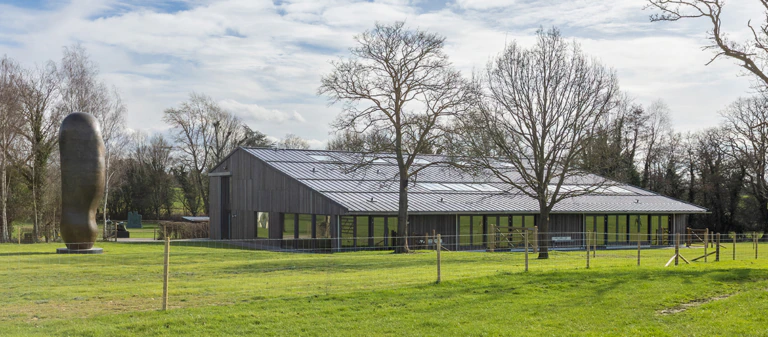
The design concept for the Chadwick Centre is of an over-sailing wing fragment roof referencing a heavy bomber wing, which visually connects with the Spire memorial. The building has been named after Roy Chadwick, the designer of the Lancaster Bomber, a plane that had a great impact on the outcome of the war. It is a design that became a blueprint for many future aircraft.
The Chadwick Centre has been designed to be low maintenance and energy efficient, and to act as a foil to all the activities held in it. Low running costs were an essential element in its development to ease the burden on donations and income in the future. The building is equipped with solar panels, air-source heating pumps and intelligent fresh-air systems, all of which will reduce not only the bills but also its environmental impact.
The Spire celebrates flight and the connection between earth and sky, while signifying the destruction of war by its intrinsic material construction – it is formed of two wing fragments that taper as they rise towards the sky, connected by two perforated linking plates. The rear wing is five metres higher than the front one, visually fragmenting the memorial at its apex and dissolving into the sky.
The memorial is surrounded by a series of walls in fractured concentric circles, which hold the names of the 58,000 that lost their lives serving in Bomber Command during the second world war. The fragments are set in a landscape that echoes the wartime airfields of Lincolnshire, with the memorial approached along an avenue that crosses this landscape from the enclosure of the Chadwick Centre, evoking the journeys of the aircrew crossing to their aircraft at the start of a mission.
Both elements of the memorial are made from Corten steel plate, an alloyed steel that forms a patina preventing corrosion, giving the memorial an almost indefinite, maintenance-free lifespan. The walls are set in bound gravel broken up with wildflower areas and curved seating and hedges.
Stephen Palmer is the director of Place Architecture
Main funders Garfield Weston; Heritage Lottery Fund; Biffa Award, Wren FCC Community Action Fund; Foyle Foundation; Libor; North Kesteven District Council
Architecture and exhibition design Place Architecture
Exhibition design Redman Design
Graphic design Redman Design
Lighting Sutton Vane
Display cases The Hub
Exhibition fitout The Hub
Audiovisual design Centre Screen
Admission Adults £8.20 on the door, £7.20 in advance. Charge only applies to exhibition as the rest of the site is free
The first impression of the newly built Chadwick Centre building is of a fitting, if surprisingly modern, memorial to the 55,000 air crew (and those associated with them) who were killed during the conflict. Visitors enter an airy atrium, where large windows give a palpable sense of its geographical context, with views over Lincoln and neighbouring agricultural land. Around 400 sq miles of similar land were used as airfields at the outbreak of war. It is impossible to miss the Spire, a memorial to the Bomber Command crew who lost their lives. It is the tallest war memorial in the UK at 102ft, which is the wing span of a Lancaster bomber.
The visitor centre has all the up-to-date facilities one would expect and is a welcoming space. The experience begins with an informative series of films that introduces the causes of the second world war and the conditions that led to large-scale bombing by both sides in a succinct way. The films make excellent use of archive footage and photographs, and all the narration is subtitled. A welcome realisation is that the centre acknowledges the controversial legacy of Bomber Command and the suffering on both sides of the conflict.
Time to remember
After the films, visitors are encouraged to follow a timeline in the main exhibition space of a bomber crew’s day. The timeline is interesting but text-heavy, and it is easy to be distracted by other content in the room. At several stations, video screens show full-height projections of historical characters – air and ground crew, men and women – who engage visitors in a striking way, using stories of the people who experienced the conflict.
Their striking youth and vitality is what hits home: bomber crew members were usually in their early 20s and many did not return from missions. This is conveyed more effectively through these moving, speaking characters than it ever could be through static archive photographs.
This space is a repository of stories, with more to explore and understand at the touch of a button or turn of a dial. Vintage telephones play oral history recordings, while audio handsets with further oral histories are found beneath object displays. The centre has a remit to tell the stories of all those involved in Bomber Command during the war and, if anything, it is perhaps a little too effective, as all the narratives vie for visitor attention.
While the quantity and quality of recorded histories is impressive, it is unlikely that many people will have the patience to engage with the full breadth of them, especially since listening to an audio handset – only one per station – can be an isolating experience. Several audiovisual presentations in this space compete to be heard despite some directional speakers and sensor activation, and visitors sensitive to noise might struggle here.
At regular intervals, the gallery fades into darkness and a spectacular AV display begins. This uses a large screen for the main presentation, but integrates the other screens, lighting effects on the ceiling and an impressive surround-sound system. The rumbling of bomber engines and explosions create a dramatic atmosphere, but could frighten younger visitors.
Glancing up, you might see the silhouettes of bombers above shortly before the room is cast in the glow of the flames of a burning city. This is an immersive experience, with emotional learning at its heart. It brings home the terrifying reality of the bombing raids. At other times, the large screen displays a graphic of all the bombing raids in Europe, condensed into 10 minutes. The resulting constellation of bright dots, each one representing a real raid, is perhaps the most moving installation and conveys the scale of Bomber Command operations.
Commanding questions
The needs of children have also been considered in this space: there is an interactive touchscreen that allows them to put together a bomber crew, as well as a traditional jigsaw of a plane. They will also enjoy the vintage telephones and video displays.
Upstairs there is a gallery about the home front. This is a smaller space with fewer interactives, but it still presents compelling stories. It has a more traditional exhibition format, which is a bit of an anti-climax after the immersive experience downstairs. But it makes excellent use of video in telling the stories of characters such as a conscripted female factory worker and a ground crew apprentice. A magnetic guessing game about wartime slang is a good family talking point.
In the final section, in a mezzanine space, interpretation panels reflect on memorialising Bomber Command, noting how the legacy has been controversial, influenced by fiction and national narratives. Bomber Command has been perceived as both the height of national glory and the darkest part of the British war effort, something to be quietly forgotten, which is demonstrated by the fact that there was no national memorial until 2012. The centre’s final question for visitors is “Can bombing ever be justified?” It is a mark of how well-judged the exhibitions are that the centre does not provide answers, but leaves visitors informed enough to ponder the issue.
In all three main exhibition spaces, the IBCC is light on object displays, with only a few – such as an airman’s boots and lucky charms from a cockpit – presented. They are labelled well but, more importantly, are explicitly linked to the oral histories that play from their pedestals. This is not a museum of things, but of stories. Those looking for artefacts or a traditional museum could be disappointed. But that would be missing the point of the IBCC.
The landscaping is an important part of the experience and the gardens are designed for reflection. The Spire is a stunning memorial and is surrounded by walls displaying the names of the crew who were lost. There is also the Ribbon of Remembrance, which is made from bricks that visitors can order from the centre and have engraved with messages of remembrance. The site includes two peace gardens with trees to represent each bomber base in Lincolnshire, along with plaques noting their losses.
The IBCC is more than just a museum and requires visitors to get immersed in its stories. Although it does ask important questions about war, this does not take away from its overriding purpose of remembrance.
Rebecca Morris-Buck is a freelance writer
Focus on: Architecture
The site of the International Bomber Command Centre (IBCC) comprises three parts, the Chadwick Centre in the middle, which houses the museum, the Spire memorial, which is linked to the museum via the Memorial Avenue, and two Peace Gardens.The design concept for the Chadwick Centre is of an over-sailing wing fragment roof referencing a heavy bomber wing, which visually connects with the Spire memorial. The building has been named after Roy Chadwick, the designer of the Lancaster Bomber, a plane that had a great impact on the outcome of the war. It is a design that became a blueprint for many future aircraft.
The Chadwick Centre has been designed to be low maintenance and energy efficient, and to act as a foil to all the activities held in it. Low running costs were an essential element in its development to ease the burden on donations and income in the future. The building is equipped with solar panels, air-source heating pumps and intelligent fresh-air systems, all of which will reduce not only the bills but also its environmental impact.
The Spire celebrates flight and the connection between earth and sky, while signifying the destruction of war by its intrinsic material construction – it is formed of two wing fragments that taper as they rise towards the sky, connected by two perforated linking plates. The rear wing is five metres higher than the front one, visually fragmenting the memorial at its apex and dissolving into the sky.
The memorial is surrounded by a series of walls in fractured concentric circles, which hold the names of the 58,000 that lost their lives serving in Bomber Command during the second world war. The fragments are set in a landscape that echoes the wartime airfields of Lincolnshire, with the memorial approached along an avenue that crosses this landscape from the enclosure of the Chadwick Centre, evoking the journeys of the aircrew crossing to their aircraft at the start of a mission.
Both elements of the memorial are made from Corten steel plate, an alloyed steel that forms a patina preventing corrosion, giving the memorial an almost indefinite, maintenance-free lifespan. The walls are set in bound gravel broken up with wildflower areas and curved seating and hedges.
Stephen Palmer is the director of Place Architecture
Project data
Cost £10.4m Main funders Garfield Weston; Heritage Lottery Fund; Biffa Award, Wren FCC Community Action Fund; Foyle Foundation; Libor; North Kesteven District Council
Architecture and exhibition design Place Architecture
Exhibition design Redman Design
Graphic design Redman Design
Lighting Sutton Vane
Display cases The Hub
Exhibition fitout The Hub
Audiovisual design Centre Screen
Admission Adults £8.20 on the door, £7.20 in advance. Charge only applies to exhibition as the rest of the site is free