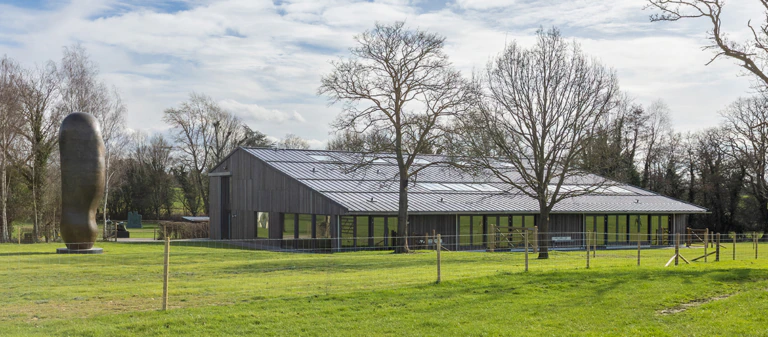
The first I thing noticed on arrival at Headstone Manor & Museum was not the manor house itself, but the new visitor centre, with its wood-clad walls and curved lower roof reaching up to a sharp apex, making it look like an inverted longship. I also noted the ample parking, the sense of space, the recent investment in the paving and benches, and the smart Headstone Manor logo on an introductory panel. The house itself is visible to the right beyond the moat. Directly ahead is the small barn, with a striking silver “Museum open” sign displayed on its doors.
I happened to visit the recently refurbished Headstone Manor Museum at lunchtime, so I headed straight to the cafe in the visitor centre. The building is lofty inside, with fluorescent tube lighting playfully hung vertically and plenty of seating. A series of interpretation panels on the rear wall gives an overview of the site and the recent restoration project. A cartoon duck called Bill jars slightly with the slick graphics, but it is an early sign that efforts have been made to welcome visitors of all ages.
Fuelled by a toastie and tea, I headed to the small barn, which is the entrance to the manor site proper. On a warmer day, I would have taken the time to enjoy the mix of new and ancient wood in the restored building frame. Bitter weather also kept me from watching much of the introductory video presentation (useful if you missed the panels in the visitor centre). The friendly duty manager said the video lasted nine minutes and what I saw looked well-produced, screened in an appealing triptych frame. But nearly 10 minutes felt like a long time to pause at the start of an intriguing site, cold weather or not.
Through the barn to the left is the granary, which was moved to Headstone from its original home at the nearby Pinner Park Farm in 1989. The granary has a new drop-in family space on the ground floor, but the activities are limited to crayons and rubbings. It felt more like an events space than an active part of the historic site, yet there was interpretation, with graphic panels along one wall featuring more of Bill the duck. The panels are aimed at children, though I was not sure of what age, because the volume of text, the activities and the height of the panels did not seem to be in sync.
The far side of the yard is dominated by the great barn. It was shut when I visited and was firmly pitched as a venue for hire. There is clearly great potential for earning income from events in such an attractive setting.
Too much text
Heading over the moat, I came to an unassuming door and met a welcoming volunteer as I stepped inside the manor house. The first room has a terrific block model of the house for visitors to take apart and rebuild, showing the various sections from different eras, though I couldn’t understand why it was at a height only teenagers and adults could enjoy.
This pattern of misjudged scale was repeated in the bakehouse room, where wooden vegetables were set on benches too high for my two-year-old (who I had brought along) to reach – he loves “chopping” wooden vegetables so it would have been perfect. It was also sad that the beautifully made dressing-up clothes were only fit for adults. There are some great ideas throughout this museum, but not all hit the mark.
The house is a delight: a rambling building in which great pleasure can be found by simply turning the next corner and enjoying the ancient beams, 20th-century wallpapers and Elizabethan painted patterns wherever they emerge. The best interpretation is in the singular panels focusing on a detail of the building, including the carefully written piece explaining the “G for golliwog” mentioned in some 1950s children’s alphabet wallpaper. The wallpaper has been left in situ, despite it including an image that many people will find offensive, as a record of an era of the house’s use.
There is a strong sense of the house being a place where people have lived and worked, and that the building has been added to through the ages, as seen in the interpretation. But the main panels have too much text. There are too many general facts about world events in the timelines and references to other places in Harrow that I didn’t know.
I was dimly aware of different interpretative trails and changing colour schemes, but I couldn’t follow them. And here is my main difficulty with Headstone: this remarkable site – a Scheduled Ancient Monument – is also trying to be the museum of Harrow. At the same time and in the same space. For me, it didn’t work.
Muddled history
The rooms follow different local-history beats: here second world war, there Victorian; here Georgian, there Tudor. But no room is wholly consistent with its designated theme. A Made in Harrow display on three significant local industries is spread over two rooms, one of which also has a bed frame stuck to the wall and a display of toys with no interpretation. In the room with the children’s wallpaper (a bedroom), the objects on display were kitchen equipment. Objects have labels that don’t make any connection to Harrow or Headstone. Maybe a truly local audience could latch on, but I felt muddled.
Where the interpretation uses the site rather than turning away from it, good things happen. A video panel of an actor-as-farmer describing the decline of farming at Headstone in the early 20th century is set between two windows. The view of the barns links perfectly to the script. A cheeky glass panel etched with dropped britches made a garderobe, or medieval toilet, both safe and silly.
My toddler and I finished in the medieval hall, which was the best essence of Headstone Manor: bigger than expected, full of detail, ancient and impressive.
Despite my gripes, I was charmed by the effort put into the restoration and development of a tremendous local asset. I hope there is enough post-project energy to keep refining the details of the presentation in order to attract the biggest possible audience.
Steve Gardam is the director of the Roald Dahl Museum and Story Centre, Buckinghamshire
Main funders Heritage Lottery Fund; Country Houses Foundation; Garfield Weston Foundation; Harrow Council
Architect Buttress Architects
Exhibition and graphic design Imagemakers
Interpretation Imagemakers; in-house
Lighting Buttress Architects; Max Fordham; Imagemakers
Display cases Hadley Interiors; Access Displays
Exhibition fitout Hadley Interiors
Audiovisual design Wide Sky Design
Admission Free
I happened to visit the recently refurbished Headstone Manor Museum at lunchtime, so I headed straight to the cafe in the visitor centre. The building is lofty inside, with fluorescent tube lighting playfully hung vertically and plenty of seating. A series of interpretation panels on the rear wall gives an overview of the site and the recent restoration project. A cartoon duck called Bill jars slightly with the slick graphics, but it is an early sign that efforts have been made to welcome visitors of all ages.
Fuelled by a toastie and tea, I headed to the small barn, which is the entrance to the manor site proper. On a warmer day, I would have taken the time to enjoy the mix of new and ancient wood in the restored building frame. Bitter weather also kept me from watching much of the introductory video presentation (useful if you missed the panels in the visitor centre). The friendly duty manager said the video lasted nine minutes and what I saw looked well-produced, screened in an appealing triptych frame. But nearly 10 minutes felt like a long time to pause at the start of an intriguing site, cold weather or not.
Through the barn to the left is the granary, which was moved to Headstone from its original home at the nearby Pinner Park Farm in 1989. The granary has a new drop-in family space on the ground floor, but the activities are limited to crayons and rubbings. It felt more like an events space than an active part of the historic site, yet there was interpretation, with graphic panels along one wall featuring more of Bill the duck. The panels are aimed at children, though I was not sure of what age, because the volume of text, the activities and the height of the panels did not seem to be in sync.
The far side of the yard is dominated by the great barn. It was shut when I visited and was firmly pitched as a venue for hire. There is clearly great potential for earning income from events in such an attractive setting.
Too much text
Heading over the moat, I came to an unassuming door and met a welcoming volunteer as I stepped inside the manor house. The first room has a terrific block model of the house for visitors to take apart and rebuild, showing the various sections from different eras, though I couldn’t understand why it was at a height only teenagers and adults could enjoy.
This pattern of misjudged scale was repeated in the bakehouse room, where wooden vegetables were set on benches too high for my two-year-old (who I had brought along) to reach – he loves “chopping” wooden vegetables so it would have been perfect. It was also sad that the beautifully made dressing-up clothes were only fit for adults. There are some great ideas throughout this museum, but not all hit the mark.
The house is a delight: a rambling building in which great pleasure can be found by simply turning the next corner and enjoying the ancient beams, 20th-century wallpapers and Elizabethan painted patterns wherever they emerge. The best interpretation is in the singular panels focusing on a detail of the building, including the carefully written piece explaining the “G for golliwog” mentioned in some 1950s children’s alphabet wallpaper. The wallpaper has been left in situ, despite it including an image that many people will find offensive, as a record of an era of the house’s use.
There is a strong sense of the house being a place where people have lived and worked, and that the building has been added to through the ages, as seen in the interpretation. But the main panels have too much text. There are too many general facts about world events in the timelines and references to other places in Harrow that I didn’t know.
I was dimly aware of different interpretative trails and changing colour schemes, but I couldn’t follow them. And here is my main difficulty with Headstone: this remarkable site – a Scheduled Ancient Monument – is also trying to be the museum of Harrow. At the same time and in the same space. For me, it didn’t work.
Muddled history
The rooms follow different local-history beats: here second world war, there Victorian; here Georgian, there Tudor. But no room is wholly consistent with its designated theme. A Made in Harrow display on three significant local industries is spread over two rooms, one of which also has a bed frame stuck to the wall and a display of toys with no interpretation. In the room with the children’s wallpaper (a bedroom), the objects on display were kitchen equipment. Objects have labels that don’t make any connection to Harrow or Headstone. Maybe a truly local audience could latch on, but I felt muddled.
Where the interpretation uses the site rather than turning away from it, good things happen. A video panel of an actor-as-farmer describing the decline of farming at Headstone in the early 20th century is set between two windows. The view of the barns links perfectly to the script. A cheeky glass panel etched with dropped britches made a garderobe, or medieval toilet, both safe and silly.
My toddler and I finished in the medieval hall, which was the best essence of Headstone Manor: bigger than expected, full of detail, ancient and impressive.
Despite my gripes, I was charmed by the effort put into the restoration and development of a tremendous local asset. I hope there is enough post-project energy to keep refining the details of the presentation in order to attract the biggest possible audience.
Steve Gardam is the director of the Roald Dahl Museum and Story Centre, Buckinghamshire
Project data
Cost £5.1mMain funders Heritage Lottery Fund; Country Houses Foundation; Garfield Weston Foundation; Harrow Council
Architect Buttress Architects
Exhibition and graphic design Imagemakers
Interpretation Imagemakers; in-house
Lighting Buttress Architects; Max Fordham; Imagemakers
Display cases Hadley Interiors; Access Displays
Exhibition fitout Hadley Interiors
Audiovisual design Wide Sky Design
Admission Free