“Austin Wright is possibly the best sculptor of whom you have never heard. He is well known here in Yorkshire, where he lived and worked for many years, but he did not make it onto the national stage like many of his contemporaries, such as Kenneth Armitage, or his earlier influences – Henry Moore and Barbara Hepworth.
The main reason Wright isn’t so well known is because he opted to stay in Yorkshire instead of going to London. He hit his artistic stride relatively late in life, so although he had a love for the local landscape, he also had family responsibilities that kept him in his home county.
Career-wise, Wright only really got going when he was awarded a Gregory Fellowship in sculpture at the University of Leeds in 1961, when he was 50 years old.
Prior to that, for many years Wright used to teach modern languages and do a bit of sculpture on the side. There’s a story about him going to meet Moore to get some advice. Moore apparently told him to “just get on with it”.
We start our exhibition in the late 1950s when Wright was producing small lead figures – some human forms, others more abstract – which was a typical postwar look.
When he came to Leeds, his work became bigger and bolder, vertical and more abstract, thanks to aluminium becoming his material of choice.
Working with aluminium was obviously an easier business than casting in concrete and lead, and Wright was pleased with its sheen in daylight.
Another influence was the work of Irene Manton, a botanist at the university and an art collector herself, who placed her favourite pictures alongside her electron microscope photographs of the internal structures of plants.
Wright was fascinated by this juxtaposition and you can see its influence in this work, which has elements of the interior of a growing plant with a stalk and seed pods blown up to a massive size.
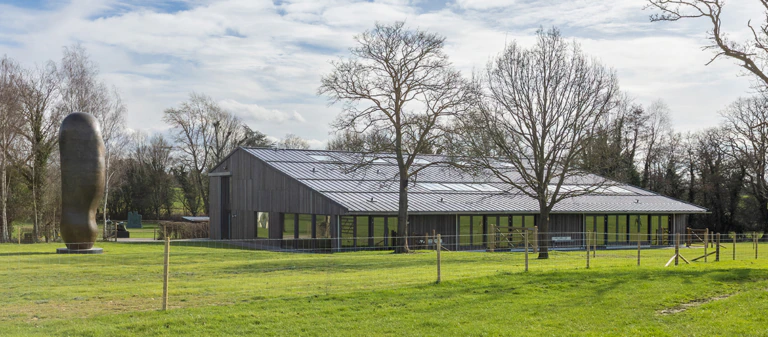
I’ve admired this piece ever since I saw it hanging in the music room at the Wright family home. I got to know his wife, Sue, when she gave us an important work, which is now installed as an outdoor sculpture in the university grounds.
Wallscape was one of Wright’s ‘sketches’ for a proposed three-dimensional sculpture he had been asked to design for the frontage of the old Leeds Art Gallery – a project that, unfortunately, never came to fruition.
However, there are a lot of Wright’s works in public spaces around the county, even though some pieces have not survived. For instance, one work that was installed after a lot of public debate at a site on the moors was vandalised and is believed to have fallen prey to metal thieves.”
Interview by John Holt. Austin Wright: Emerging Forms is at the Stanley & Audrey Burton Gallery, University of Leeds, until 17 March
The main reason Wright isn’t so well known is because he opted to stay in Yorkshire instead of going to London. He hit his artistic stride relatively late in life, so although he had a love for the local landscape, he also had family responsibilities that kept him in his home county.
Career-wise, Wright only really got going when he was awarded a Gregory Fellowship in sculpture at the University of Leeds in 1961, when he was 50 years old.
Prior to that, for many years Wright used to teach modern languages and do a bit of sculpture on the side. There’s a story about him going to meet Moore to get some advice. Moore apparently told him to “just get on with it”.
We start our exhibition in the late 1950s when Wright was producing small lead figures – some human forms, others more abstract – which was a typical postwar look.
When he came to Leeds, his work became bigger and bolder, vertical and more abstract, thanks to aluminium becoming his material of choice.
Working with aluminium was obviously an easier business than casting in concrete and lead, and Wright was pleased with its sheen in daylight.
Another influence was the work of Irene Manton, a botanist at the university and an art collector herself, who placed her favourite pictures alongside her electron microscope photographs of the internal structures of plants.
Wright was fascinated by this juxtaposition and you can see its influence in this work, which has elements of the interior of a growing plant with a stalk and seed pods blown up to a massive size.
I’ve admired this piece ever since I saw it hanging in the music room at the Wright family home. I got to know his wife, Sue, when she gave us an important work, which is now installed as an outdoor sculpture in the university grounds.
Wallscape was one of Wright’s ‘sketches’ for a proposed three-dimensional sculpture he had been asked to design for the frontage of the old Leeds Art Gallery – a project that, unfortunately, never came to fruition.
However, there are a lot of Wright’s works in public spaces around the county, even though some pieces have not survived. For instance, one work that was installed after a lot of public debate at a site on the moors was vandalised and is believed to have fallen prey to metal thieves.”
Interview by John Holt. Austin Wright: Emerging Forms is at the Stanley & Audrey Burton Gallery, University of Leeds, until 17 March