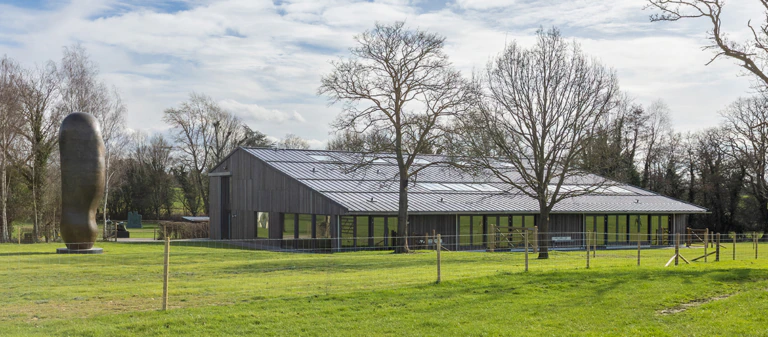
Aerospace Bristol is situated on the former Filton airfield, one of the most significant UK sites for aircraft manufacture and its related industries. This new museum is housed in a former aircraft assembly building, with a modernised interior that retains and celebrates the original features of the structure.
Entering via the “arrivals” door, I purchased my “boarding pass” before entering the “departure lounge” (the shop). A queuing system to the desk reflects the check-in process at an airport, although it was a more friendly welcome than you’d get at the latter. Visitor services are laid out clearly and conveniently to allow you to prepare for your visit in comfort.
The displays in the first building take you on a chronological journey from the birth of the Bristol Aeroplane Company in 1910 at Filton to all the interrelated high-tech industries that have come from it. Space travel and speculation about its future is also covered.
The first section describes the steps taken by the founder of the Bristol Aeroplane Company, George White, who saw the potential for flying as a leisure activity and the commercial carriage of passengers. At several audio points we hear the voice of his great-grandson, who recounts personal stories and anecdotes about his forebears. While I felt this gave a personal insight and connection to the past, I would have liked to have heard more of the voices of others involved at Filton. This would give a broader, more inclusive perspective and widen the appeal to those without a great interest in the nuts and bolts of the industry.
Flying power
The second section explains the changing nature of flying for international and domestic tourism, the interruption of the second world war and the development of new planes, engines and munitions production that this global event (and hence market opportunity) spawned.
The industrial processes became grander in scale, new materials were employed and technological innovation saw the development of helicopters, larger but lighter aircraft with more powerful engines, doing more extraordinary things. A particular favourite of mine to see was the revolutionary British-made Sea Harrier jump-jet that transformed military air use by eliminating the need for runways.
Throughout the museum there are references to the workers, people and skills involved in the industry.
Another section focuses on secret developments during the cold war and other covert operations that are now well documented. There are no major surprises here, but it is good that the museum acknowledges the secretive nature of aircraft design as well as its role in warfare.
The venue holds a range of aircraft, including originals and replicas, complete and incomplete, as well as sections of engines and numerous scale models. These are interspersed with interactives and stamping points for children to clock in and out of work.
The displays of aircraft are beautifully presented and well-lit in most cases, supported by good graphics, which take a layered approach, so visitors can get a general sense of the industry as well as dive further into the detail. I felt there were entry points for most audiences in the range of interpretation provided.
The cleverly considered visitor journey spills you out directly into the cafe for a break prior to the final section of the visit and what for many will be the highlight – Concorde.
The cafe has huge glass windows but, surprisingly, limited views out onto the airfield and surrounding area. As I enjoyed the excellent food I contemplated the significance of the location and how the original village of Filton expanded rapidly as the industry grew around it.This is a large semi-industrial site, which will be developed into housing over the coming years.
My pause in the cafe gave me time to consider the fact that nearly 60,000 people in south-west England are still employed by the aerospace industry, from the construction of aircraft wings, making landing gear to building engines.
Glory days of Concorde
The final part of Aerospace Bristol is well worth the wait. Having been through galleries rich with information and the historic context and overview, you are ready for the grand reveal of Concorde itself. This is housed in a new purpose-built space, which at once feels more modern than the first one.
The plane is spectacular and presented in full glory with dramatic lighting and projections onto its nose. It has a rather patriotic climax that swathes the plane in red, white and blue, which seems ironic as part of the success of the innovation was that it was the result of international collaboration – and much of the current aerospace industry is a pan-European endeavour.
While the exterior of the plane was striking, the rest of the displays in the final section were a little lacklustre. Apart from Concorde, one of the most popular interactives for all ages was a flight simulator housed in the cockpit of a plane – children and adults alike were enamoured by the multitude of dials, switches, levers and controls.
I was intrigued to see who was visiting and was pleased that it was a wide-ranging audience, including families, couples, grandparents and grandchildren as well as small groups of men who were clearly into aviation. Others seemed to have a personal or family connection with the industry.
However, the focus of the museum is both its strength and its weakness, in that it will appeal to some but not all. Making the most of the extraordinary Concorde in the marketing should help it to attract a broad audience and meet anticipated visitor figures.
Although areas of the displays were incomplete at the time of my visit and there are a few teething problems with some interactives, the ticket price allows for as many return trips as you want for a year from the date you visit. And while I may not become a frequent flyer, I will definitely be making a return visit to this strong addition to the region’s cultural offer.
Philip Walker is the head of engagement at Bristol Culture
The time, love and effort that we put in was recognised when the volunteer team was collectively awarded the Queen’s Award for Voluntary Service in 2017. As the receivers of the equivalent to “the MBE for volunteer groups”, we felt incredibly proud.
The illustrious award was created in 2002 to celebrate the anniversary of the Queen’s coronation, and sets the national benchmark for excellence in volunteering and recognises groups whose outstanding work has significantly benefited their local community.
There were many diverse tasks we helped with during the process of opening the new museum. This included working on a Bristol Britannia prototype that was forced to land on the mud flats of the River Severn during a 1954 test flight.
Our dedicated team spent more than two years on the Bristol Britannia aircraft, including upgrading many of its electrical elements and lighting.
Other highlights included preparing a Skylark 12 rocket for display, as well as restoring a variety of guided weapons. We also helped repurpose a Concorde training flight deck into a static flight simulator, which allows museum visitors to put their piloting skills to the test. A similar task was to adapt a mock-up of an Airbus A320 flight deck for use as another static flight simulator.
Our team also helped to restore and conserve the game-changing Sea Harrier jet, which was spectacularly airlifted to Aerospace Bristol by an RAF Chinook – a tandem rotor helicopter – in March 2017.
We’ve done a lot over the past few years, but more volunteer help is ever needed. Aerospace Bristol is now seeking volunteers to join the team in visitor service and collections roles.
Co-authored by the volunteer team at Aerospace Bristol
Main funders Heritage Lottery Fund; BAE Systems; Rolls-Royce; Airbus; South Gloucestershire Council
Architect Purcell
Design Event Communications
Lighting design DHA Designs
Display cases Meyvaert
Exhibition fitout Beck Interiors
Graphic design Event Communications; Surface 3
AV design Projections Artworks; Spiral Productions; Sysco
Admission Adult £15; Child £8; Concessions £13; Family of four £39
Entering via the “arrivals” door, I purchased my “boarding pass” before entering the “departure lounge” (the shop). A queuing system to the desk reflects the check-in process at an airport, although it was a more friendly welcome than you’d get at the latter. Visitor services are laid out clearly and conveniently to allow you to prepare for your visit in comfort.
The displays in the first building take you on a chronological journey from the birth of the Bristol Aeroplane Company in 1910 at Filton to all the interrelated high-tech industries that have come from it. Space travel and speculation about its future is also covered.
The first section describes the steps taken by the founder of the Bristol Aeroplane Company, George White, who saw the potential for flying as a leisure activity and the commercial carriage of passengers. At several audio points we hear the voice of his great-grandson, who recounts personal stories and anecdotes about his forebears. While I felt this gave a personal insight and connection to the past, I would have liked to have heard more of the voices of others involved at Filton. This would give a broader, more inclusive perspective and widen the appeal to those without a great interest in the nuts and bolts of the industry.
Flying power
The second section explains the changing nature of flying for international and domestic tourism, the interruption of the second world war and the development of new planes, engines and munitions production that this global event (and hence market opportunity) spawned.
The industrial processes became grander in scale, new materials were employed and technological innovation saw the development of helicopters, larger but lighter aircraft with more powerful engines, doing more extraordinary things. A particular favourite of mine to see was the revolutionary British-made Sea Harrier jump-jet that transformed military air use by eliminating the need for runways.
Throughout the museum there are references to the workers, people and skills involved in the industry.
Another section focuses on secret developments during the cold war and other covert operations that are now well documented. There are no major surprises here, but it is good that the museum acknowledges the secretive nature of aircraft design as well as its role in warfare.
The venue holds a range of aircraft, including originals and replicas, complete and incomplete, as well as sections of engines and numerous scale models. These are interspersed with interactives and stamping points for children to clock in and out of work.
The displays of aircraft are beautifully presented and well-lit in most cases, supported by good graphics, which take a layered approach, so visitors can get a general sense of the industry as well as dive further into the detail. I felt there were entry points for most audiences in the range of interpretation provided.
The cleverly considered visitor journey spills you out directly into the cafe for a break prior to the final section of the visit and what for many will be the highlight – Concorde.
The cafe has huge glass windows but, surprisingly, limited views out onto the airfield and surrounding area. As I enjoyed the excellent food I contemplated the significance of the location and how the original village of Filton expanded rapidly as the industry grew around it.This is a large semi-industrial site, which will be developed into housing over the coming years.
My pause in the cafe gave me time to consider the fact that nearly 60,000 people in south-west England are still employed by the aerospace industry, from the construction of aircraft wings, making landing gear to building engines.
Glory days of Concorde
The final part of Aerospace Bristol is well worth the wait. Having been through galleries rich with information and the historic context and overview, you are ready for the grand reveal of Concorde itself. This is housed in a new purpose-built space, which at once feels more modern than the first one.
The plane is spectacular and presented in full glory with dramatic lighting and projections onto its nose. It has a rather patriotic climax that swathes the plane in red, white and blue, which seems ironic as part of the success of the innovation was that it was the result of international collaboration – and much of the current aerospace industry is a pan-European endeavour.
While the exterior of the plane was striking, the rest of the displays in the final section were a little lacklustre. Apart from Concorde, one of the most popular interactives for all ages was a flight simulator housed in the cockpit of a plane – children and adults alike were enamoured by the multitude of dials, switches, levers and controls.
I was intrigued to see who was visiting and was pleased that it was a wide-ranging audience, including families, couples, grandparents and grandchildren as well as small groups of men who were clearly into aviation. Others seemed to have a personal or family connection with the industry.
However, the focus of the museum is both its strength and its weakness, in that it will appeal to some but not all. Making the most of the extraordinary Concorde in the marketing should help it to attract a broad audience and meet anticipated visitor figures.
Although areas of the displays were incomplete at the time of my visit and there are a few teething problems with some interactives, the ticket price allows for as many return trips as you want for a year from the date you visit. And while I may not become a frequent flyer, I will definitely be making a return visit to this strong addition to the region’s cultural offer.
Philip Walker is the head of engagement at Bristol Culture
Focus on: volunteers
To get Aerospace Bristol up and running a dedicated team of over 150 volunteers helped on the day-to-day preparations. Together, our contribution has amounted to more than £1.2m worth of time, hard work, resourcefulness and expertise that helped to conserve and restore a range of exhibits spanning more than a century of aviation history in the Bristol area, an industry that still thrives today.The time, love and effort that we put in was recognised when the volunteer team was collectively awarded the Queen’s Award for Voluntary Service in 2017. As the receivers of the equivalent to “the MBE for volunteer groups”, we felt incredibly proud.
The illustrious award was created in 2002 to celebrate the anniversary of the Queen’s coronation, and sets the national benchmark for excellence in volunteering and recognises groups whose outstanding work has significantly benefited their local community.
There were many diverse tasks we helped with during the process of opening the new museum. This included working on a Bristol Britannia prototype that was forced to land on the mud flats of the River Severn during a 1954 test flight.
Our dedicated team spent more than two years on the Bristol Britannia aircraft, including upgrading many of its electrical elements and lighting.
Other highlights included preparing a Skylark 12 rocket for display, as well as restoring a variety of guided weapons. We also helped repurpose a Concorde training flight deck into a static flight simulator, which allows museum visitors to put their piloting skills to the test. A similar task was to adapt a mock-up of an Airbus A320 flight deck for use as another static flight simulator.
Our team also helped to restore and conserve the game-changing Sea Harrier jet, which was spectacularly airlifted to Aerospace Bristol by an RAF Chinook – a tandem rotor helicopter – in March 2017.
We’ve done a lot over the past few years, but more volunteer help is ever needed. Aerospace Bristol is now seeking volunteers to join the team in visitor service and collections roles.
Co-authored by the volunteer team at Aerospace Bristol
Project data
Cost £19mMain funders Heritage Lottery Fund; BAE Systems; Rolls-Royce; Airbus; South Gloucestershire Council
Architect Purcell
Design Event Communications
Lighting design DHA Designs
Display cases Meyvaert
Exhibition fitout Beck Interiors
Graphic design Event Communications; Surface 3
AV design Projections Artworks; Spiral Productions; Sysco
Admission Adult £15; Child £8; Concessions £13; Family of four £39