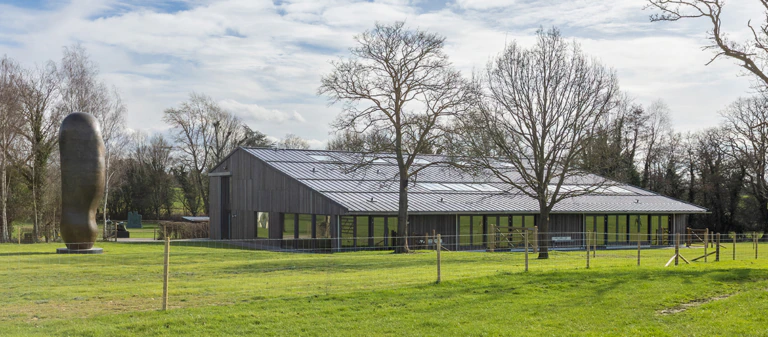
The Garden Museum in Lambeth, London, reopened in May following an 18-month redevelopment funded by the Heritage Lottery Fund. This has resulted in more display space for the permanent collection and temporary exhibitions, a cafe, spacious learning studios and two new gardens. It has also addressed fundamental questions about the purpose of the museum and its target audience.
The museum is housed in the deconsecrated church of St Mary-at-Lambeth, which has a history of its own that relates to the people of Lambeth and those interred in the graveyard. These stories are now being told alongside the celebration of gardens and gardening that forms the core of the museum. The connection between the two comes in the form of the Tradescants, father and son, who are buried in a magnificent tomb framed by the new courtyard extension.
The Tradescants were gardeners, collectors and plant hunters, and their eclectic assemblage of specimens was displayed in their residence, affectionately nicknamed The Ark, in Lambeth, which later formed the core of the Ashmolean Museum in Oxford. The Ashmolean’s collection was founded by Elias Ashmole, one of the main buyers of the curiosities the Tradescants sold. It was a vast cabinet of curiosities that formed the basis for the first museum to open to the public. So it is fitting that there is now a gallery devoted to the Tradescants and their collection at the Garden Museum, which links the building to the history of gardening.
A copy of Ashmole’s catalogue bought by John Evelyn in 1657 is on display in the Tradescants gallery. It is opened at a page listing natural history specimens and giving a sense of the weird and wonderful: “Lynxe’s head”, “Wolfes teeth” and “Beavers skin, teeth, testicles”.
The original Ark would have been stuffed to the rafters with ethnographic specimens, natural history curios and fantastical objects, including a “mermaid’s hand”, a piece of the True Cross, a dodo, a picture made from feathers and a bat as large as a pigeon.
The collections that have been loaned from the Ashmolean, although beautifully displayed in handsome cabinets, are disappointingly sparse and unrepresentative of the original collections. The exception is the intriguing round case holding the “Vegetable Lamb of Tartary”, although it would benefit from more interpretation.
Something for everyone
The large open space of the nave is light and welcoming, with plenty of wall space for the display of paintings and drawings. The boxy plywood exhibition design in this medieval church respects the architecture of the building while providing well-lit and comfortable spaces for the display and contemplation of the collections, as well as enough flexibility to accommodate events and other activities. Unobtrusive audio stations telling the stories of some of those buried in the church are built into the walls of the ground-floor space – tombstones are evident as floor stones, most notably in the cafe.
Rising to the mezzanine floor, the displays focusing on gardens and gardening are arranged thematically and can be explored in any order. Gardens mean different things to different people and the curators have responded to this by offering collections representing various aspects of gardening, including on garden design, the profession and its history.
From gnomes to items representing flower shows, wartime gardening, allotments, children’s toys, lawnmowers, horticultural colleges to those illustrating the television show Ground Force, the displays encompass a lot. They are modern and attractive with clear, unobtrusive labelling. There are also some innovative concepts, such as a Wendy house with a ceiling embellished with designs inspired by the illustrations in children’s novel Tom’s Midnight Garden. This has gardening toys and books inside. The objects have minimal accompanying interpretation, encouraging visitors to look and think (and sometimes reminisce), but the museum has missed an opportunity to provide in-depth information.
Many of the objects must have personal stories connected to them, such as the rows of trophies and medals awarded at horticultural shows, but without these individual narratives and contextual details the objects lack meaning.
Personal stories are told via audiovisual presentations and visitors can enter a garden shed to watch six short films of gardeners talking about the importance of their sheds, in settings ranging from allotments to college gardens. The shed is a contemplative space and I wondered whether the designer was being deliberately subversive by positioning this most humble of workspaces directly over the church altar.
The shed is surrounded by tools of all shapes and sizes, which represent the timelessness and the technology of the garden. Close inspection reveals the beauty to be found in utilitarian objects, such as a 17th-century ivory and brass seed dibber. The earliest example of a watering can from c.1750 is displayed alongside a plastic elephant one, bringing gardening right up to date and engaging younger visitors.
Unexplored history
Gardening’s appeal for all ages is reflected in the displays, with interactives encouraging visitors to create gardens using wooden blocks, arrange vegetables for display at a horticultural show, look at stereoscopic images of Victorian gardens, design seed packets and play a digital plant-hunting game – all thoughtfully conceived and smartly presented.
The section on garden design is less engaging and necessarily two-dimensional. But it is fascinating to see the concepts for landscapes such as Land Use Consultants’ design for the Eden Project in Cornwall and Charles Jencks’s drawings for his Garden of Cosmic Speculation (the final work is at Jupiter Artland just outside Edinburgh) alongside an 18th-century engraving by the surveyor and cartographer John Roque and the garden designer Gertrude Jekyll’s plan for a flower border. The display lacks a detailed overview of the history of garden design though – what visitors can learn is little more than the sum of its parts.
Given its foundation as the Museum of Garden History, it is surprising that the new incarnation does not provide a basic chronology of gardens and their design through the centuries to contextualise the work of the landscape designers featured. Perhaps it intends to address this in temporary exhibitions, such as next year’s show about the 18th-century landscape designer Humphry Repton.
The museum is proud to display the Irish gardener William Robinson’s cloak, Jekyll’s writing desk and hatpin, and landscape designer Frederick Gibberd’s hat, but these objects need to be used as the basis to tell the stories of their owners’ contribution to the history of gardens and gardening, not merely shown as treasured relics.
An important addition to the building is the study room, where researchers can access the garden design archive. This space has a glazed wall, as do the two learning studios, making the educational aspect of the museum visible to visitors. The outdoor space is also significant in a museum dedicated to gardening, and the renowned garden designers Dan Pearson and Tom Stuart Smith have each created part of that garden to complement the collections.
If we really are a nation of gardeners then the Garden Museum has something for everyone, but it may not be clear how significant that something is to the uninitiated.
Caroline Ikin has worked for the Gardens Trust and is doing postgraduate research
Project data
Cost £7.5m
Main funder Heritage Lottery Fund
Architect Dow Jones Architects
Exhibition design GuM
Interpretation In-house; Elbow
Graphic design Thomas Manss & Company; Pentagram
Display cases Armour Systems
Installation Benchworks; Plowden & Smith
Main contractor Rooff
Lighting DHA Designs
The museum is housed in the deconsecrated church of St Mary-at-Lambeth, which has a history of its own that relates to the people of Lambeth and those interred in the graveyard. These stories are now being told alongside the celebration of gardens and gardening that forms the core of the museum. The connection between the two comes in the form of the Tradescants, father and son, who are buried in a magnificent tomb framed by the new courtyard extension.
The Tradescants were gardeners, collectors and plant hunters, and their eclectic assemblage of specimens was displayed in their residence, affectionately nicknamed The Ark, in Lambeth, which later formed the core of the Ashmolean Museum in Oxford. The Ashmolean’s collection was founded by Elias Ashmole, one of the main buyers of the curiosities the Tradescants sold. It was a vast cabinet of curiosities that formed the basis for the first museum to open to the public. So it is fitting that there is now a gallery devoted to the Tradescants and their collection at the Garden Museum, which links the building to the history of gardening.
A copy of Ashmole’s catalogue bought by John Evelyn in 1657 is on display in the Tradescants gallery. It is opened at a page listing natural history specimens and giving a sense of the weird and wonderful: “Lynxe’s head”, “Wolfes teeth” and “Beavers skin, teeth, testicles”.
The original Ark would have been stuffed to the rafters with ethnographic specimens, natural history curios and fantastical objects, including a “mermaid’s hand”, a piece of the True Cross, a dodo, a picture made from feathers and a bat as large as a pigeon.
The collections that have been loaned from the Ashmolean, although beautifully displayed in handsome cabinets, are disappointingly sparse and unrepresentative of the original collections. The exception is the intriguing round case holding the “Vegetable Lamb of Tartary”, although it would benefit from more interpretation.
Something for everyone
The large open space of the nave is light and welcoming, with plenty of wall space for the display of paintings and drawings. The boxy plywood exhibition design in this medieval church respects the architecture of the building while providing well-lit and comfortable spaces for the display and contemplation of the collections, as well as enough flexibility to accommodate events and other activities. Unobtrusive audio stations telling the stories of some of those buried in the church are built into the walls of the ground-floor space – tombstones are evident as floor stones, most notably in the cafe.
Rising to the mezzanine floor, the displays focusing on gardens and gardening are arranged thematically and can be explored in any order. Gardens mean different things to different people and the curators have responded to this by offering collections representing various aspects of gardening, including on garden design, the profession and its history.
From gnomes to items representing flower shows, wartime gardening, allotments, children’s toys, lawnmowers, horticultural colleges to those illustrating the television show Ground Force, the displays encompass a lot. They are modern and attractive with clear, unobtrusive labelling. There are also some innovative concepts, such as a Wendy house with a ceiling embellished with designs inspired by the illustrations in children’s novel Tom’s Midnight Garden. This has gardening toys and books inside. The objects have minimal accompanying interpretation, encouraging visitors to look and think (and sometimes reminisce), but the museum has missed an opportunity to provide in-depth information.
Many of the objects must have personal stories connected to them, such as the rows of trophies and medals awarded at horticultural shows, but without these individual narratives and contextual details the objects lack meaning.
Personal stories are told via audiovisual presentations and visitors can enter a garden shed to watch six short films of gardeners talking about the importance of their sheds, in settings ranging from allotments to college gardens. The shed is a contemplative space and I wondered whether the designer was being deliberately subversive by positioning this most humble of workspaces directly over the church altar.
The shed is surrounded by tools of all shapes and sizes, which represent the timelessness and the technology of the garden. Close inspection reveals the beauty to be found in utilitarian objects, such as a 17th-century ivory and brass seed dibber. The earliest example of a watering can from c.1750 is displayed alongside a plastic elephant one, bringing gardening right up to date and engaging younger visitors.
Unexplored history
Gardening’s appeal for all ages is reflected in the displays, with interactives encouraging visitors to create gardens using wooden blocks, arrange vegetables for display at a horticultural show, look at stereoscopic images of Victorian gardens, design seed packets and play a digital plant-hunting game – all thoughtfully conceived and smartly presented.
The section on garden design is less engaging and necessarily two-dimensional. But it is fascinating to see the concepts for landscapes such as Land Use Consultants’ design for the Eden Project in Cornwall and Charles Jencks’s drawings for his Garden of Cosmic Speculation (the final work is at Jupiter Artland just outside Edinburgh) alongside an 18th-century engraving by the surveyor and cartographer John Roque and the garden designer Gertrude Jekyll’s plan for a flower border. The display lacks a detailed overview of the history of garden design though – what visitors can learn is little more than the sum of its parts.
Given its foundation as the Museum of Garden History, it is surprising that the new incarnation does not provide a basic chronology of gardens and their design through the centuries to contextualise the work of the landscape designers featured. Perhaps it intends to address this in temporary exhibitions, such as next year’s show about the 18th-century landscape designer Humphry Repton.
The museum is proud to display the Irish gardener William Robinson’s cloak, Jekyll’s writing desk and hatpin, and landscape designer Frederick Gibberd’s hat, but these objects need to be used as the basis to tell the stories of their owners’ contribution to the history of gardens and gardening, not merely shown as treasured relics.
An important addition to the building is the study room, where researchers can access the garden design archive. This space has a glazed wall, as do the two learning studios, making the educational aspect of the museum visible to visitors. The outdoor space is also significant in a museum dedicated to gardening, and the renowned garden designers Dan Pearson and Tom Stuart Smith have each created part of that garden to complement the collections.
If we really are a nation of gardeners then the Garden Museum has something for everyone, but it may not be clear how significant that something is to the uninitiated.
Caroline Ikin has worked for the Gardens Trust and is doing postgraduate research
Project data
Cost £7.5m
Main funder Heritage Lottery Fund
Architect Dow Jones Architects
Exhibition design GuM
Interpretation In-house; Elbow
Graphic design Thomas Manss & Company; Pentagram
Display cases Armour Systems
Installation Benchworks; Plowden & Smith
Main contractor Rooff
Lighting DHA Designs