Newmarket is horseracing and horseracing is Newmarket. As far back as 1671, Charles II built a palace and stables in the town to enable him to fulfil his passion for racing and hunting. Today, the Jockey Club estimates that more than a third of the town’s population is directly employed in the industry. With two famous racecourses, 70 training yards, 80 stud farms and more than 2,500 horses in training, the town has good reason to consider itself the spiritual home of thoroughbred horseracing.
Newmarket’s new Palace House National Heritage Centre for Horseracing and Sporting Art is therefore a long-overdue celebration of what has become an international multimillion pound industry. Through the centre’s own collections, complemented by well-chosen loans from elsewhere, Palace House captures the stories, characters, traditions and obsessions of horseracing.
And for those of us who can scarcely tell one end of a horse from the other, Palace House invites us to enter an unfamiliar world to glimpse what goes on behind the scenes at stables and racecourses, and leaves us touched by the enthusiasm and excitement of the sport.
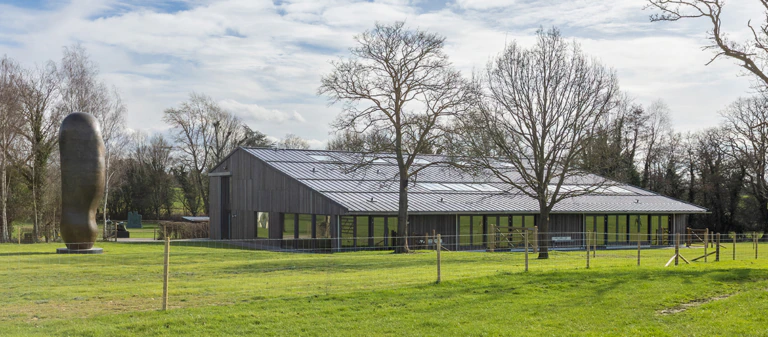
Three institutions – the National Horseracing Museum, the Fred Packard Museum and Galleries for British Sporting Art and the Retraining of Racehorses charity – have been brought together in a cluster of buildings around Charles II’s palace and two refurbished stable yards.
Though Charles II’s stables no longer exist, their foundations were excavated as part of the redevelopment, and their footprint is now marked in Kings Yard. The map in the introductory leaflet, along with a horseracing glossary, is essential to helping visitors find their way around what might otherwise be a confusing site.
Current connections
The National Horseracing Museum, relocated from its previous cramped site on the high street, is now in what was the Trainer’s House, where beautifully presented galleries tell stories about horseracing through an eclectic mix of objects, artworks and documents.
The exhibitions are not inward looking: themed panels running through the galleries relate horseracing to wider social, cultural, political and economic themes such as transport, agriculture, religion, media and motor racing. It is the diversity of the objects, from racing trophies to Red Rum’s birthday cards, which make the stories accessible and intriguing for a wide range of audiences, while films animate the space and introduce voices of people from different aspects of the industry.
The Wellcome Trust-sponsored science gallery fearlessly tackles evolution, comparative morphology, genetics and biophysics with curriculum-relevant resources, including a stunning wall-sized slow motion work demonstrating the Newtonian mechanics of steeplechasing. Thoroughbred bloodlines provide a great illustration of selective breeding and genetics, and I found it fascinating to see how all current racehorses can be traced back to just a few 18th-century horses.
Out in Kings Yard, the stables have been converted to house further exhibitions and interactives, including the opportunity to design your own racing silks, try out racing saddles and have a go on the racehorse simulator. Represented here are vets, farriers and the industries associated with horseracing, along with careers information for young people.
Local relationships
A couple of well-intentioned aspects of the displays are unfortunately beset by small glitches, though they should be easy to fix: floor-level cases with items that kids would enjoy are almost impossible to view unless you are lying on the floor, while a panel about the lack of visibility of Victorian women in horseracing has ended up partially obscured by a pillar. However, considerable thought and planning has gone into ensuring that the displays lend themselves to a strong and relevant educational offer. With a fine education suite and some great tactile resources (the textile horse intestines particularly spring to mind), the centre is clearly committed to building strong sustainable relationships with local schools.
As the last remnant of Charles II’s sporting residence, Palace House itself is a fitting location as the new home of the British Sporting Art Trust. As might be expected, the collection is heavily biased towards horses and racing, with a comprehensive audioguide providing a narrative through the galleries. I found these collections complemented the museum, enabling me to reflect on and try out my newly gained understanding of all things equine. A child-friendly tour, coupled with the wealth of interactives, means there is plenty for families across the site.
Visit Newmarket on a non-race day and it’s odds on that you won’t see a horse. Apart from early morning training on the gallops, for much of the day the horses are hidden away behind neatly clipped hedges and security gates. It’s here that the third element of the new National Heritage Centre comes into its own as, for the first time, horses are stabled on site.
At one of the twice-daily demonstrations, even in the miserable drizzle, it was hard not to be impressed by the size, strength and beauty of the horses being put through their paces, and by the dedication and enthusiasm of the trainers.
The presence of these retired racehorses, along with knowledgeable museum guides, gives a sense of authenticity to the stories told by the collections, and ensures that the site remains connected with the reality of today’s horseracing industry.
Palace House stands as a model for a new resilient approach for independent museums, with a clear understanding and recognition of its own commercial potential. Ticket prices are benchmarked against local historic houses rather than museums, with the option to convert a day ticket to an annual pass for no extra charge.
The museum shop, Tack Room restaurant, Kings Yard and bakery are all open to non-ticket holders. Promoting this offer will be key to Palace House building broad, loyal engagement among local communities and fulfilling its potential as a magnificent new cultural space that is truly at the heart of the town.
Liz Hide is the museums officer at the University of Cambridge
An exhibit that showcases this new approach is in our Thoroughbred Gallery – a near life-sized projection of how a racehorse gallops and then leaps over a jump. We wanted to show visitors what lies “under the bonnet” of these equine racing machines.
To do that, we worked with Spiral Productions to create this feature, which combines live film, animation, atmospheric sound effects and a narrative voice-over.
As the horse gallops, overlaid animation dissects layers of the anatomy to reveal musculature, skeletal structure, heart, lungs and spleen, and how they all contribute to the athleticism of a racehorse.
The exhibit is supported by low-tech hands-on interactives that let visitors explore the extraordinary anatomy of a racehorse for themselves. The lifesize heart and brain models are proving particularly popular.
The racehorse is a key study specimen in areas of anatomy and physiology and there are many research papers investigating the effects of exercise on a horse’s cardiovascular and musculoskeletal system, as well as comparisons between the physical composition of thoroughbreds to other equine breeds.
We were lucky enough to film a galloping horse for the animation sequence on the Newmarket Gallops, bringing full circle the connection of the town, the landscape and the local legacy of the horseracing industry.
Briony Jackson is the science learning and participation officer at the National Heritage Centre for Horseracing and Sporting Art
Main funders Forest Heath District Council; Suffolk County Council; Heritage Lottery Fund; Wellcome Trust; private individuals and trusts
Exhibition design Mather & Co
Architects GWP Architecture
Display cases Armour Systems
Fit-out Elmwood Projects
Audiovisual Hardware Fusion LX; Spiral Productions
Lighting Mather & Co; Fusion LX
Admission Adult £16.50, children under 16 £9.50, under five £5.50
Newmarket’s new Palace House National Heritage Centre for Horseracing and Sporting Art is therefore a long-overdue celebration of what has become an international multimillion pound industry. Through the centre’s own collections, complemented by well-chosen loans from elsewhere, Palace House captures the stories, characters, traditions and obsessions of horseracing.
And for those of us who can scarcely tell one end of a horse from the other, Palace House invites us to enter an unfamiliar world to glimpse what goes on behind the scenes at stables and racecourses, and leaves us touched by the enthusiasm and excitement of the sport.
Three institutions – the National Horseracing Museum, the Fred Packard Museum and Galleries for British Sporting Art and the Retraining of Racehorses charity – have been brought together in a cluster of buildings around Charles II’s palace and two refurbished stable yards.
Though Charles II’s stables no longer exist, their foundations were excavated as part of the redevelopment, and their footprint is now marked in Kings Yard. The map in the introductory leaflet, along with a horseracing glossary, is essential to helping visitors find their way around what might otherwise be a confusing site.
Current connections
The National Horseracing Museum, relocated from its previous cramped site on the high street, is now in what was the Trainer’s House, where beautifully presented galleries tell stories about horseracing through an eclectic mix of objects, artworks and documents.
The exhibitions are not inward looking: themed panels running through the galleries relate horseracing to wider social, cultural, political and economic themes such as transport, agriculture, religion, media and motor racing. It is the diversity of the objects, from racing trophies to Red Rum’s birthday cards, which make the stories accessible and intriguing for a wide range of audiences, while films animate the space and introduce voices of people from different aspects of the industry.
The Wellcome Trust-sponsored science gallery fearlessly tackles evolution, comparative morphology, genetics and biophysics with curriculum-relevant resources, including a stunning wall-sized slow motion work demonstrating the Newtonian mechanics of steeplechasing. Thoroughbred bloodlines provide a great illustration of selective breeding and genetics, and I found it fascinating to see how all current racehorses can be traced back to just a few 18th-century horses.
Out in Kings Yard, the stables have been converted to house further exhibitions and interactives, including the opportunity to design your own racing silks, try out racing saddles and have a go on the racehorse simulator. Represented here are vets, farriers and the industries associated with horseracing, along with careers information for young people.
Local relationships
A couple of well-intentioned aspects of the displays are unfortunately beset by small glitches, though they should be easy to fix: floor-level cases with items that kids would enjoy are almost impossible to view unless you are lying on the floor, while a panel about the lack of visibility of Victorian women in horseracing has ended up partially obscured by a pillar. However, considerable thought and planning has gone into ensuring that the displays lend themselves to a strong and relevant educational offer. With a fine education suite and some great tactile resources (the textile horse intestines particularly spring to mind), the centre is clearly committed to building strong sustainable relationships with local schools.
As the last remnant of Charles II’s sporting residence, Palace House itself is a fitting location as the new home of the British Sporting Art Trust. As might be expected, the collection is heavily biased towards horses and racing, with a comprehensive audioguide providing a narrative through the galleries. I found these collections complemented the museum, enabling me to reflect on and try out my newly gained understanding of all things equine. A child-friendly tour, coupled with the wealth of interactives, means there is plenty for families across the site.
Visit Newmarket on a non-race day and it’s odds on that you won’t see a horse. Apart from early morning training on the gallops, for much of the day the horses are hidden away behind neatly clipped hedges and security gates. It’s here that the third element of the new National Heritage Centre comes into its own as, for the first time, horses are stabled on site.
At one of the twice-daily demonstrations, even in the miserable drizzle, it was hard not to be impressed by the size, strength and beauty of the horses being put through their paces, and by the dedication and enthusiasm of the trainers.
The presence of these retired racehorses, along with knowledgeable museum guides, gives a sense of authenticity to the stories told by the collections, and ensures that the site remains connected with the reality of today’s horseracing industry.
Palace House stands as a model for a new resilient approach for independent museums, with a clear understanding and recognition of its own commercial potential. Ticket prices are benchmarked against local historic houses rather than museums, with the option to convert a day ticket to an annual pass for no extra charge.
The museum shop, Tack Room restaurant, Kings Yard and bakery are all open to non-ticket holders. Promoting this offer will be key to Palace House building broad, loyal engagement among local communities and fulfilling its potential as a magnificent new cultural space that is truly at the heart of the town.
Liz Hide is the museums officer at the University of Cambridge
Focus on: the science behind horseracing
One of the advantages of having a larger site for the museum is that we could expand on the topics and themes previously presented, in particular the science of horseracing. It is a topic that many visitors, especially those that were familiar with the old museum are not expecting to see on show. An exhibit that showcases this new approach is in our Thoroughbred Gallery – a near life-sized projection of how a racehorse gallops and then leaps over a jump. We wanted to show visitors what lies “under the bonnet” of these equine racing machines.
To do that, we worked with Spiral Productions to create this feature, which combines live film, animation, atmospheric sound effects and a narrative voice-over.
As the horse gallops, overlaid animation dissects layers of the anatomy to reveal musculature, skeletal structure, heart, lungs and spleen, and how they all contribute to the athleticism of a racehorse.
The exhibit is supported by low-tech hands-on interactives that let visitors explore the extraordinary anatomy of a racehorse for themselves. The lifesize heart and brain models are proving particularly popular.
The racehorse is a key study specimen in areas of anatomy and physiology and there are many research papers investigating the effects of exercise on a horse’s cardiovascular and musculoskeletal system, as well as comparisons between the physical composition of thoroughbreds to other equine breeds.
We were lucky enough to film a galloping horse for the animation sequence on the Newmarket Gallops, bringing full circle the connection of the town, the landscape and the local legacy of the horseracing industry.
Briony Jackson is the science learning and participation officer at the National Heritage Centre for Horseracing and Sporting Art
Project data
Cost £15mMain funders Forest Heath District Council; Suffolk County Council; Heritage Lottery Fund; Wellcome Trust; private individuals and trusts
Exhibition design Mather & Co
Architects GWP Architecture
Display cases Armour Systems
Fit-out Elmwood Projects
Audiovisual Hardware Fusion LX; Spiral Productions
Lighting Mather & Co; Fusion LX
Admission Adult £16.50, children under 16 £9.50, under five £5.50