Catalogues can relate to exhibitions in many ways: as documentary records, quasi-books and many shades between. For Freeze Frame, which focuses on Michael Lyons’ sculpture and drawings from the 1970s, an early decision to keep gallery labelling to a minimum influenced the scope of the catalogue’s three contextual essays. Images were sourced from the artist’s vast slide library and the designers responded with a retro-inspired layout: clean, geometric, but with accents of orange and brown, echoing the patina of steel.
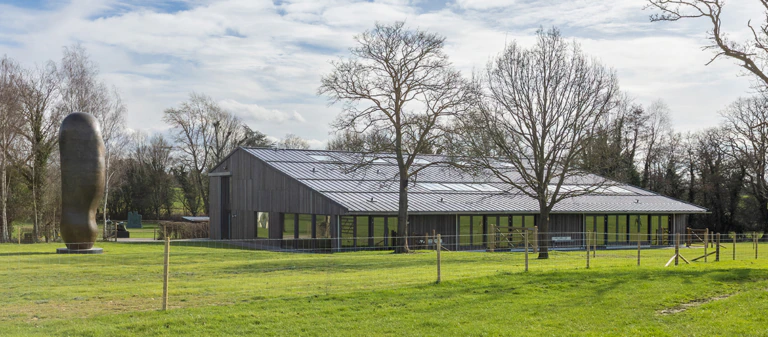
The opportunity for this show came with a five-year loan of Lyons’ sculpture Lenten Cover (1979) to the University of Leeds, part of its flagship programme of public art on campus. Sited on the western campus, Lenten Cover forms a monumental archway from reclaimed steel, framing views of the university and city.
Since Freeze Frame contextualises a work outside of the gallery itself, an important role of the catalogue was to place Lenten Cover firmly in the exhibition’s narrative.
The display is complemented by the catalogue’s exploration of the role of photography, implied movement and the formal device of the archway. Period images chart Lyons’ engagement with form and space, from Traitors’ Gate (1966), Lyons’ first “arch” sculpture, through Derby Roll (1972), to the overt gateway of Heights of David (1976-77).
There was a rich prehistory to Lyons’ arch forms, as Julia Kelly’s essay examines. A childhood in the industrial Midlands drew him simultaneously to the natural and the industrial, the structure of buds or of gas lamps. Later, Lyons drew objects in science museums, collaging elements into fantastic sculptural machines.
Michael Howard’s essay probes the consequences of this dialogue between drawing and sculpture, as well as the metaphysical nature of Lenten Cover as portal. Both essays forge unexpected visual links – from West African sculpture to the drawings of Albrecht Dürer.
Lyons’ photographs adopt low vantages to exaggerate scale, while an image of Brancusi’s The Gate of Kiss in Târgu Jiu, Romania, indicates the appeal of the country for British sculptors. Lyons’ own pilgrimage, in 1976, is documented in the gallery through slides exploring the Endless Column’s presence in the landscape.
Lyons responded unflinchingly to the scale of Brancusi’s work at Târgu Jiu through his own sculpture’s increased dimensions, its transition from gallery to outdoors and his involvement in the founding of Yorkshire Sculpture Park in 1977.
Displaying works unseen for decades precipitated a debate on the ethics of restoration. But through archival photographs and a catalogue endnote we were able to document this process and bridge the aesthetics of the 1970s with the concerns of today.
Judith LeGrove is a freelance writer who works with artists. Michael Lyons: Freeze Frame is at the Stanley and Audrey Burton Gallery, University of Leeds, until 9 July
The opportunity for this show came with a five-year loan of Lyons’ sculpture Lenten Cover (1979) to the University of Leeds, part of its flagship programme of public art on campus. Sited on the western campus, Lenten Cover forms a monumental archway from reclaimed steel, framing views of the university and city.
Since Freeze Frame contextualises a work outside of the gallery itself, an important role of the catalogue was to place Lenten Cover firmly in the exhibition’s narrative.
The display is complemented by the catalogue’s exploration of the role of photography, implied movement and the formal device of the archway. Period images chart Lyons’ engagement with form and space, from Traitors’ Gate (1966), Lyons’ first “arch” sculpture, through Derby Roll (1972), to the overt gateway of Heights of David (1976-77).
There was a rich prehistory to Lyons’ arch forms, as Julia Kelly’s essay examines. A childhood in the industrial Midlands drew him simultaneously to the natural and the industrial, the structure of buds or of gas lamps. Later, Lyons drew objects in science museums, collaging elements into fantastic sculptural machines.
Michael Howard’s essay probes the consequences of this dialogue between drawing and sculpture, as well as the metaphysical nature of Lenten Cover as portal. Both essays forge unexpected visual links – from West African sculpture to the drawings of Albrecht Dürer.
Lyons’ photographs adopt low vantages to exaggerate scale, while an image of Brancusi’s The Gate of Kiss in Târgu Jiu, Romania, indicates the appeal of the country for British sculptors. Lyons’ own pilgrimage, in 1976, is documented in the gallery through slides exploring the Endless Column’s presence in the landscape.
Lyons responded unflinchingly to the scale of Brancusi’s work at Târgu Jiu through his own sculpture’s increased dimensions, its transition from gallery to outdoors and his involvement in the founding of Yorkshire Sculpture Park in 1977.
Displaying works unseen for decades precipitated a debate on the ethics of restoration. But through archival photographs and a catalogue endnote we were able to document this process and bridge the aesthetics of the 1970s with the concerns of today.
Judith LeGrove is a freelance writer who works with artists. Michael Lyons: Freeze Frame is at the Stanley and Audrey Burton Gallery, University of Leeds, until 9 July