At the time of the Caro at Chatsworth exhibition in 2010, it struck me that Anthony Caro had made a rod for his own back.
It seemed everyone – judging by the huge number of reviews and interviews the show received – wanted to know about the artist’s views on Henry Moore, whose assistant Caro was in the 1950s.
How much does an artist need to achieve in their own right, I wondered, before they break free of their master’s influence? As far as Caro was concerned, one would think a further 60 years or more of considerable high points and great successes would be enough, but no.
If the continual references bothered him, he never let on – not publicly anyway – and I never had the chance to ask him about his feelings on the subject before he died in 2013.
In retrospect, perhaps Caro realised that he had set the parameters of his own legacy: by seeking to differentiate his work from Moore’s and eschewing bronze figures on plinths and big figures in the landscape, he had unwittingly created the reference point to which everyone has since deferred.
Travelling to Yorkshire, I had resolved that this review of the Caro in Yorkshire exhibitions (until 1 November) would redress the balance by trying not to mention Moore at all – an impossible task.
The exhibitions, organised by Yorkshire Sculpture Park (YSP) and the Hepworth Wakefield, are in Moore’s home county. At the time of my visit, YSP had a beautiful show of Moore’s work in its gallery, as well as large works among the sheep outside.
And to hammer the point home, a Caro is sited outside the Henry Moore Institute in Leeds.
Inside and out
Moore cast a long shadow over the latter part of the 20th century, which affected the careers of his peers – such as Barbara Hepworth – and those who followed in his wake. For now, it seems this will persist among writers, critics and curators until someone tries to break the mould.
It may be interesting to consider Caro’s attitude to Hepworth, especially on the occasion of the show in her eponymous gallery in Wakefield – A Greater Freedom (until April 2016) – and a rare foray into London at the Tate Britain (until 25 October).
Eleanor Clayton, a curator at the Hepworth Wakefield, attempts this by saying that Caro and Hepworth might have had more in common than either realised, particularly regarding the relationship between sculpture and architecture, and the notion of sculpture as place.
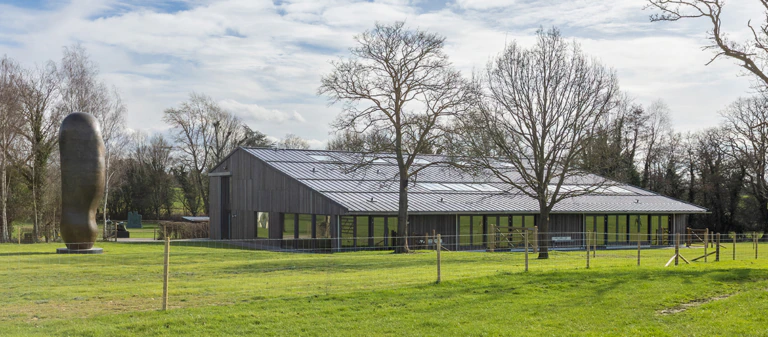
There are many claims made by the two venues involved in the current Caro show, most notably that they have brought together the largest body of his work ever, at least in Europe. The show is housed in the Longside Gallery, the visitor centre and across the park at YSP, as well as outside and inside the Hepworth Wakefield. A bus shuttles visitors between the sites, and both parts of the exhibition shine.
Peter Murray, the founder of YSP, has a long association with Caro’s work and it shows. A large number of sculptures from Caro’s 1974 Flats series, as well as other rusted and varnished steel works, look magnificent in the grounds between the orangery and the lake. Beautifully installed, they neither dominate the landscape nor appear diminished by it. Instead, the display is the perfect union of work and context.
As I run a sculpture park where many works in the Flats series have been shown to great effect, it was inevitable that I would gravitate towards this grouping. But here we have an opportunity to regard them as perhaps one of the most important series Caro created.
Showing sculpture outdoors could be a thorny issue for Caro, seeing that he railed against it at the start of his career. But it is undeniable that in some circumstances his work never looks better than when it is shown outdoors.
The viewer is able to experience it close-up as the artist intended, but can also appreciate the impact from afar. The Flats are no less impressive at distance.
Early creations
Across the valley in the Longside Gallery there are some great moments too. Early works from the 1950s, including Picasso- esque drawings, a bronze reclining nude from the Arts Council Collection, portraits and African-style heads are shown in a separate area.
These will come as a surprise to many and reveal a sculptor exploring different avenues, looking for inspiration.
In the main room, the advent of Caro’s use of colour for his welded steel sculptures on the floor is meant to convey a shock of the new. The newly repainted pieces pack a punch, particularly the early Sculpture Seven (1961), which gives away Caro’s engineering background.
But it is the more reductive efforts of Smoulder and Slow Movement (both 1965) that seem most radical in their simplicity. In just a few shapes and lines, Caro conveys everything he wanted to about the sculptural concerns of gravity, weight, balance and form.
The show focuses on paper and perspex perhaps a little too much at this point, but reminds us that Caro was more than a man of steel – he was a master of other materials, including stoneware.
Meanwhile, in Wakefield, David Chipperfield’s building provides an appropriate setting for Caro’s more architectural sculptures: the light-filled, asymmetric spaces seem in perfect harmony with the work.
The installation feels spacious and uncluttered, despite the fact that there are some complex works here, including Child’s Tower Room (1983-84) and Morning Shadows (2012) from the unrealised Park Avenue project.
Comprehensive collection
A long plinth of Table Pieces (1966-68) creates a dramatic focal point and is a clever solution to the problem of showing smaller works in a large space. One has the chance to consider the similarities and differences between the sculptures, and to study the variety that is possible in an ongoing series when a great imagination is at its peak.
Caro’s systematic repainting of these early sculptures may come as a surprise, and while their freshness is perhaps at odds with their age, this was neither a problem for the artist in his lifetime nor has it been since his death. The right colour for the right sculpture was vital to him (he was advised by his painter wife, Sheila Girling) and his repainting ensured the colours did not deteriorate.
The Hepworth’s exhibitions feel thorough, covering everything from Caro’s use of “found” architectural details to the more grandiose “sculpitecture” and the sometimes ill-fated public projects.
A rare opportunity here and at YSP to see the tiny models used for projects gives us a glimpse into the artist’s working methods and is a reminder that he treated steel as if it were paper – often cutting and folding it to great lyrical effect.
Since his death in 2013, this is the first opportunity to consider Caro’s achievements in full. It is also the first major exhibition he has not been involved in and the first that has not been signed off by his wife, although she sanctioned it. Her death this year
meant she could not give her final blessing as she had done for all of Caro’s previous shows; their son Paul, however, has given his approval.
Since Caro only died two years ago, perhaps it is too soon to appreciate his impact fully. Despite this comprehensive exhibition and recent shows in Los Angeles and London, along with the current display of his Duccio Variations No. 3 (1999- 2000) in London’s National Gallery, we might need more distance before we can assess such a long and prolific career.
I feel that in time there will be a more definitive show of Caro’s work, but for now this combined effort sets a high standard. The fact that it is the result of a collaboration between YSP and the Hepworth Wakefield must be used as an example of good practice. Institutions need not work in competition for audiences. Together, they can attract the large numbers that I don’t doubt will visit the venues.
The Yorkshire Sculpture Triangle is not just a logo, declared Simon Wallis, the director of the Hepworth Wakefield. It is a group of four institutions in three locations that can work well together. I hope Caro in Yorkshire is not a one-off as it bodes so well for the future.
Stephen Feeke is the director of the New Art Centre, Roche Court Sculpture Park
Main funders Yorkshire Sculpture Triangle (Leeds City Council and Wakefield Council partnership)
Yorkshire Sculpture Park
Curator Helen Pheby
Installation Alan Mackenzie, Iain Stephenson and their team
The Hepworth Wakefield
Curator Eleanor Clayton
Installation Matt Kelly and his technical team
It seemed everyone – judging by the huge number of reviews and interviews the show received – wanted to know about the artist’s views on Henry Moore, whose assistant Caro was in the 1950s.
How much does an artist need to achieve in their own right, I wondered, before they break free of their master’s influence? As far as Caro was concerned, one would think a further 60 years or more of considerable high points and great successes would be enough, but no.
If the continual references bothered him, he never let on – not publicly anyway – and I never had the chance to ask him about his feelings on the subject before he died in 2013.
In retrospect, perhaps Caro realised that he had set the parameters of his own legacy: by seeking to differentiate his work from Moore’s and eschewing bronze figures on plinths and big figures in the landscape, he had unwittingly created the reference point to which everyone has since deferred.
Travelling to Yorkshire, I had resolved that this review of the Caro in Yorkshire exhibitions (until 1 November) would redress the balance by trying not to mention Moore at all – an impossible task.
The exhibitions, organised by Yorkshire Sculpture Park (YSP) and the Hepworth Wakefield, are in Moore’s home county. At the time of my visit, YSP had a beautiful show of Moore’s work in its gallery, as well as large works among the sheep outside.
And to hammer the point home, a Caro is sited outside the Henry Moore Institute in Leeds.
Inside and out
Moore cast a long shadow over the latter part of the 20th century, which affected the careers of his peers – such as Barbara Hepworth – and those who followed in his wake. For now, it seems this will persist among writers, critics and curators until someone tries to break the mould.
It may be interesting to consider Caro’s attitude to Hepworth, especially on the occasion of the show in her eponymous gallery in Wakefield – A Greater Freedom (until April 2016) – and a rare foray into London at the Tate Britain (until 25 October).
Eleanor Clayton, a curator at the Hepworth Wakefield, attempts this by saying that Caro and Hepworth might have had more in common than either realised, particularly regarding the relationship between sculpture and architecture, and the notion of sculpture as place.
There are many claims made by the two venues involved in the current Caro show, most notably that they have brought together the largest body of his work ever, at least in Europe. The show is housed in the Longside Gallery, the visitor centre and across the park at YSP, as well as outside and inside the Hepworth Wakefield. A bus shuttles visitors between the sites, and both parts of the exhibition shine.
Peter Murray, the founder of YSP, has a long association with Caro’s work and it shows. A large number of sculptures from Caro’s 1974 Flats series, as well as other rusted and varnished steel works, look magnificent in the grounds between the orangery and the lake. Beautifully installed, they neither dominate the landscape nor appear diminished by it. Instead, the display is the perfect union of work and context.
As I run a sculpture park where many works in the Flats series have been shown to great effect, it was inevitable that I would gravitate towards this grouping. But here we have an opportunity to regard them as perhaps one of the most important series Caro created.
Showing sculpture outdoors could be a thorny issue for Caro, seeing that he railed against it at the start of his career. But it is undeniable that in some circumstances his work never looks better than when it is shown outdoors.
The viewer is able to experience it close-up as the artist intended, but can also appreciate the impact from afar. The Flats are no less impressive at distance.
Early creations
Across the valley in the Longside Gallery there are some great moments too. Early works from the 1950s, including Picasso- esque drawings, a bronze reclining nude from the Arts Council Collection, portraits and African-style heads are shown in a separate area.
These will come as a surprise to many and reveal a sculptor exploring different avenues, looking for inspiration.
In the main room, the advent of Caro’s use of colour for his welded steel sculptures on the floor is meant to convey a shock of the new. The newly repainted pieces pack a punch, particularly the early Sculpture Seven (1961), which gives away Caro’s engineering background.
But it is the more reductive efforts of Smoulder and Slow Movement (both 1965) that seem most radical in their simplicity. In just a few shapes and lines, Caro conveys everything he wanted to about the sculptural concerns of gravity, weight, balance and form.
The show focuses on paper and perspex perhaps a little too much at this point, but reminds us that Caro was more than a man of steel – he was a master of other materials, including stoneware.
Meanwhile, in Wakefield, David Chipperfield’s building provides an appropriate setting for Caro’s more architectural sculptures: the light-filled, asymmetric spaces seem in perfect harmony with the work.
The installation feels spacious and uncluttered, despite the fact that there are some complex works here, including Child’s Tower Room (1983-84) and Morning Shadows (2012) from the unrealised Park Avenue project.
Comprehensive collection
A long plinth of Table Pieces (1966-68) creates a dramatic focal point and is a clever solution to the problem of showing smaller works in a large space. One has the chance to consider the similarities and differences between the sculptures, and to study the variety that is possible in an ongoing series when a great imagination is at its peak.
Caro’s systematic repainting of these early sculptures may come as a surprise, and while their freshness is perhaps at odds with their age, this was neither a problem for the artist in his lifetime nor has it been since his death. The right colour for the right sculpture was vital to him (he was advised by his painter wife, Sheila Girling) and his repainting ensured the colours did not deteriorate.
The Hepworth’s exhibitions feel thorough, covering everything from Caro’s use of “found” architectural details to the more grandiose “sculpitecture” and the sometimes ill-fated public projects.
A rare opportunity here and at YSP to see the tiny models used for projects gives us a glimpse into the artist’s working methods and is a reminder that he treated steel as if it were paper – often cutting and folding it to great lyrical effect.
Since his death in 2013, this is the first opportunity to consider Caro’s achievements in full. It is also the first major exhibition he has not been involved in and the first that has not been signed off by his wife, although she sanctioned it. Her death this year
meant she could not give her final blessing as she had done for all of Caro’s previous shows; their son Paul, however, has given his approval.
Since Caro only died two years ago, perhaps it is too soon to appreciate his impact fully. Despite this comprehensive exhibition and recent shows in Los Angeles and London, along with the current display of his Duccio Variations No. 3 (1999- 2000) in London’s National Gallery, we might need more distance before we can assess such a long and prolific career.
I feel that in time there will be a more definitive show of Caro’s work, but for now this combined effort sets a high standard. The fact that it is the result of a collaboration between YSP and the Hepworth Wakefield must be used as an example of good practice. Institutions need not work in competition for audiences. Together, they can attract the large numbers that I don’t doubt will visit the venues.
The Yorkshire Sculpture Triangle is not just a logo, declared Simon Wallis, the director of the Hepworth Wakefield. It is a group of four institutions in three locations that can work well together. I hope Caro in Yorkshire is not a one-off as it bodes so well for the future.
Stephen Feeke is the director of the New Art Centre, Roche Court Sculpture Park
Project data
Main funders Yorkshire Sculpture Triangle (Leeds City Council and Wakefield Council partnership)
Yorkshire Sculpture Park
Curator Helen Pheby
Installation Alan Mackenzie, Iain Stephenson and their team
The Hepworth Wakefield
Curator Eleanor Clayton
Installation Matt Kelly and his technical team