There is a buoyant mood in the Whitworth as I make my first visit since the reopening.
A seductive marketing campaign invited people to “fall in love again” with the gallery and its world-class collections, and so they did, with the 100,000th visitor passing through the doors after just seven weeks.
It has also won the Riba North West Building of the Year Award, a step on the way to the coveted Riba Stirling Prize. Manchester’s so-called “Tate of the north” is back with a bang.
The £15m redevelopment by Muma (McInnes Usher McKnight Architects) seeks to connect the gallery with its surroundings, the vision of the founders of the Whitworth Institute and Park in 1889.
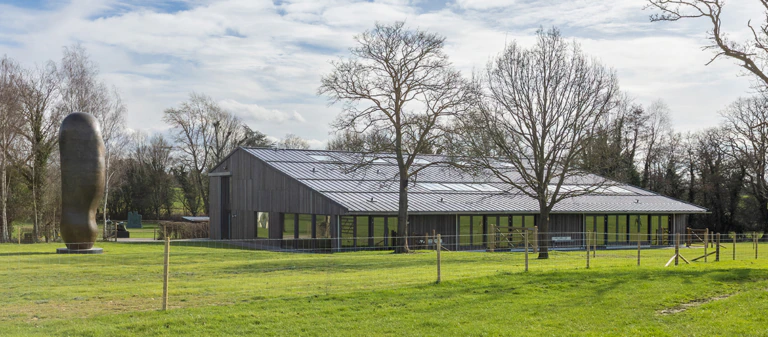
As well as gardens designed by RHS Chelsea Flower Show gold medallist Sarah Price, which have yet to be fully established, the new design incorporates two extensions that reach out from the back of the gallery to bring the outside in.
The park itself hosts artworks by Christine Borland, Jacqueline Donachie and others that have been donated by the Karpidas Foundation, which is also behind a major gift of contemporary painting and photography on display inside.
When approaching from Oxford Road, where you still have to play chicken with the cyclists speeding along the cycle path, the gallery does not appear to have changed. The forecourt has been made into a public space but the imposing brick building remains a formidable proposition for the casual visitor.
Once through the entrance, however, you are greeted by a receptionist stationed at a semi-circular information point, a welcome change from John Davies’s grimacing painted bronze head that I remember from my student days.
Manifesto for a museum
The first half of the building feels largely untouched. The collections are presented in the open-plan, timber-clad galleries designed in a revamp that followed shortly after the Whitworth became a university gallery in 1958.
Here, the curators set out their stall in displays that are designed to showcase the collections but also act as a manifesto for the museum. The textiles gallery hosts an eclectic selection on the theme “Green”, referencing its stance as an environmentally friendly building, now heated by ground source pumps.
A hang-’em high display of portraits (until 22 November) features the great and good associated with the gallery’s history, from Joseph Whitworth himself to Derrick Greaves’s painting of Victor Musgrave and curator Monika Kinley, who donated the renowned collection of outsider art in 2010.
Elsewhere, English artist and book illustrator Walter Crane jostles with American artist Lee Godie; Georges Adéagbo, a key artist in We Face Forward, the gallery’s ground-breaking exhibition of contemporary African art held before it closed in 2012, is placed alongside Michael Clark’s portrait of English film director Derek Jarman; and all circle Mary Kelly’s Love Songs: Multi-Story House, a 2007 work featuring a greenhouse inscribed with observations from two generations of the women’s movement.
The first of five contemporary exhibitions is sited in the Sculpture Court, added in 1995 at the mezzanine level, which is wallpapered with Sarah Lucas’s Tits in Space (until 19 July). This acts as a backdrop for many of her well-known, playful sculptures including Willy and the Stinker.
In the neighbouring gallery, Low Tide Wandering (until 19 July), an installation of more than 100 etchings by the German artist Thomas Schütte, is strung at eye-level. Both reference the Whitworth’s collections: the major gift of wallpapers acquired in 1967, as well as its holdings of historic and modern prints.
Leaving the 1960s galleries behind on the ground floor, the space suddenly opens up and this is where the beauty of Muma’s design is revealed. The central exhibition galleries and lecture theatre have been transformed by exposing the original Victorian barrel-vaulted ceilings.
When I visited, these elegant galleries were dedicated to Cornelia Parker (14 February – 31 May), the headline artist of the Whitworth’s inaugural programme, and included Auguste Rodin’s 1901-4 The Kiss, in which she bound the lovers with a mile of rope.
This was placed centrally, framed by a view through to the glazed corridor and the park beyond. The galleries at either side of this central space were dedicated to single works. One was Parker’s iconic 1991 work, Cold Dark Matter: An Exploded View, featuring the contents of a shed blown apart and lit from within by a single bulb.
The other was a new commission, War Room, an immersive installation made from the red paper left over in the making British Legion poppies, with the ghost-like spaces providing a visual metaphor for lives lost in the first world war.
Generous spaces
To the left, the queue for the cafe snakes through the corridor, with people eager to enjoy the experience of dining in this glazed room that projects into the trees.
To the right, the new landscape gallery contains Unmanned Nature by Chinese artist Cai Guo- Qiang (until 21 June), the first time this drawing from 2008, created into the building but when I was there the effect was stifled by the need to pick your way through Parker’s floor-based works.
However, the contemporary programme is well-judged: a stimulating and broadly popular combination of British and international art, both provocative and playful, and with an overdue major exhibition of one of our most thoughtful, complex and theatrical artists.
I look forward to seeing how the programme develops and how the spaces will be used beyond this opening programme. Manchester is known as a city that has an innate ability to adapt to changing social and political times, and the Whitworth’s director, Maria Balshaw, and her team appear to have achieved something of the same in reinventing the Whitworth for the 21st century while retaining its original purpose as a gallery for “the perpetual gratification of the people of Manchester”.
When the curatorial team and the director, Maria Balshaw, discussed the reopening displays we talked about telling the story of the Whitworth.
But we didn't want to do this in a conventional way. We wanted to use the collection to tell the gallery’s own story.
Many of the displays talk about key moments in the Whitworth's history: the 1960s, which was the last time the gallery was comprehensively redeveloped; or the founding gift of British watercolours given more than a century ago by John Edward Taylor, then owner of the Manchester Guardian newspaper.
In the Portraits display we wanted to hint at the multiplicity of people behind the collection, and included in the collection. From unknown artists to celebrated patrons, the display includes formal portraits of people that relate directly to the history of the gallery, including Joseph Whitworth.
However, the majority of those portrayed are artists. Some are famous, such as Hogarth, Rembrandt or Renoir, but many others are less well-known. They include works by
self-taught artists from the Musgrave Kinley Outsider Art Collection.
Even in the style of the hang we wanted to suggest the depth and breadth of the collection, so the display is very dense, with more than 170 individual artworks in one room. It includes items from our historical and contemporary fine art collections and textiles collection, from a Portrait of Lucian Freud by Francis Bacon to an embroidered portrait made of hair.
When hanging the exhibition I wanted to create a sense that you were walking into a room full of people. Even though these works cross continents and centuries, I imagined the groupings of works as being gatherings of people in the same time and space.
Some were old acquaintances, others had never met before, but they each had something to say to the others. Bryony Bond is a curator (temporary exhibitions) at the Whitworth
Cost: £15m
Main funders: Heritage Lottery Fund £8.5m; University of Manchester; Arts Council England; Clore Duffield Foundation; Friends of the Whitworth; Headley Trust; Granada Foundation; Clothworkers’ Foundation; Wolfson Foundation; Garfield Weston Foundation; Sir Siegmund Warburg’s Voluntary Settlement; J Paul Getty Jnr Charitable Trust; Pilgrim Trust; Mercers Company
Architect: McInnes Usher McKnight Architects Garden design Sarah Price
Main contractor: ISG Structural engineer Ramboll Services engineer Buro Happold
Cost consultant: Appleyard & Trew
A seductive marketing campaign invited people to “fall in love again” with the gallery and its world-class collections, and so they did, with the 100,000th visitor passing through the doors after just seven weeks.
It has also won the Riba North West Building of the Year Award, a step on the way to the coveted Riba Stirling Prize. Manchester’s so-called “Tate of the north” is back with a bang.
The £15m redevelopment by Muma (McInnes Usher McKnight Architects) seeks to connect the gallery with its surroundings, the vision of the founders of the Whitworth Institute and Park in 1889.
As well as gardens designed by RHS Chelsea Flower Show gold medallist Sarah Price, which have yet to be fully established, the new design incorporates two extensions that reach out from the back of the gallery to bring the outside in.
The park itself hosts artworks by Christine Borland, Jacqueline Donachie and others that have been donated by the Karpidas Foundation, which is also behind a major gift of contemporary painting and photography on display inside.
When approaching from Oxford Road, where you still have to play chicken with the cyclists speeding along the cycle path, the gallery does not appear to have changed. The forecourt has been made into a public space but the imposing brick building remains a formidable proposition for the casual visitor.
Once through the entrance, however, you are greeted by a receptionist stationed at a semi-circular information point, a welcome change from John Davies’s grimacing painted bronze head that I remember from my student days.
Manifesto for a museum
The first half of the building feels largely untouched. The collections are presented in the open-plan, timber-clad galleries designed in a revamp that followed shortly after the Whitworth became a university gallery in 1958.
Here, the curators set out their stall in displays that are designed to showcase the collections but also act as a manifesto for the museum. The textiles gallery hosts an eclectic selection on the theme “Green”, referencing its stance as an environmentally friendly building, now heated by ground source pumps.
A hang-’em high display of portraits (until 22 November) features the great and good associated with the gallery’s history, from Joseph Whitworth himself to Derrick Greaves’s painting of Victor Musgrave and curator Monika Kinley, who donated the renowned collection of outsider art in 2010.
Elsewhere, English artist and book illustrator Walter Crane jostles with American artist Lee Godie; Georges Adéagbo, a key artist in We Face Forward, the gallery’s ground-breaking exhibition of contemporary African art held before it closed in 2012, is placed alongside Michael Clark’s portrait of English film director Derek Jarman; and all circle Mary Kelly’s Love Songs: Multi-Story House, a 2007 work featuring a greenhouse inscribed with observations from two generations of the women’s movement.
The first of five contemporary exhibitions is sited in the Sculpture Court, added in 1995 at the mezzanine level, which is wallpapered with Sarah Lucas’s Tits in Space (until 19 July). This acts as a backdrop for many of her well-known, playful sculptures including Willy and the Stinker.
In the neighbouring gallery, Low Tide Wandering (until 19 July), an installation of more than 100 etchings by the German artist Thomas Schütte, is strung at eye-level. Both reference the Whitworth’s collections: the major gift of wallpapers acquired in 1967, as well as its holdings of historic and modern prints.
Leaving the 1960s galleries behind on the ground floor, the space suddenly opens up and this is where the beauty of Muma’s design is revealed. The central exhibition galleries and lecture theatre have been transformed by exposing the original Victorian barrel-vaulted ceilings.
When I visited, these elegant galleries were dedicated to Cornelia Parker (14 February – 31 May), the headline artist of the Whitworth’s inaugural programme, and included Auguste Rodin’s 1901-4 The Kiss, in which she bound the lovers with a mile of rope.
This was placed centrally, framed by a view through to the glazed corridor and the park beyond. The galleries at either side of this central space were dedicated to single works. One was Parker’s iconic 1991 work, Cold Dark Matter: An Exploded View, featuring the contents of a shed blown apart and lit from within by a single bulb.
The other was a new commission, War Room, an immersive installation made from the red paper left over in the making British Legion poppies, with the ghost-like spaces providing a visual metaphor for lives lost in the first world war.
Generous spaces
To the left, the queue for the cafe snakes through the corridor, with people eager to enjoy the experience of dining in this glazed room that projects into the trees.
To the right, the new landscape gallery contains Unmanned Nature by Chinese artist Cai Guo- Qiang (until 21 June), the first time this drawing from 2008, created into the building but when I was there the effect was stifled by the need to pick your way through Parker’s floor-based works.
However, the contemporary programme is well-judged: a stimulating and broadly popular combination of British and international art, both provocative and playful, and with an overdue major exhibition of one of our most thoughtful, complex and theatrical artists.
I look forward to seeing how the programme develops and how the spaces will be used beyond this opening programme. Manchester is known as a city that has an innate ability to adapt to changing social and political times, and the Whitworth’s director, Maria Balshaw, and her team appear to have achieved something of the same in reinventing the Whitworth for the 21st century while retaining its original purpose as a gallery for “the perpetual gratification of the people of Manchester”.
Focus on portraits
When the curatorial team and the director, Maria Balshaw, discussed the reopening displays we talked about telling the story of the Whitworth.
But we didn't want to do this in a conventional way. We wanted to use the collection to tell the gallery’s own story.
Many of the displays talk about key moments in the Whitworth's history: the 1960s, which was the last time the gallery was comprehensively redeveloped; or the founding gift of British watercolours given more than a century ago by John Edward Taylor, then owner of the Manchester Guardian newspaper.
In the Portraits display we wanted to hint at the multiplicity of people behind the collection, and included in the collection. From unknown artists to celebrated patrons, the display includes formal portraits of people that relate directly to the history of the gallery, including Joseph Whitworth.
However, the majority of those portrayed are artists. Some are famous, such as Hogarth, Rembrandt or Renoir, but many others are less well-known. They include works by
self-taught artists from the Musgrave Kinley Outsider Art Collection.
Even in the style of the hang we wanted to suggest the depth and breadth of the collection, so the display is very dense, with more than 170 individual artworks in one room. It includes items from our historical and contemporary fine art collections and textiles collection, from a Portrait of Lucian Freud by Francis Bacon to an embroidered portrait made of hair.
When hanging the exhibition I wanted to create a sense that you were walking into a room full of people. Even though these works cross continents and centuries, I imagined the groupings of works as being gatherings of people in the same time and space.
Some were old acquaintances, others had never met before, but they each had something to say to the others. Bryony Bond is a curator (temporary exhibitions) at the Whitworth
Project data
Cost: £15m
Main funders: Heritage Lottery Fund £8.5m; University of Manchester; Arts Council England; Clore Duffield Foundation; Friends of the Whitworth; Headley Trust; Granada Foundation; Clothworkers’ Foundation; Wolfson Foundation; Garfield Weston Foundation; Sir Siegmund Warburg’s Voluntary Settlement; J Paul Getty Jnr Charitable Trust; Pilgrim Trust; Mercers Company
Architect: McInnes Usher McKnight Architects Garden design Sarah Price
Main contractor: ISG Structural engineer Ramboll Services engineer Buro Happold
Cost consultant: Appleyard & Trew