The Bethlem Museum of the Mind has a difficult brief to meet: on one hand it needs to display and explore the complex institutional history of the world’s oldest psychiatric hospital; on the other to provide a safe and trusted space run by and within the current Bethlem Royal Hospital.
Visitors to the new museum arrive with a curiosity and, for many, a personal connection to this sensitive and important subject matter.
You are walking in the footsteps of sightseers to the spectacle of Bedlam, the hospital’s 18th-century “combination of prison and freak show” and the curators invite self-reflection on this from the start.
The museum intends to “explore Bethlem’s controversial and often misunderstood history through the lens of mental health issues which are as relevant today as in the past”.
The statement that “one in four British adults will experience mental health problems” in any given year is the start of a deft and intelligent experience. Potentially distressing historical and contemporary issues are constantly brought back to the reflective present at every turn.
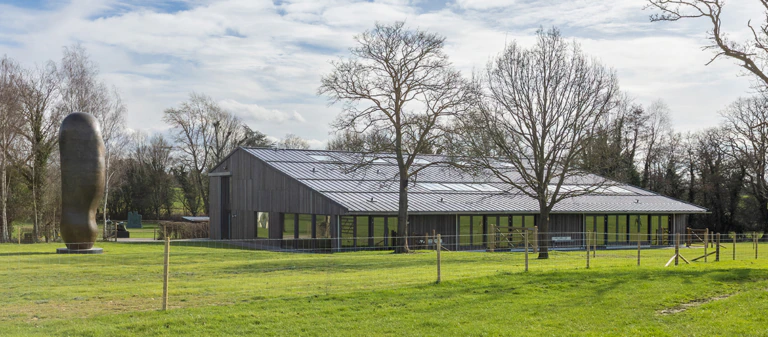
The museum has been relocated within an administrative building at the centre of Bethlem Royal Hospital, which is set in 270 acres of parkland. Visitors enter a ground-floor reception and gallery before ascending an art deco staircase to the museum and a second temporary exhibition gallery above.
The stairs are flanked by Caius Gabriel Cibber’s statues Raving and Melancholy Madness and the contrast between the elegant stairway and a 17th-century stone giant in chains is disquieting and memorable.
At the top of the stairs a timeline charts Bethlem’s 800-year “continuous history of caring for the mentally disordered”, evolving from a 13th-century Bishopsgate priory to a hospital housing six “insane” patients in 1403.
Relocations are highlighted with the 1676 Moorfields move to a hospital for 120 “pauper lunatics” and later to St George’s Fields and finally Beckenham, Kent, in 1930.
The lightness and warmth of the museum space is striking. Displays are laid out across one room – actually a relatively small space, but divisions into three zones and additional enclosed areas are cleverly done.
From the huge screen that greets you at the start, where a succession of men and women narrate their own Bethlem experiences, a wealth of lived experience is used to draw you into the deeply human subject of mental health.
Good graphics create an effective ebb and flow of information and despite large quantities of objects, panels and interactives, the museum is more akin to a stylish living room or therapist’s consultation room.
This sense of the domestic is enhanced by prominently positioned furniture – a bulky Victorian desk, browsable shelves with books by Oliver Sacks, Spike Milligan and John Cleese, a fireplace and grandfather clock. The light-wood shelves and colourful Rorschach print wallpaper are more Ikea than institutional, making it a place to relax and unwind – not unravel.
The first section of the gallery (Labelling and Diagnosis) covers debates around language used to describe mental health conditions, patient records, psychiatric diagnosis and the use of physiognomy in the 19th century.
This area confidently intermingles art and information. Ambivalent Falls features a twice-caged heart, “a prison within a prison”, beneath an array of suspended labels, and speaks of pain more memorably than a text panel could.
Louis Wain’s cats are here and Dominic Davies’s portrait series At Face Value presents his subjects framed within discreet wooden drawers – ready to be shut away.
Art and mental health
Bethlem has a long institutional history of deploying art as therapy for service users with its power to provoke, unlock emotion and provide escape. Rich collections result and the adjacent temporary exhibition gallery will show four exhibitions a year.
Just beyond the colourful first section is Inside and Out – a partially enclosed corner displaying wall padding from an isolation room.
These stained fabric panels evoke a sense of confinement, heightened by contrast to the immediately adjacent windows with views over the grounds – the “open and therapeutic environment” of Bethlem in the 20th century.
Here, visitors can listen to deeply moving letters from former patients and service users from 1867 to 2014.
In the central section, people are invited to “take a break” on sofas surrounded by an intriguing mix of art and objects generally unmediated by text, on the walls and in bookcase-style shelving.
The assembled jars, keys, locks, syringes and models encourage visitors to simply sit, look and reflect.
Reframing the vision
The therapeutic warmth emerging from the well-paced delivery of information shifts when more brutal aspects of mental health treatment are addressed.
In Freedom and Constraint, early 19th-century physical restraints for wrists, collars, ankles and a straitjacket are displayed and discussed. They are sensitively placed, not only away from the central areas, but also partially shielded from view.
The acknowledgement that “questions of freedom and constraint still challenge us today” is repeated and prominent.
The parallel section, Chemical Restraint, explores the use of psychiatric drugs – an equally powerful agent of control – a message that the wall of glass medicine jars reinforces.
Alongside this case visitors can watch a short film and vote on whether a teenager should be detained under the Mental Health Act. Similarly participatory are the revolving painting captions.
You are invited to “make your own judgements” on the art or “rotate the captions to learn more” – an effective gallery tactic more usually deployed within interactive family spaces, and rarely as the sole means of information delivery in a permanent gallery.
Bethlem is one of only a handful of UK museums whose sole focus is the exploration of mental health (others include the Freud Museum in London and the Mental Health Museum, Wakefield). Further afield, Het Dolhuys in the Netherlands and Museum Dr Guislain in Belgium were direct inspirations to the curatorial team.
Mental health issues may be invisible, but they are no less a part of disability history. Actor and activist Mat Fraser recently set a challenge to the museum sector to “reframe and change the prism” through which disabled people are seen.
Bethlem Museum uses the voices of human experience throughout and provides a transformative example of Fraser’s reframing model, as well as a moving and fascinating visit.
Each of the mental health-related themes around which Bethlem Museum of the Mind’s permanent displays are organised has contemporary relevance, as well as historic resonance, and none more so than the issue of freedom and constraint within a mental health context.
As a result, sensitive interpretation of historic artefacts such as locks and keys, chains and straitjackets, sections of padded cell and drug jars, formed just one half of the task of curating the displays that addressed this theme.
The other half of the curatorial task was to invite visitors to reflect on how concepts of freedom and constraint might, or should, play out in mental health treatment today.
Recent experience of the Anne Frank Museum’s Free2choose installation provided the initial spark of inspiration for how this task would be approached.
Fictional but credible treatment scenarios that engaged considerations of freedom and constraint were scripted and filmed, and an interactive display constructed to allow visitors to opt into seeing the films and consider how they might respond to the circumstances presented.
The intention was not to steer visitors towards a “correct" answer – the scenarios were not scripted through to a conclusion after the point of decision – but to prompt serious thought on this important issue in contemporary mental healthcare.
The size and location of the installation dictated that interactions with it would be individual, though not purely private. Anecdotally, these interactions do not appear to generate much by way of conversations among visitors. Then again, neither do interactions with the larger-scale Free2choose installation, it would seem.
But the video content of this interactive – supported by material on risk management, ethics and the law – has been employed to great effect in the museum’s educational programming, and impact assessment is underway.
This display is just one element of the museum’s wider treatment of issues of freedom and constraint within mental healthcare (which is in turn just one theme among several addressed in its permanent displays). It plays a role, however, in the juxtaposition of historic and contemporary perspectives on this theme, and in holding open a space for visitor participation.
Colin Gale is the archivist at the Bethlem Museum of the Mind, Beckenham, Kent
Cost: £4m
Main funders: Maudsley Charity; South London and Maudsley NHS Foundation Trust; Heritage Lottery Fund
Exhibition design: Real Studios
Architect: Fraser Brown Mackenna
Emma Shepley is the curator of the Royal College of Physicians, London
Visitors to the new museum arrive with a curiosity and, for many, a personal connection to this sensitive and important subject matter.
You are walking in the footsteps of sightseers to the spectacle of Bedlam, the hospital’s 18th-century “combination of prison and freak show” and the curators invite self-reflection on this from the start.
The museum intends to “explore Bethlem’s controversial and often misunderstood history through the lens of mental health issues which are as relevant today as in the past”.
The statement that “one in four British adults will experience mental health problems” in any given year is the start of a deft and intelligent experience. Potentially distressing historical and contemporary issues are constantly brought back to the reflective present at every turn.
The museum has been relocated within an administrative building at the centre of Bethlem Royal Hospital, which is set in 270 acres of parkland. Visitors enter a ground-floor reception and gallery before ascending an art deco staircase to the museum and a second temporary exhibition gallery above.
The stairs are flanked by Caius Gabriel Cibber’s statues Raving and Melancholy Madness and the contrast between the elegant stairway and a 17th-century stone giant in chains is disquieting and memorable.
At the top of the stairs a timeline charts Bethlem’s 800-year “continuous history of caring for the mentally disordered”, evolving from a 13th-century Bishopsgate priory to a hospital housing six “insane” patients in 1403.
Relocations are highlighted with the 1676 Moorfields move to a hospital for 120 “pauper lunatics” and later to St George’s Fields and finally Beckenham, Kent, in 1930.
The lightness and warmth of the museum space is striking. Displays are laid out across one room – actually a relatively small space, but divisions into three zones and additional enclosed areas are cleverly done.
From the huge screen that greets you at the start, where a succession of men and women narrate their own Bethlem experiences, a wealth of lived experience is used to draw you into the deeply human subject of mental health.
Good graphics create an effective ebb and flow of information and despite large quantities of objects, panels and interactives, the museum is more akin to a stylish living room or therapist’s consultation room.
This sense of the domestic is enhanced by prominently positioned furniture – a bulky Victorian desk, browsable shelves with books by Oliver Sacks, Spike Milligan and John Cleese, a fireplace and grandfather clock. The light-wood shelves and colourful Rorschach print wallpaper are more Ikea than institutional, making it a place to relax and unwind – not unravel.
The first section of the gallery (Labelling and Diagnosis) covers debates around language used to describe mental health conditions, patient records, psychiatric diagnosis and the use of physiognomy in the 19th century.
This area confidently intermingles art and information. Ambivalent Falls features a twice-caged heart, “a prison within a prison”, beneath an array of suspended labels, and speaks of pain more memorably than a text panel could.
Louis Wain’s cats are here and Dominic Davies’s portrait series At Face Value presents his subjects framed within discreet wooden drawers – ready to be shut away.
Art and mental health
Bethlem has a long institutional history of deploying art as therapy for service users with its power to provoke, unlock emotion and provide escape. Rich collections result and the adjacent temporary exhibition gallery will show four exhibitions a year.
Just beyond the colourful first section is Inside and Out – a partially enclosed corner displaying wall padding from an isolation room.
These stained fabric panels evoke a sense of confinement, heightened by contrast to the immediately adjacent windows with views over the grounds – the “open and therapeutic environment” of Bethlem in the 20th century.
Here, visitors can listen to deeply moving letters from former patients and service users from 1867 to 2014.
In the central section, people are invited to “take a break” on sofas surrounded by an intriguing mix of art and objects generally unmediated by text, on the walls and in bookcase-style shelving.
The assembled jars, keys, locks, syringes and models encourage visitors to simply sit, look and reflect.
Reframing the vision
The therapeutic warmth emerging from the well-paced delivery of information shifts when more brutal aspects of mental health treatment are addressed.
In Freedom and Constraint, early 19th-century physical restraints for wrists, collars, ankles and a straitjacket are displayed and discussed. They are sensitively placed, not only away from the central areas, but also partially shielded from view.
The acknowledgement that “questions of freedom and constraint still challenge us today” is repeated and prominent.
The parallel section, Chemical Restraint, explores the use of psychiatric drugs – an equally powerful agent of control – a message that the wall of glass medicine jars reinforces.
Alongside this case visitors can watch a short film and vote on whether a teenager should be detained under the Mental Health Act. Similarly participatory are the revolving painting captions.
You are invited to “make your own judgements” on the art or “rotate the captions to learn more” – an effective gallery tactic more usually deployed within interactive family spaces, and rarely as the sole means of information delivery in a permanent gallery.
Bethlem is one of only a handful of UK museums whose sole focus is the exploration of mental health (others include the Freud Museum in London and the Mental Health Museum, Wakefield). Further afield, Het Dolhuys in the Netherlands and Museum Dr Guislain in Belgium were direct inspirations to the curatorial team.
Mental health issues may be invisible, but they are no less a part of disability history. Actor and activist Mat Fraser recently set a challenge to the museum sector to “reframe and change the prism” through which disabled people are seen.
Bethlem Museum uses the voices of human experience throughout and provides a transformative example of Fraser’s reframing model, as well as a moving and fascinating visit.
Focus on interpretation
Each of the mental health-related themes around which Bethlem Museum of the Mind’s permanent displays are organised has contemporary relevance, as well as historic resonance, and none more so than the issue of freedom and constraint within a mental health context.
As a result, sensitive interpretation of historic artefacts such as locks and keys, chains and straitjackets, sections of padded cell and drug jars, formed just one half of the task of curating the displays that addressed this theme.
The other half of the curatorial task was to invite visitors to reflect on how concepts of freedom and constraint might, or should, play out in mental health treatment today.
Recent experience of the Anne Frank Museum’s Free2choose installation provided the initial spark of inspiration for how this task would be approached.
Fictional but credible treatment scenarios that engaged considerations of freedom and constraint were scripted and filmed, and an interactive display constructed to allow visitors to opt into seeing the films and consider how they might respond to the circumstances presented.
The intention was not to steer visitors towards a “correct" answer – the scenarios were not scripted through to a conclusion after the point of decision – but to prompt serious thought on this important issue in contemporary mental healthcare.
The size and location of the installation dictated that interactions with it would be individual, though not purely private. Anecdotally, these interactions do not appear to generate much by way of conversations among visitors. Then again, neither do interactions with the larger-scale Free2choose installation, it would seem.
But the video content of this interactive – supported by material on risk management, ethics and the law – has been employed to great effect in the museum’s educational programming, and impact assessment is underway.
This display is just one element of the museum’s wider treatment of issues of freedom and constraint within mental healthcare (which is in turn just one theme among several addressed in its permanent displays). It plays a role, however, in the juxtaposition of historic and contemporary perspectives on this theme, and in holding open a space for visitor participation.
Colin Gale is the archivist at the Bethlem Museum of the Mind, Beckenham, Kent
Project data
Cost: £4m
Main funders: Maudsley Charity; South London and Maudsley NHS Foundation Trust; Heritage Lottery Fund
Exhibition design: Real Studios
Architect: Fraser Brown Mackenna
Emma Shepley is the curator of the Royal College of Physicians, London