As I sat on the train heading north into the Kingdom of Fife I ran through all that I knew about Kirkcaldy. The Lang Toun. Adam Smith. Linoleum. Raith Rovers. Gordon Brown. Coalmining. Jocky Wilson.
I’ve stared out at Kirkcaldy often enough from Edinburgh, on a bright day glistening in the distance on the north shore of the Firth of Forth. However, on the day that I visited the sea was sludge grey and the sky even grimmer. Time to head indoors to the warmth of a local museum.
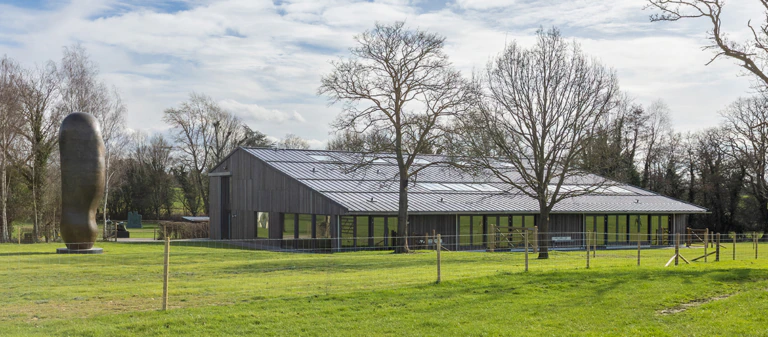
The Kirkcaldy Galleries, which reopened last year following a £2.5m redevelopment, is situated in the town’s 1920s War Memorial building, which also houses a museum art gallery, library, local and family history room.
If only I’d known in advance about the bright and friendly cafe, I would have been spared a trudge around the town in search of lunch.
Community hub
On such an unprepossessing day, the building creates a lively community and cultural hub. The museum’s permanent ground-floor displays, Moments in Time, presents key moments in Kirkcaldy’s history – for example, the publication of Adam Smith’s Wealth of Nations in 1776, the last fatal duel in 1826, and Raith Rovers’ famous Scottish League Cup win in 1994.
These are set out episodically, but not crushingly chronological, and build up a picture of a proud town with global links through whaling, trade and industry. The displays are well-ordered, visually appealing and accessible.
The juxtaposition is made throughout the displays between the deliberately parochial and the town’s place on a wider stage through bold headline graphics and images. However, these stories are not always sufficiently supported by objects but carried mainly through text and images.
Some of the already small cases look quite bare, and the supporting object selection is predicable at times – Wemyss pottery, miners’ equipment, and the ever-dependable penny farthing as a signifier of the 19th century.
The sports display features a few shields and a couple of bowls, while I was hoping for something more gripping such as Jocky Wilson’s arrows or even his false teeth. I followed the sound of a hissing industrial machine anticipating movement and interaction, only to find a screen showing footage of one in action.
The audiovisual displays are disappointing. They are not clearly labelled, so visitors aren’t tempted or intrigued – and there is an over reliance of repurposed existing material, 1960s films of linoleum production and Gordon Brown talking about Adam Smith’s contribution to political economy are as exciting as they sound.
I understand the difficulties and costs of bringing in new and digital interpretation, but its absence gives an already dated feel to the displays. One or two elements done well would vary the pace and presentation.
There is a missed opportunity in not including a range of oral history and personal testimonies, for example in the displays about the decline of the mining industry and the 1980s strike, or the stories of the 700-year-old Links Market.
People’s voices are lacking in a museum that quite rightly celebrates a proud civic history. Instead there is a somewhat flat, uninhabited feeling to the rooms.
Effective interactives
This area that has experienced seismic shifts over the past 50 years, seeing new town expansion followed by rapid industrial decline. The recent film The Happy Lands, about Fife mining communities, showed the wit and imagination that can be brought to local histories, but little of that vitality, passion and complexity of narratives is conveyed here.
And just a few miles up the East Neuk, the Scottish Fisheries Museum provides a much richer picture of life on the edge of the land and the sea.
There are some simple and effective interactives – dressing-up boxes and arranging floor covering patterns aimed at younger visitors, which engaged those children I saw being taken round by their parents.
Older visitors – I assume local – were engrossed in reading the text and sharing their experiences in their groups. I would have liked to have seen more proactive engagement by and welcome from front-of-house staff, who retreated behind their library terminals when I was there.
Child’s play
A temporary exhibition, A Century of Childhood, offered more in the way of interactivity, with a variety of toys and games for families to use; indeed, the sound of the giant Connect 4 carried through the galleries.
However, the lack of even simple object labelling and a hurried and sometimes inaccurate (for heaven’s sake, get the dates of the Spanish civil war right!) set of decade-by-decade text panels gave a frustratingly uncontextualised experience.
There is real scope in this space for community exhibitions, with audiences and groups’ responses to the collections, which I hope that the future exhibitions programme is able to deliver.
The art galleries contain pleasant works by SJ Peploe and William McTaggart, among others; I can neatly sidestep any comment on the local artist Jack Vettriano as his work was on display over at Kelvingrove in Glasgow.
However, apart from the obligatory introductory panels and spartan labels there is no interpretation, and the flatness is unenlivened by anything three dimensional beyond an awkwardly positioned sculpture, Silver Darlings – a lovely piece by Martin Rayner.
The inclusion of contemporary works by other artists and groups would help give different textures and pace to these displays.
This £2.5m refurbishment of the Kirkcaldy Galleries has created a thriving centre for the local community, and the flow through from the adjacent library will help drive footfall.
The new galleries offer a solid foundation for future displays and exhibitions to reflect a fascinating part of Scotland at a time of economic, political and social change. Now is the time for more ambition in terms of content and programmes.
Stephen Allen is the head of learning and programmes at National Museums Scotland
I’ve stared out at Kirkcaldy often enough from Edinburgh, on a bright day glistening in the distance on the north shore of the Firth of Forth. However, on the day that I visited the sea was sludge grey and the sky even grimmer. Time to head indoors to the warmth of a local museum.
The Kirkcaldy Galleries, which reopened last year following a £2.5m redevelopment, is situated in the town’s 1920s War Memorial building, which also houses a museum art gallery, library, local and family history room.
If only I’d known in advance about the bright and friendly cafe, I would have been spared a trudge around the town in search of lunch.
Community hub
On such an unprepossessing day, the building creates a lively community and cultural hub. The museum’s permanent ground-floor displays, Moments in Time, presents key moments in Kirkcaldy’s history – for example, the publication of Adam Smith’s Wealth of Nations in 1776, the last fatal duel in 1826, and Raith Rovers’ famous Scottish League Cup win in 1994.
These are set out episodically, but not crushingly chronological, and build up a picture of a proud town with global links through whaling, trade and industry. The displays are well-ordered, visually appealing and accessible.
The juxtaposition is made throughout the displays between the deliberately parochial and the town’s place on a wider stage through bold headline graphics and images. However, these stories are not always sufficiently supported by objects but carried mainly through text and images.
Some of the already small cases look quite bare, and the supporting object selection is predicable at times – Wemyss pottery, miners’ equipment, and the ever-dependable penny farthing as a signifier of the 19th century.
The sports display features a few shields and a couple of bowls, while I was hoping for something more gripping such as Jocky Wilson’s arrows or even his false teeth. I followed the sound of a hissing industrial machine anticipating movement and interaction, only to find a screen showing footage of one in action.
The audiovisual displays are disappointing. They are not clearly labelled, so visitors aren’t tempted or intrigued – and there is an over reliance of repurposed existing material, 1960s films of linoleum production and Gordon Brown talking about Adam Smith’s contribution to political economy are as exciting as they sound.
I understand the difficulties and costs of bringing in new and digital interpretation, but its absence gives an already dated feel to the displays. One or two elements done well would vary the pace and presentation.
There is a missed opportunity in not including a range of oral history and personal testimonies, for example in the displays about the decline of the mining industry and the 1980s strike, or the stories of the 700-year-old Links Market.
People’s voices are lacking in a museum that quite rightly celebrates a proud civic history. Instead there is a somewhat flat, uninhabited feeling to the rooms.
Effective interactives
This area that has experienced seismic shifts over the past 50 years, seeing new town expansion followed by rapid industrial decline. The recent film The Happy Lands, about Fife mining communities, showed the wit and imagination that can be brought to local histories, but little of that vitality, passion and complexity of narratives is conveyed here.
And just a few miles up the East Neuk, the Scottish Fisheries Museum provides a much richer picture of life on the edge of the land and the sea.
There are some simple and effective interactives – dressing-up boxes and arranging floor covering patterns aimed at younger visitors, which engaged those children I saw being taken round by their parents.
Older visitors – I assume local – were engrossed in reading the text and sharing their experiences in their groups. I would have liked to have seen more proactive engagement by and welcome from front-of-house staff, who retreated behind their library terminals when I was there.
Child’s play
A temporary exhibition, A Century of Childhood, offered more in the way of interactivity, with a variety of toys and games for families to use; indeed, the sound of the giant Connect 4 carried through the galleries.
However, the lack of even simple object labelling and a hurried and sometimes inaccurate (for heaven’s sake, get the dates of the Spanish civil war right!) set of decade-by-decade text panels gave a frustratingly uncontextualised experience.
There is real scope in this space for community exhibitions, with audiences and groups’ responses to the collections, which I hope that the future exhibitions programme is able to deliver.
The art galleries contain pleasant works by SJ Peploe and William McTaggart, among others; I can neatly sidestep any comment on the local artist Jack Vettriano as his work was on display over at Kelvingrove in Glasgow.
However, apart from the obligatory introductory panels and spartan labels there is no interpretation, and the flatness is unenlivened by anything three dimensional beyond an awkwardly positioned sculpture, Silver Darlings – a lovely piece by Martin Rayner.
The inclusion of contemporary works by other artists and groups would help give different textures and pace to these displays.
This £2.5m refurbishment of the Kirkcaldy Galleries has created a thriving centre for the local community, and the flow through from the adjacent library will help drive footfall.
The new galleries offer a solid foundation for future displays and exhibitions to reflect a fascinating part of Scotland at a time of economic, political and social change. Now is the time for more ambition in terms of content and programmes.
Stephen Allen is the head of learning and programmes at National Museums Scotland
Project data
- Cost £2.5m
- Main funder Heritage Lottery Fund