The battle of Bannockburn was a pivotal moment in Scottish history, when Robert Bruce, King of Scots, faced down the English army led by Edward II.
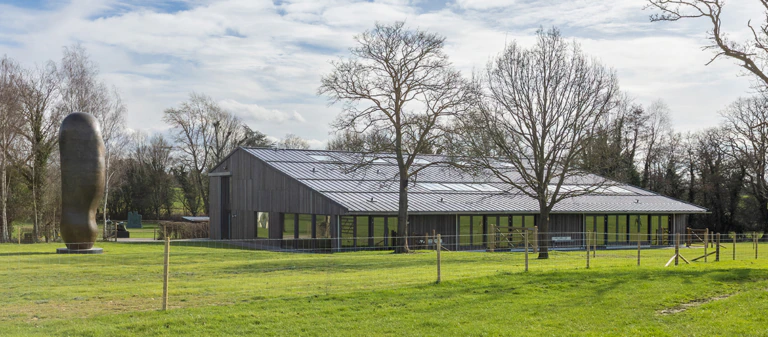
The battle took place on 23-24 June 1314 and the exact location is still a subject of debate, but most historians agree that the first day of fighting was roughly on the site of the National Trust for Scotland visitor centre, which recently opened near Stirling.
This year marks the 700th anniversary of the battle, which coincides with the referendum to decide if Scotland should be an independent country. In this politically charged context, the trust successfully interprets the historical significance of the battle, using the latest 3D digital technology.
The visit starts with two quirky animated films setting the context and key players leading up to the battle. These are highly enjoyable, despite noise spill from the reception and shop nearby.
The National Trust for Scotland (NTS) recruited some of the UK’s top experts to inform the interpretation. It worked with the Centre for Digital Documentation and Visualisation (a partnership between the Glasgow School of Art’s Digital Design Studio and Historic Scotland), and used motion-capture technology similar to that used in the Lord of the Rings films.
Re-enactors spar in real fight scenes that are digitally captured to animate the 3D Prepare for Battle characters. More complex battle sequences were created by combining the motion-capture data with special effects at a later stage in the production.
Computer-generated figures
The overall result is impressive, as visitors wearing 3D spectacles are plunged into the very heart of the fight with horses and soldiers thundering around, seemingly within arm’s reach. I thought the film could have been gorier, but three young girls aged 10-13 were deeply engaged, shouting out “I wouldn’t want to be that guy!” and “Look, that’s Robert the Bruce! There’s Edward!”
Behind the battle arena is the Character Station, which features life-size computer-generated figures activated by visitors “waving” their hands to trigger bite-size pieces of dialogue. This has been a fantastic outreach opportunity, as volunteers from across the UK had their faces laser scanned to create some of these figures.
These range from Margaret Malherbe from Stirling, “one of the small folk who stood at a distance from battle to give the impression of great numbers”, to Dafydd ap Cynwrig, a Welsh archer and professional soldier on the English side, and Juliana Coldingham, a Scottish spy trading information about Bruce’s army for money.
The quality of historical content and digital technology in this section is very high but there is a lot going on in this space. Prepare for Battle also includes a display of replica weapons and armour to touch and explore, and two touchscreen computers explaining the next section, the Battle Room presentations. This next section is time-ticketed, with single entrance and exit through Prepare for Battle, which can get swamped between presentations.
Leadership games
The Battle Room offers two separate experiences focused on 3D sequencing of the battle projected on to a tabletop. The first is a 10-minute Battle Show audio, narrated by Tony Pollard, the director of the Centre for Battlefield Archaeology at the University of Glasgow, and Fiona Watson, an author, historian and broadcaster.
Both academics have an easy accessible style but I would have enjoyed watching them on film in the actual battle site, which would have provided a change of interpretive pace and a link between the visitor centre and the historic landscape.
The second part is the 40-minute Battle Game, led by a costumed battlemaster. Visitors are assigned a number and coat of arms, shown on the tabletop. Visitors don’t know at this point who they are and two players are surprised to discover that they are the kings. The battlemaster sets the battle context and gives the verbal instructions that the players can use to move their tiny, digital troops.
The game does not seek at this point to recreate the actual battle, but gives players an experience of commanding troops under pressure. It is time-limited and a dropping vertical white bar shows casualties or total annihilation of troops. Team members can confer and it is possible to alter the course of history – there have been English victories over the Scots at Bannockburn.
Ambitious project
On my first visit at a pre-opening, I wondered how this section would work with an audience of strangers. Taking part next time with families, overseas students and older adults, everyone worked hard and fast together as Team Scots or Team English.
A final 3D-animated film moves the story on to the aftermath and turbulent years of establishing Scottish independence, a wall graphic reminding us that: “Robert Bruce’s remarkable victory at Bannockburn represented a huge step forward in the campaign to restore Scotland as an independent nation.”
The visit ends with a short walk from the visitor centre to the historic battlefield landscape and monuments, restored to mark the 700th anniversary of the battle.
NTS has taken a brave approach to interpreting a site where little material evidence has been recovered. All staff excel at supporting visitors to get the most from their experience. In this, they are indebted to all those behind the scenes who have generated research and content around the battle of Bannockburn.
Christine McLean is the community engagement manager at National Museums Scotland
Spotlight on... Digital storytelling
One of the most innovative aspects of the new interpretation at the Battle of Bannockburn centre is the combination of digital storytelling techniques with a strong academic basis and verification.
This was made possible by partnerships between the National Trust for Scotland, the Project Academic Advisory Panel, interpretative designers Bright White, and the Centre for Digital Documentation and Visualisation.
For example, the immersive 3D visualisations conjured up in the centre of those involved in the battle are distilled from a vast body of specialist knowledge. They set a new benchmark for the visualisation of medieval fighting men, and constitute a digital armoury rich in historical detail, with untold learning potential.
The battle simulator, at the heart of the experience, is another example. The project team used aerial scan data and worked with historians and paleo-environmental archaeologists to develop a luminous 3D-model of the battlefield, complete with hills and rivers, trees and marshes. This means that the gaming environment is as accurate as can possibly be known, 700 years after the event.
As a result of these unique innovations, visitors approach the surrounding landscape and monuments with their imaginations enlivened by authentic and compelling drama, and with an appreciation of Bruce's audacity as a strategic commander facing up to Edward's larger army.
Tom Ingrey-Counter is the interpretation project manager for the Battle of Bannockburn Visitor Centre. He is among the speakers at Show and Tell: New Approaches to Display and Interpretation, a Museum Practice seminar being held on 11 June in Glasgow.
Project data
- Cost £9.1m
- Main funders Scottish government £5m; Heritage Lottery Fund £4.1m
- 3D media research, development and realisation Centre for Digital Documentation and Visualisation
- Interpretive designer Bright White
- Architect Reiach & Hall Landscape architect Ian White Associates Structural engineer SKM M&E engineer KJ Tait Engineers Main contractor Mansell Construction Services
- Quantity surveyor Turner & Townsend