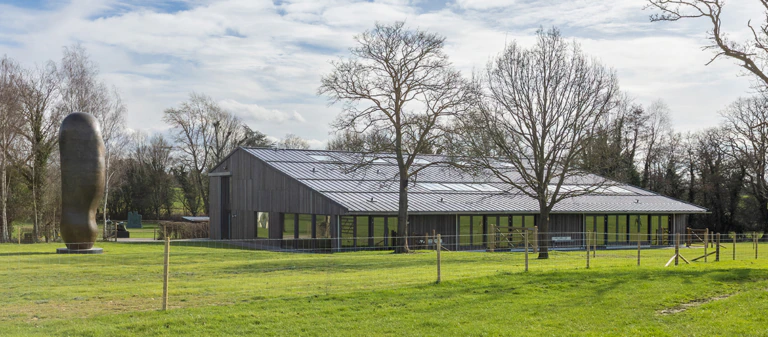
After 12 years in the shadow of its big brother, Alnwick Castle, Bailiffgate Museum and Gallery has reopened after a three-month refurbishment.
This project, financed with a grant from the Heritage Lottery Fund (HLF), has resulted in a delightful new social history museum dedicated to the history of Alnwick and Northumberland.
The redeveloped museum now acts as a centre for local historical research as well as having a range of permanent social-history displays. Temporary exhibitions are held in the first-floor area, which was created when the church was first turned into a museum in 2002.
The museum’s large collection of images will be accessible on the museum’s new website. This also acts as an online shop, lists events and provides access to a range of other resources.
Volunteer-run
Bailiffgate is managed and staffed by volunteers, and the museum’s designer has carefully incorporated this aspect into the displays. Volunteers have contributed to the design and provided some of the images used on the 50-plus information boards. They have also come up with the museum’s new mascot, Finlay the mouse, who acts as guide for younger visitors.
Finlay is named after the grandchild of a trustee and, in a similar vein, another trustee has lent his facial features to the full-size figure of 19th-century printmaker William Davison, who appears in a reconstruction of this printshop.
The schoolroom – with desks and full-size schoolteacher – and the print shop are two of the three large displays in the museum and they form the core of the galleries. Visitors start their tour in the new, larger reception/shop area, where a book, Singin’ Hinnies, takes pride of place among a good display of merchandise. This was co-published with the local Glanton Heritage Group to coincide with the reopening of the museum and is part of a professionally executed programme to refurbish and relaunch the museum.
Humour
The anti-clockwise tour starts with a brief introductory film. Bailiffgate Museum has not used too much digital media, thereby avoiding the now traditional dark screens with the “out of order” signs that often punctuate modern museum displays.
Digital media is in evidence in the shape of QR codes and a video-jukebox in the tiny upstairs gallery, which also acts as a cafe. The jukebox could do with better sound but, other than that, the self-service catering facility, with its spotless crockery and roomy honesty-box, works well.
The museum’s volunteers and designer have struck exactly the right balance of humour and seriousness in the displays. You could walk through the entire museum in minutes but this is nevertheless a museum that wants to take you on a historical trek over thousands of years, from the Mesolithic to the present. A bold colour scheme divides the different areas of the museum and the mannequins include a miner in a bath.
The basement is devoted to the coalmining industry and it has been possible to squeeze in not only a “living room area”, where the miner is having his bath, but also what must count as the world’s shortest crawl-through reconstructed coalmine gallery. I resisted the temptation to descend to floor level but I imagine that this experience will enhance the visit for younger audiences.
Triumph
The museum contains an eclectic choice of artefacts. I happened to stop at the military displays and enjoyed looking at the full-sized radar screen from RAF Boulmer. The display case next to it features, among other things, two small personal collections of wartime memorabilia.
They show the kind of individual collecting that forms the basis of much of the museum’s activity but also clearly anchors events of world significance – the first world war and the Korean war – in the personal experiences of the museum’s own constituency.
Alnwick’s relaunched Bailiffgate Museum is a triumph. It has been carefully planned and is well-executed and it has received good support from friendly local media. We should not underestimate the value of the traditional print and electronic media, whose coverage of local museums is often excellent and helpful.
But I suspect that behind that support there was also a well-designed media campaign leading to a drip-feed of information to keep interest in the museum alive. In all kinds of ways, this is a fine example of the community setting up and running its own museum and we must celebrate this.
Visitor attraction
Alnwick’s mayor has said that Bailiffgate Museum is also important as a visitor attraction. But in this case, the tourists are likely to approach the museum through Alnwick Castle. They will end up by the wall where Harry Potter learned to play quidditch and, if they are so inclined, they may visit the fine little Fusiliers Museum. But will people make it to Bailiffgate? And if they don't, does it matter?
Social history
I am not convinced that Bailiffgate – and perhaps other volunteer museums – are helped by being hitched to the heritage tourism wagon. The people of Alnwick and Northumberland now have a fine social history museum that can act as the focus for the current and future collection of historical evidence.
If, in addition to the displays and its other activities and events, the museum can also encourage some research into its collections, then it will have more than served the community.
Tyne and Wear Archives and Museums has given items from its collections to the redeveloped museum. These provide a level of knowledge and expertise that complements the fine work performed by the museum’s volunteers. Volunteers they may be, but they are by no means amateurs.
Hans-Christian Andersen is a senior lecturer in cultural tourism at Newcastle Business School and a committee member of Museums North
Project data
- Cost £135,000
- Main funder Heritage Lottery Fund
- Exhibition design Janvs Design/Vidar Media
- Website Colin Harris Website Development
- Consultant Tyne and Wear Archives and Museums
- Project management and interpretation in-house