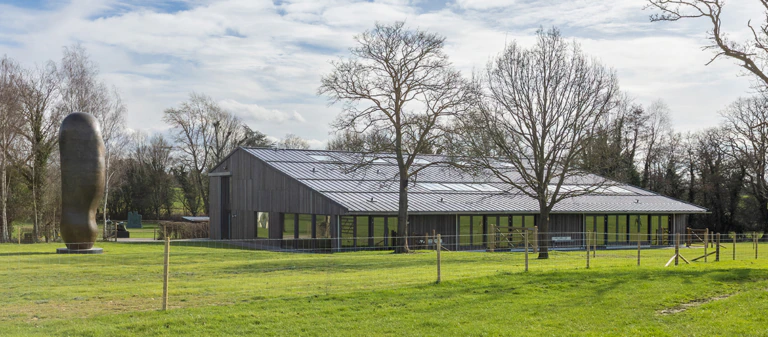
It’s not an unusual marriage – an old industrial building housing a contemporary art gallery. This particular one, which has lots of clean lines, bright lights and glitter balls, opened recently in central London in a refurbished Express Dairies facility.
And at the Dairy Art Centre, it’s a relationship that works –the steel girders, industrial flooring and tattered skylights make the space feel intimate and provide a gritty backdrop to the art.
A different initiative?
The Dairy is a privately funded not-for-profit initiative and is the brainchild of two big names in contemporary art collecting – Frank Cohen and Nicolai Frahm.
Exhibitions will include work from both of their collections, but the Dairy also intends to borrow art from other collectors and establishments.
The opening of the Dairy has invited comparisons to the art collector Charles Saatchi and his King’s Road gallery, although in reality the centre couldn’t be more different.
It’s much smaller and more intimate, with a less corporate feel. Its stated aim is to create “a different kind of art initiative” in which curatorial boundaries will be pushed.
Exhibitions will vary from solo shows (such as the inaugural exhibition featuring Swiss artist John Armleder) to group shows. The publicity says it wants to be a space for everyone – the local community, families, art professionals and enthusiasts.
The refurbishment of the single-storey building has created interesting display spaces, including rooms of various sizes with different sources of light, two outside spaces, and “the fridge”, a room retaining its original name and flooring.
Interpretation
Armleder’s show, Quicksand, mixes different genre and media including paintings, installations, and sculptures. For this exhibition, the Dairy has decided not to label individual pieces of art.
This supports the artist’s idea of the exhibition as a medium in its own right and means that no one else’s interpretation is imposed on visitors.
For those wishing to know more about Armleder and his work there is a leafl et written by the curator, Alessandro Rabottini. Although Rabottini’s analysis will help art connoisseurs to appreciate the exhibition, it required a high level of art- historical background knowledge and I found it hard to read while looking around.
If the Dairy is aiming to be for everyone, there is a need for a more basic level of information. I wanted to know the dates of some of the pieces, especially since I knew that some of the work on display was made collaboratively for the exhibition.
I guessed that one of these was the multimedia installation in “the Fridge”, but was unsure which other works fell into this category.
The Dairy received the detailed outline of the show from Armleder just six weeks before the gallery was to open. There must have been a frantic rush to get the artworks installed and some practical issues seem to have been overlooked.
When I visited the venue two days after it had opened there were no signs at all leading to its quiet corner of Bloomsbury. Even when the centre came into view, the Dairy sign (black glitter on black gloss) was hard to read from a distance.
Once there, the centre did not seem very welcoming, and I wonder if some people would not even try the door to gain entry.
Signage inside the centre also seemed to be incomplete. There were no indications where the toilets were and the signs on the doors were either hard to understand or non-existent. There was a plan of the gallery on the information sheet but this was not laid out very clearly.
Room for improvement
From a selfish point of view, I was disappointed that the bar (designed by Armleder, black and shiny with rainbow-coloured stools) in the reception area was, on the day I visited, a “non-functional work of art”.
Sometimes this piece is used as a bar, but a permanent bar or café would really help to encourage more people to visit the centre.
With the inaugural exhibition, the Dairy has set a high standard and has gone some way to meeting its aims. But now this first show is open, it needs to concentrate on improving other areas, such as signage, and meeting the needs of all of its potential audiences, not just the ones with existing knowledge.
But it’s an exciting space and I am looking forward to seeing what it does next.
Julia Edge is a former collections manager at the Horniman Museum, London, and a volunteer at Storrington and District Museum, West Sussex
And at the Dairy Art Centre, it’s a relationship that works –the steel girders, industrial flooring and tattered skylights make the space feel intimate and provide a gritty backdrop to the art.
A different initiative?
The Dairy is a privately funded not-for-profit initiative and is the brainchild of two big names in contemporary art collecting – Frank Cohen and Nicolai Frahm.
Exhibitions will include work from both of their collections, but the Dairy also intends to borrow art from other collectors and establishments.
The opening of the Dairy has invited comparisons to the art collector Charles Saatchi and his King’s Road gallery, although in reality the centre couldn’t be more different.
It’s much smaller and more intimate, with a less corporate feel. Its stated aim is to create “a different kind of art initiative” in which curatorial boundaries will be pushed.
Exhibitions will vary from solo shows (such as the inaugural exhibition featuring Swiss artist John Armleder) to group shows. The publicity says it wants to be a space for everyone – the local community, families, art professionals and enthusiasts.
The refurbishment of the single-storey building has created interesting display spaces, including rooms of various sizes with different sources of light, two outside spaces, and “the fridge”, a room retaining its original name and flooring.
Interpretation
Armleder’s show, Quicksand, mixes different genre and media including paintings, installations, and sculptures. For this exhibition, the Dairy has decided not to label individual pieces of art.
This supports the artist’s idea of the exhibition as a medium in its own right and means that no one else’s interpretation is imposed on visitors.
For those wishing to know more about Armleder and his work there is a leafl et written by the curator, Alessandro Rabottini. Although Rabottini’s analysis will help art connoisseurs to appreciate the exhibition, it required a high level of art- historical background knowledge and I found it hard to read while looking around.
If the Dairy is aiming to be for everyone, there is a need for a more basic level of information. I wanted to know the dates of some of the pieces, especially since I knew that some of the work on display was made collaboratively for the exhibition.
I guessed that one of these was the multimedia installation in “the Fridge”, but was unsure which other works fell into this category.
The Dairy received the detailed outline of the show from Armleder just six weeks before the gallery was to open. There must have been a frantic rush to get the artworks installed and some practical issues seem to have been overlooked.
When I visited the venue two days after it had opened there were no signs at all leading to its quiet corner of Bloomsbury. Even when the centre came into view, the Dairy sign (black glitter on black gloss) was hard to read from a distance.
Once there, the centre did not seem very welcoming, and I wonder if some people would not even try the door to gain entry.
Signage inside the centre also seemed to be incomplete. There were no indications where the toilets were and the signs on the doors were either hard to understand or non-existent. There was a plan of the gallery on the information sheet but this was not laid out very clearly.
Room for improvement
From a selfish point of view, I was disappointed that the bar (designed by Armleder, black and shiny with rainbow-coloured stools) in the reception area was, on the day I visited, a “non-functional work of art”.
Sometimes this piece is used as a bar, but a permanent bar or café would really help to encourage more people to visit the centre.
With the inaugural exhibition, the Dairy has set a high standard and has gone some way to meeting its aims. But now this first show is open, it needs to concentrate on improving other areas, such as signage, and meeting the needs of all of its potential audiences, not just the ones with existing knowledge.
But it’s an exciting space and I am looking forward to seeing what it does next.
Julia Edge is a former collections manager at the Horniman Museum, London, and a volunteer at Storrington and District Museum, West Sussex
Project data
- Cost undisclosed
- Main funders Frank Cohen; Nicolai Frahm
- Architect Jenny Jones