The Victoria and Albert Museum (V&A) is celebrating 60 years of British design as its contribution to this Olympic year. Starting such a retrospective in 1948 might seem odd as there are more obvious dates.
What about 1946, the year of the Britain Can Make It (but can’t have it) exhibition, or 1951, the year of the Festival of Britain, which was such a successful showcase for our designers? But there is a precedent, as the V&A hosted its Sport in Art exhibition in 1948.
And 1948 was the last time that Britain hosted the Olympics, so it’s a reasonable starting point. A year of continuing postwar austerity, shortages, enormous national debt and a hope that the Olympics would help raise the national mood as the country struggled to find its place in a changed world.
So what happened to British design in the intervening years and what has the V&A got to say about it?
Firstly, this exhibition is unashamedly a celebration of the best of British design, and one that focuses on the aesthetics of the design process. This is mainly about the look of things, what the late visual arts writer and critic Peter Dormer called “above the line” design.
Science, engineering and manufacturing, “below the line design”, hardly get a look in. The exhibition says little about the market and the consumer and the dramatic decline of Britain as a manufacturing nation.
There are lots of beautiful objects here, and they are what anyone with a passing knowledge of design history would expect. You want the big names, you get them.
The exhibition’s intellectual thrust is based around three underlying themes: Tradition and Modernity; Subversion; and Innovation and Creativity. Each section has a gallery to itself.
You enter the show to be faced by John Piper’s mural for the Homes and Gardens Pavilion from the 1951 Festival of Britain, alongside Ernest Race’s metal chairs.
So, we started at 1951 after all, didn’t we? Next, there is a section devoted to the Festival of Britain and also a case study of postwar reconstruction as exemplified by Coventry Cathedral.
World of interiors
It would have been interesting to have something on the advances in material production that took place in the war and the philosophy of the Design Council but instead we go straight into a series of smaller themed displays that take the subject of Tradition and Modernity discussing new towns, country-house style, craft and the land, educational buildings and transportation.
The country-house style links the work of John Fowler, Laura Ashley, Edward Bawden, Hardy Amies and Vivienne Westwood. It closes with sections on interior design from the 1960s, 1970s and 1980s.
Maybe it was the design, but it all felt confusing. I left the gallery not knowing where that tension between tradition and modernity had taken us to. Perhaps we have yet to resolve it.
I arrived in the second gallery, home to Subversion which, a bit like sex, seems to have been invented in the late 1950s and 1960s. It charts the explosive spirit of the art colleges, the This is Tomorrow show at London’s Whitechapel Gallery and the fusing of an iconoclastic, rock ’n’ roll attitude.
This is illustrated through an Allen Jones chair, a Hockney painting, an Eduardo Paolozzi sculpture and clothes from Quant through to McQueen. Alongside this are sections on film and photography.
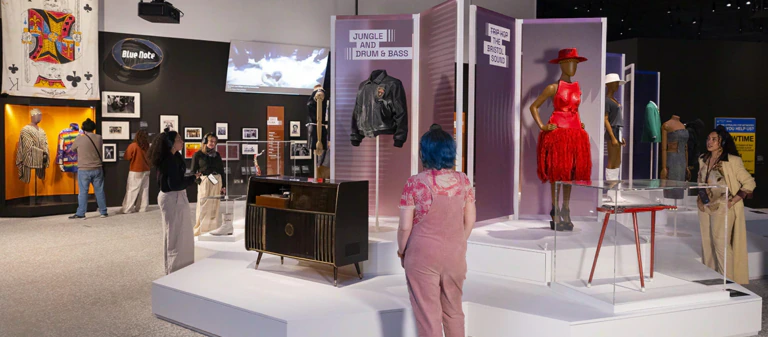
The rock ’n’ roll influence is strong, with stage costumes worn by Roxy Music, David Bowie and Marc Bolan, a wall of punk T-shirts and graphics and a reconstruction of part of the Haçienda dance floor, designed, like this show, by Ben Kelly.
Alongside, are the usual Factory record sleeves and The Face and i-D magazine covers and a booth playing videos; no acid house though.
The Haçienda was a design revelation when it opened, but its greater legacy is a cultural and musical one, which like so many of the things here was inspired by American culture and amplified by drugs.
Given this gallery is about subversion, a discussion of the associated drug culture is surprisingly absent, although it ends with a reconstruction of Damien Hirst’s Pharmacy restaurant, a truly chemically inspired creation.
Finally, we get Innovation and Creativity, which looks at pioneering designs and the move “away from traditional manufacturing towards innovative financial, retail and creative services”… aka Britain Can Design It… (but won’t make it).
It includes a model of Concorde, a Dyson vacuum cleaner, stylish products by Kenneth Grange, and Jonathan Ive, video games and architectural models. And that was it really.
Critical voice
OK, it’s a celebration, but I was hoping for something a bit more critical and more on how innovation and creativity fared as we moved from postwar state-sponsored optimism through industrial decline.
There are a few examples, such as the vacuum cleaner designed by James Dyson, where the label explains that no major UK manufacturers would take on his idea.
After licensing the design in Japan, production eventually took place in the UK before moving to China. I wanted some discussion of failure and where this knowledge could take us.
The first object in this section is a gorgeous Jaguar E-Type (grown men were weeping), but equally interesting would have been a Triumph Dolomite, whose creative concept – a compact, luxurious, high performance four-door saloon – could have developed into a world beater but, thanks to the reasons noted above, never happened.
In the end the exhibition petered out with no conclusion. Given the 1948-2012 timeframe, there was no real attempt to discuss our current condition: austerity, inequality, enormous national debt and the hope that the Olympics might raise the national mood as the country struggles to find its place in a changed world.
I wanted to know where the authors felt British design was going as we struggle to re-balance our economy and re-engage with making things again. Some of this is there in the huge book that accompanies the show, but that’s no reason why the exhibition itself should not have had more of a voice.
Mark Suggitt is the director of Derwent Valley Mills World Heritage Site, Derbyshire
What about 1946, the year of the Britain Can Make It (but can’t have it) exhibition, or 1951, the year of the Festival of Britain, which was such a successful showcase for our designers? But there is a precedent, as the V&A hosted its Sport in Art exhibition in 1948.
And 1948 was the last time that Britain hosted the Olympics, so it’s a reasonable starting point. A year of continuing postwar austerity, shortages, enormous national debt and a hope that the Olympics would help raise the national mood as the country struggled to find its place in a changed world.
So what happened to British design in the intervening years and what has the V&A got to say about it?
Firstly, this exhibition is unashamedly a celebration of the best of British design, and one that focuses on the aesthetics of the design process. This is mainly about the look of things, what the late visual arts writer and critic Peter Dormer called “above the line” design.
Science, engineering and manufacturing, “below the line design”, hardly get a look in. The exhibition says little about the market and the consumer and the dramatic decline of Britain as a manufacturing nation.
There are lots of beautiful objects here, and they are what anyone with a passing knowledge of design history would expect. You want the big names, you get them.
The exhibition’s intellectual thrust is based around three underlying themes: Tradition and Modernity; Subversion; and Innovation and Creativity. Each section has a gallery to itself.
You enter the show to be faced by John Piper’s mural for the Homes and Gardens Pavilion from the 1951 Festival of Britain, alongside Ernest Race’s metal chairs.
So, we started at 1951 after all, didn’t we? Next, there is a section devoted to the Festival of Britain and also a case study of postwar reconstruction as exemplified by Coventry Cathedral.
World of interiors
It would have been interesting to have something on the advances in material production that took place in the war and the philosophy of the Design Council but instead we go straight into a series of smaller themed displays that take the subject of Tradition and Modernity discussing new towns, country-house style, craft and the land, educational buildings and transportation.
The country-house style links the work of John Fowler, Laura Ashley, Edward Bawden, Hardy Amies and Vivienne Westwood. It closes with sections on interior design from the 1960s, 1970s and 1980s.
Maybe it was the design, but it all felt confusing. I left the gallery not knowing where that tension between tradition and modernity had taken us to. Perhaps we have yet to resolve it.
I arrived in the second gallery, home to Subversion which, a bit like sex, seems to have been invented in the late 1950s and 1960s. It charts the explosive spirit of the art colleges, the This is Tomorrow show at London’s Whitechapel Gallery and the fusing of an iconoclastic, rock ’n’ roll attitude.
This is illustrated through an Allen Jones chair, a Hockney painting, an Eduardo Paolozzi sculpture and clothes from Quant through to McQueen. Alongside this are sections on film and photography.
The rock ’n’ roll influence is strong, with stage costumes worn by Roxy Music, David Bowie and Marc Bolan, a wall of punk T-shirts and graphics and a reconstruction of part of the Haçienda dance floor, designed, like this show, by Ben Kelly.
Alongside, are the usual Factory record sleeves and The Face and i-D magazine covers and a booth playing videos; no acid house though.
The Haçienda was a design revelation when it opened, but its greater legacy is a cultural and musical one, which like so many of the things here was inspired by American culture and amplified by drugs.
Given this gallery is about subversion, a discussion of the associated drug culture is surprisingly absent, although it ends with a reconstruction of Damien Hirst’s Pharmacy restaurant, a truly chemically inspired creation.
Finally, we get Innovation and Creativity, which looks at pioneering designs and the move “away from traditional manufacturing towards innovative financial, retail and creative services”… aka Britain Can Design It… (but won’t make it).
It includes a model of Concorde, a Dyson vacuum cleaner, stylish products by Kenneth Grange, and Jonathan Ive, video games and architectural models. And that was it really.
Critical voice
OK, it’s a celebration, but I was hoping for something a bit more critical and more on how innovation and creativity fared as we moved from postwar state-sponsored optimism through industrial decline.
There are a few examples, such as the vacuum cleaner designed by James Dyson, where the label explains that no major UK manufacturers would take on his idea.
After licensing the design in Japan, production eventually took place in the UK before moving to China. I wanted some discussion of failure and where this knowledge could take us.
The first object in this section is a gorgeous Jaguar E-Type (grown men were weeping), but equally interesting would have been a Triumph Dolomite, whose creative concept – a compact, luxurious, high performance four-door saloon – could have developed into a world beater but, thanks to the reasons noted above, never happened.
In the end the exhibition petered out with no conclusion. Given the 1948-2012 timeframe, there was no real attempt to discuss our current condition: austerity, inequality, enormous national debt and the hope that the Olympics might raise the national mood as the country struggles to find its place in a changed world.
I wanted to know where the authors felt British design was going as we struggle to re-balance our economy and re-engage with making things again. Some of this is there in the huge book that accompanies the show, but that’s no reason why the exhibition itself should not have had more of a voice.
Mark Suggitt is the director of Derwent Valley Mills World Heritage Site, Derbyshire
Project data
- Cost Undisclosed
- Sponsor Ernst & Young
- Curators Christopher Breward; Ghislaine Wood
- Exhibition design Ben Kelly Design
- Graphics Graphic Thought Facility
- Audiovisuals Soda
- Visual identity/catalogue Barnbrook Design
- Exhibition ends 12 August