“Do not wave your hands to friends in the audience. As far as you are concerned, the audience does not exist.”
This stern rebuke from pageant master Louis N Parker to the amateur performers in the 1909 Colchester pageant was recorded on a poster. A 100 years later, the audience is at the heart of Firstsite, the new contemporary art space in Colchester with the mission to “make contemporary art relevant to everyone”.
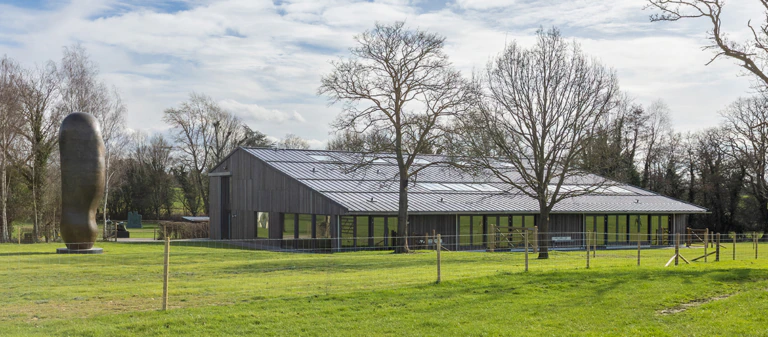
Firstsite is housed in a crescent-shaped building designed by Rafael Viñoly, a Latin-American architect based in New York. Clad in a distinctive copper-aluminium alloy, it glows gold even on damp days, hence the local nickname, the Golden Banana.
As the site is a Scheduled Ancient Monument, the structure is designed to “float” on a concrete raft foundation. Despite its exotic appearance, the building looks as though it has always been there, as it embraces the remains of an 18th-century landscaped garden.
So embedded is it in the site that it’s difficult to get an overall view of the building. Inside, the glass walls bring in the historic buildings that surround it: part of the Roman wall, the remains of an 11th-century priory, and the Georgian architecture of the Minories, Firstsite’s first home.
Mosaic centre
Despite being one of the largest contemporary art venues in the UK, everything is on a human scale. This is not one of those galleries designed to inspire shock and awe.
You can tell that from the first installation, We the People by Danh Vo, whose latest project is a full-scale copper replica of the Statue of Liberty; a mere fragment of the hand and part of the torch greet the visitor.
From the large glass entrance lobby, the ceiling slopes down and the arc of the building means that you are drawn to explore. The curved outer wall leads you past the auditorium to five interconnected galleries and a learning space, then to the cafe at the end of the building.
Some of the galleries are almost on a domestic scale, and I wonder how flexible the spaces will prove to be.
The heart of Firstsite is the mosaic space, echoing the courtyard of the Roman villa that once stood here. Here, the Berryfield Mosaic, reinstated under glass on the site where it was found, provides both a focal point and a reminder that the site has been occupied for 2,000 years.
Firstsite is the same length as Tate Modern’s Turbine Hall, but it’s much warmer. The galleries are flooded with natural light, the walls curve gracefully, soft pebble-like benches invite you to linger, and there is a subtle use of colour: flashes of ochre, blue and red highlight the architecture and take the chill off the white walls.
Time travel
Its inaugural exhibition, Camulodunum (until 22 January 2012), takes its name from the original Roman name for Colchester. Commissions by international artists are combined with loans from major collections including Tate, the Victoria and Albert Museum and Arts Council England. (Firstsite is one of the partners in the Plus Tate network of regional art galleries.)
A keynote of the exhibition is quirky and witty juxtapositions that leap across centuries: Andy Warhol’s Campbell Soup II – Oyster Stew shown next to photographs from the annual Colchester Oyster Feast, and Henry Moore’s Helmet Head No 1 and No 3 with Roman remains.
This feeling of time travel continues with Aleksandra Mir’s new installation Hello Colchester, which connects a 16th-century painting of Elizabeth I with a 21st-century Essex family wedding photograph, through a chain of 100 images.
This throws up some surprising neighbours, such as the present Queen and Santa Claus, linked together by a young disabled soldier. One gallery is dedicated to ESCALA, the Latin-American art collection held by the University of Essex, a partner in the project.
This collection, the best of its kind in Europe, has long looked for a suitable public venue but I found the initial exhibition of prints from Brazil, Paraguay and Chile distinctly underwhelming. Given Firstsite’s mission, the building is surprisingly difficult to navigate, and a plan, rather than just a list of galleries by number, would help with orientation.
The only plan I saw was on the back of t-shirts worn by staff. Information about the works is in a booklet handed to each visitor, but the positioning of the labels, and the lack of images in the booklet, means that linking the work with the description can be hard work.
When I visited during half term, Firstsite was crowded with families, teenagers and older couples. Judging by the comments I overheard – “brilliant”, “cool”, “civilised” – it has accomplished its mission. But, once the novelty wears off, the challenge will be to retain their enthusiasm.
Jane Weeks is a museum consultant
This stern rebuke from pageant master Louis N Parker to the amateur performers in the 1909 Colchester pageant was recorded on a poster. A 100 years later, the audience is at the heart of Firstsite, the new contemporary art space in Colchester with the mission to “make contemporary art relevant to everyone”.
Firstsite is housed in a crescent-shaped building designed by Rafael Viñoly, a Latin-American architect based in New York. Clad in a distinctive copper-aluminium alloy, it glows gold even on damp days, hence the local nickname, the Golden Banana.
As the site is a Scheduled Ancient Monument, the structure is designed to “float” on a concrete raft foundation. Despite its exotic appearance, the building looks as though it has always been there, as it embraces the remains of an 18th-century landscaped garden.
So embedded is it in the site that it’s difficult to get an overall view of the building. Inside, the glass walls bring in the historic buildings that surround it: part of the Roman wall, the remains of an 11th-century priory, and the Georgian architecture of the Minories, Firstsite’s first home.
Mosaic centre
Despite being one of the largest contemporary art venues in the UK, everything is on a human scale. This is not one of those galleries designed to inspire shock and awe.
You can tell that from the first installation, We the People by Danh Vo, whose latest project is a full-scale copper replica of the Statue of Liberty; a mere fragment of the hand and part of the torch greet the visitor.
From the large glass entrance lobby, the ceiling slopes down and the arc of the building means that you are drawn to explore. The curved outer wall leads you past the auditorium to five interconnected galleries and a learning space, then to the cafe at the end of the building.
Some of the galleries are almost on a domestic scale, and I wonder how flexible the spaces will prove to be.
The heart of Firstsite is the mosaic space, echoing the courtyard of the Roman villa that once stood here. Here, the Berryfield Mosaic, reinstated under glass on the site where it was found, provides both a focal point and a reminder that the site has been occupied for 2,000 years.
Firstsite is the same length as Tate Modern’s Turbine Hall, but it’s much warmer. The galleries are flooded with natural light, the walls curve gracefully, soft pebble-like benches invite you to linger, and there is a subtle use of colour: flashes of ochre, blue and red highlight the architecture and take the chill off the white walls.
Time travel
Its inaugural exhibition, Camulodunum (until 22 January 2012), takes its name from the original Roman name for Colchester. Commissions by international artists are combined with loans from major collections including Tate, the Victoria and Albert Museum and Arts Council England. (Firstsite is one of the partners in the Plus Tate network of regional art galleries.)
A keynote of the exhibition is quirky and witty juxtapositions that leap across centuries: Andy Warhol’s Campbell Soup II – Oyster Stew shown next to photographs from the annual Colchester Oyster Feast, and Henry Moore’s Helmet Head No 1 and No 3 with Roman remains.
This feeling of time travel continues with Aleksandra Mir’s new installation Hello Colchester, which connects a 16th-century painting of Elizabeth I with a 21st-century Essex family wedding photograph, through a chain of 100 images.
This throws up some surprising neighbours, such as the present Queen and Santa Claus, linked together by a young disabled soldier. One gallery is dedicated to ESCALA, the Latin-American art collection held by the University of Essex, a partner in the project.
This collection, the best of its kind in Europe, has long looked for a suitable public venue but I found the initial exhibition of prints from Brazil, Paraguay and Chile distinctly underwhelming. Given Firstsite’s mission, the building is surprisingly difficult to navigate, and a plan, rather than just a list of galleries by number, would help with orientation.
The only plan I saw was on the back of t-shirts worn by staff. Information about the works is in a booklet handed to each visitor, but the positioning of the labels, and the lack of images in the booklet, means that linking the work with the description can be hard work.
When I visited during half term, Firstsite was crowded with families, teenagers and older couples. Judging by the comments I overheard – “brilliant”, “cool”, “civilised” – it has accomplished its mission. But, once the novelty wears off, the challenge will be to retain their enthusiasm.
Jane Weeks is a museum consultant
Project data
- Cost £28m
- Main funders Arts Council England £9.2m; Colchester Borough Council; Essex County Council; East of England Development Agency; University of Essex
- Architect Rafael Viñoly Architects