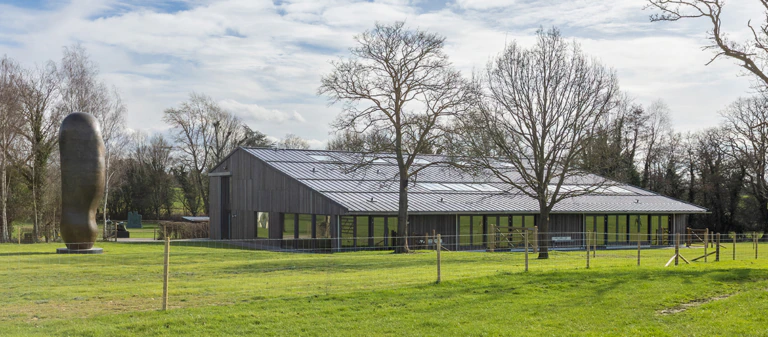
Approaching the National Maritime Museum (NMM) from Greenwich Park, the Sammy Ofer Wing creates an impressive entrance, the gleaming modern lines of the new building contrasting with the older facades.
With a nod to the museum’s subject matter, a narrow stream flows parallel to the building and marine plants grace the borders.
The wing, which opened in July, was largely funded by shipping magnate Sammy Ofer, who died in June. The extension comprises the Voyagers: Britons and the Sea gallery; the Compass Lounge, where visitors can discover the museum’s collections electronically; a cafe and brasserie; a library; and a large temporary exhibition space.
Voyagers is designed as an introduction to the museum’s collections. The first exhibit is a 25-metre long “wave” structure with images and words projected onto it. The videos include films, images of objects and archive material, and maritime related words that ebb and flow across the structure, mimicking a real wave.
While the wave and its soundtrack do create a feeling of the sea and of the museum’s collections, I am unconvinced that this is the best use of the space. The structure takes up at least half of the gallery and is less effective than the 30-metre object wall at the back of the space.
Artefacts on the object wall are grouped according to emotion rather than chronologically. This immediately makes the display more personal. Each object has a story, and is associated with a named person.
Using emotions in this way helps to engage people; we realise that museum objects represent human stories. The text with each item is concise and easy to understand.
Many of the visitors I observed did not read from one end to the other but stopped and grazed at various points. The case layout and the distinct text allow for this.
The section headings (love, anticipation, etc) are not a dominant feature of the case and missing them does not result in disorientation. Each object has enough of an explanation to put it in time and place and to be understood individually.
I enjoyed the display, and was both moved and intrigued by certain objects and stories. But I was frustrated by the lack of signposting to other displays in the museum. Where can we look to learn more?
A series of videos called What Does the Sea Mean to You? are set into pillars at various heights so that visitors can watch them as they leave the gallery. These show a range of people talking about their experiences of the sea. I found these engaging, but would have liked to have known who these people are.
The Compass Lounge encourages visitors to engage with the archives electronically. At the back of the area, five screens set on a curved wall form a “horizon”, showing images of objects from the museum’s collections.
There is no imposed interpretation as these images are organised by texture and intensity of colour, rather than by object type or chronology.
In practice, the objects still appear in groups (flags tend to be together as do ship models so on) although within these groupings are smaller ones. Visitors can view rolling images from a distance, or can navigate around them using a tracker ball.
It’s a bit like flicking through a book. Find an image that interests you and you can bring it to the front, enlarging it. This is meant to “encourage users to think differently about the connections between objects” and it works well. It is also a good introduction to the breadth of the museum’s collections and is more effective than the wave in Voyagers.
A “Plan-chest” on one side of the lounge has drawers that open to reveal large digital touchscreens that show the most popular objects from the collections website. Visitors can enlarge images and access extra information.
I enjoyed using these, although it took time to master the skill of selecting and enlarging. I persevered, but some visitors were put off when things didn’t immediately work. If the usability is improved, these touchscreens will be a good way of encouraging people to explore the collections.
A text panel explains accession numbers and how to use them in the collections website to look for more information about an object.
It is a mistake not to have a computer terminal in the Compass Lounge to access the website, although there is free wi-fi access for people with laptops and smartphones.
Each visitor to the museum is given a compass card and, from a select number of objects, can choose to “collect” items that interest them by stamping their card in a card reader. Back in the Compass Lounge, you can insert the card into a pod to access more information about the object.
You can also take the card home with you and enter a number onto the museum website to obtain the same information. Many visitors used these enthusiastically, particularly those with children.
The museum is planning to add more objects to the scheme as new galleries are opened. I would also like to see it develop by increasing the connections to related material, and in the number of stories. Again, it would be useful to be able to continue searching for connections online.
A large part of the new wing holds a cafe and brasserie. There is also a state-of-the art library and archive bringing together many items previously stored off-site. The basement of the new wing houses a temporary exhibition gallery.
Although the new wing is impressive and access to electronic information is good, I was disappointed not to see more objects on display, particularly in the Voyagers gallery.
Julia Edge is a former collections manager at the Horniman Museum, London, and a volunteer at Storrington and District Museum, West Sussex
With a nod to the museum’s subject matter, a narrow stream flows parallel to the building and marine plants grace the borders.
The wing, which opened in July, was largely funded by shipping magnate Sammy Ofer, who died in June. The extension comprises the Voyagers: Britons and the Sea gallery; the Compass Lounge, where visitors can discover the museum’s collections electronically; a cafe and brasserie; a library; and a large temporary exhibition space.
Voyagers is designed as an introduction to the museum’s collections. The first exhibit is a 25-metre long “wave” structure with images and words projected onto it. The videos include films, images of objects and archive material, and maritime related words that ebb and flow across the structure, mimicking a real wave.
While the wave and its soundtrack do create a feeling of the sea and of the museum’s collections, I am unconvinced that this is the best use of the space. The structure takes up at least half of the gallery and is less effective than the 30-metre object wall at the back of the space.
Artefacts on the object wall are grouped according to emotion rather than chronologically. This immediately makes the display more personal. Each object has a story, and is associated with a named person.
Using emotions in this way helps to engage people; we realise that museum objects represent human stories. The text with each item is concise and easy to understand.
Many of the visitors I observed did not read from one end to the other but stopped and grazed at various points. The case layout and the distinct text allow for this.
The section headings (love, anticipation, etc) are not a dominant feature of the case and missing them does not result in disorientation. Each object has enough of an explanation to put it in time and place and to be understood individually.
I enjoyed the display, and was both moved and intrigued by certain objects and stories. But I was frustrated by the lack of signposting to other displays in the museum. Where can we look to learn more?
A series of videos called What Does the Sea Mean to You? are set into pillars at various heights so that visitors can watch them as they leave the gallery. These show a range of people talking about their experiences of the sea. I found these engaging, but would have liked to have known who these people are.
The Compass Lounge encourages visitors to engage with the archives electronically. At the back of the area, five screens set on a curved wall form a “horizon”, showing images of objects from the museum’s collections.
There is no imposed interpretation as these images are organised by texture and intensity of colour, rather than by object type or chronology.
In practice, the objects still appear in groups (flags tend to be together as do ship models so on) although within these groupings are smaller ones. Visitors can view rolling images from a distance, or can navigate around them using a tracker ball.
It’s a bit like flicking through a book. Find an image that interests you and you can bring it to the front, enlarging it. This is meant to “encourage users to think differently about the connections between objects” and it works well. It is also a good introduction to the breadth of the museum’s collections and is more effective than the wave in Voyagers.
A “Plan-chest” on one side of the lounge has drawers that open to reveal large digital touchscreens that show the most popular objects from the collections website. Visitors can enlarge images and access extra information.
I enjoyed using these, although it took time to master the skill of selecting and enlarging. I persevered, but some visitors were put off when things didn’t immediately work. If the usability is improved, these touchscreens will be a good way of encouraging people to explore the collections.
A text panel explains accession numbers and how to use them in the collections website to look for more information about an object.
It is a mistake not to have a computer terminal in the Compass Lounge to access the website, although there is free wi-fi access for people with laptops and smartphones.
Each visitor to the museum is given a compass card and, from a select number of objects, can choose to “collect” items that interest them by stamping their card in a card reader. Back in the Compass Lounge, you can insert the card into a pod to access more information about the object.
You can also take the card home with you and enter a number onto the museum website to obtain the same information. Many visitors used these enthusiastically, particularly those with children.
The museum is planning to add more objects to the scheme as new galleries are opened. I would also like to see it develop by increasing the connections to related material, and in the number of stories. Again, it would be useful to be able to continue searching for connections online.
A large part of the new wing holds a cafe and brasserie. There is also a state-of-the art library and archive bringing together many items previously stored off-site. The basement of the new wing houses a temporary exhibition gallery.
Although the new wing is impressive and access to electronic information is good, I was disappointed not to see more objects on display, particularly in the Voyagers gallery.
Julia Edge is a former collections manager at the Horniman Museum, London, and a volunteer at Storrington and District Museum, West Sussex
Project data
- Cost £35m
- Main funders Sammy Ofer £20m; Heritage Lottery Fund £5m
- Client representative and project manager Malcolm Reading Consultants
- Concept design architect CF Møller
- Executive architect Purcell Miller Tritton
- Cost consultant Turner & Townsend
- Main contractor Lend Lease
- Interior designer Softroom
- Archaeological consultant MoLAS
- Access consultant David Bonnett Associates
- Signage and wayfinding Clear
- Digital signage designer The Plant
- Archive racking Rackline
- Voyagers display installation The Hub
- Voyagers gallery designer Real Studios
- Voyagers wave designer Light Surgeons
- Compass Lounge designer Kin