There is a sense that the opening of the Hepworth Wakefield is a homecoming that has been a rather long time coming. Barbara Hepworth was born in Wakefield in 1903 but left when she was 18 years old.
Shortly after, Wakefield opened its first gallery and museum and started collecting work by Hepworth, who was to become one of the most important sculptors of the 20th century.
Hepworth died in 1975 and the new building dedicated to her work has been well worth the wait. The city can now boast the largest purpose-built gallery to have opened in Britain for 50 years, in which it can display its collection and the Hepworth Family Gift.
As well as providing an opportunity to focus on Hepworth’s sculpture, the gallery will also run programme of contemporary exhibitions, which has begun with a solo show by Eva Rothschild.
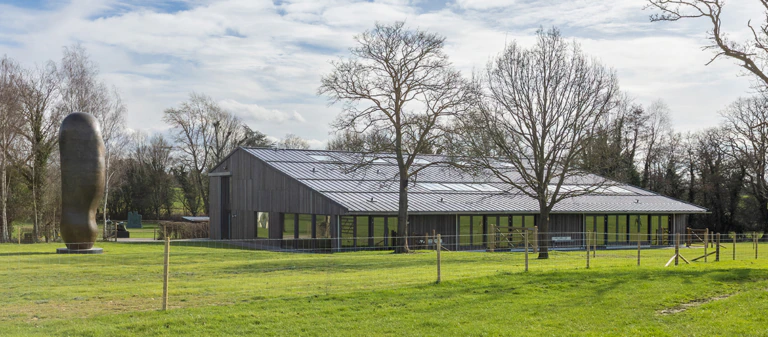
The Hepworth Wakefield is a bold and impressive design of international significance by David Chipperfield Architects. While it is sympathetic to its location and particularly to the historic warehouses nearby, its shape, scale, space, texture and weight reflects Hepworth’s own sculpture.
The building comprises ten geometric blocks huddled closely together. Each one of these blocks is a different size, shape and height to its neighbour and each one has an irregular sloping roof.
The result is surprisingly playful, and yet the sheer scale coupled with the colour of the pigmented concrete facade also creates a sense of grandeur and gravity.
Hepworth’s early carvings come readily to mind as does the later bronze Conversation with Magic Stones and the polished bronze Six Forms on a Circle.
The latter is inside the galley, while the first sculptures seen outdoors are the Parent I, Parent II and Young Girl from Hepworth’s Family of Man – given to Wakefield by the Hepworth Estate in 1993 – a reminder that the Hepworth Wakefield is very much a familial affair, since the recent gift from the artist’s estate was a galvanising force behind the initiative for a new gallery. Just beyond the gallery is a jaunty play area offering a different kind of family experience.
Into the light
The interior is initially a more sombre affair with the walls half-clad in a dark-grey MDF. The ground floor acts as an orientation point for visitors. It has a large reception area, cafe and shop, with stairs leading to the galleries on the floor above.
Top lit, these stairs take one literally into the light, and what initially impresses you on the first floor is the amount of daylight illuminating the gallery spaces from slots in the ceilings. Windows in every room further enhance the artificial lighting.
The spaces themselves continue the irregularity apparent outside. There are variations to the size and shape of the galleries, their orientation, the angles of their walls and the ceiling pitch.
Six galleries have been designed specifically with the permanent collection in mind, from light-sensitive works on paper to monumental sculptures and plasters, so that each room has a slightly different atmosphere, but also the architecture leads the eye towards the works on show.
At the top of the central flight of stairs, the first gallery has been installed sparsely with a few key examples of Hepworth’s sculpture in wood, stone, marble and bronze. Each of these materials is synonymous with certain periods in Hepworth’s career and the gallery offers a summary of her work.
From this point, visitors can turn right into the collections displays or enter the suite of galleries dedicated to the temporary exhibitions. Either way, the point one returns to is this first gallery at the top of the stairs.
The flow from gallery to gallery is logical and while the journey round them is basically one big circle, the way through is elegantly choreographed.
In the temporary exhibition galleries, Eva Rothschild’s sense of space is exhilarating and she has used every available surface to show her work: walls, floor and even ceiling.
In the collection displays, Hepworth’s sculpture is shown alongside works by her contemporaries and examples from successive generations.
Artists such as Moore, Nicholson, Epstein, Piper, Sutherland, Nash and Dalwood are represented and these are supplemented with major loans from Tate, Arts Council England and the British Council among others, including pieces by Mondrian, Brancusi, Gabo and Gaudier-Brzeska.
The installation not only positions Hepworth as a pioneering force within 20th-century British sculpture, at the centre of developments in London and then St Ives, but also as one of the main figures in the movement of international modernism.
All this information is explained in clearly written wall panels and labels, and the installation is simple and restrained.
Innovative display space
The only interactive devices are some monitors showing footage of Hepworth at work and a few drawers to open in order to see fragile archive material in a gallery devoted to her working methods.
The small-scale maquettes, tools and photos have been judiciously assembled here and the visual explanation of all the stages of the bronze casting process is especially informative.
The most innovative display though is in the gallery space devoted to the Hepworth Family Gift, a large collection of working models for bronzes in plaster and aluminium which has never been exhibited publicly before.
These are almost haphazardly placed, in an arrangement that blurs the distinction between the formality of the gallery and the informality of an artist’s studio.
Here, it is possible to appreciate close-up the monumental, full-sized prototype for Winged Figure, in a way that it is impossible on London’s Oxford Street where it can be seen on the front of the John Lewis department store.
Leaving The Hepworth Wakefield via the footbridge over the river Calder, I feel a sense of optimism that has been lacking of late in the cultural sector. But David Chipperfield, the architect of the Hepworth Wakefield and the recently opened Turner Contemporary, has voiced a note of caution about how far one building can transform a city, let alone an entire region.
However, there is a pervading sense of assurance about his design that is proving contagious. More than 175,000 people had visited by in its first 11 weeks suggesting that the Hepworth Wakefield has got off to a very good start.
Stephen Feeke is the curator of the New Art Centre, Roche Court. Hot Touch, Eva Rothschild ends on 9 October
Shortly after, Wakefield opened its first gallery and museum and started collecting work by Hepworth, who was to become one of the most important sculptors of the 20th century.
Hepworth died in 1975 and the new building dedicated to her work has been well worth the wait. The city can now boast the largest purpose-built gallery to have opened in Britain for 50 years, in which it can display its collection and the Hepworth Family Gift.
As well as providing an opportunity to focus on Hepworth’s sculpture, the gallery will also run programme of contemporary exhibitions, which has begun with a solo show by Eva Rothschild.
The Hepworth Wakefield is a bold and impressive design of international significance by David Chipperfield Architects. While it is sympathetic to its location and particularly to the historic warehouses nearby, its shape, scale, space, texture and weight reflects Hepworth’s own sculpture.
The building comprises ten geometric blocks huddled closely together. Each one of these blocks is a different size, shape and height to its neighbour and each one has an irregular sloping roof.
The result is surprisingly playful, and yet the sheer scale coupled with the colour of the pigmented concrete facade also creates a sense of grandeur and gravity.
Hepworth’s early carvings come readily to mind as does the later bronze Conversation with Magic Stones and the polished bronze Six Forms on a Circle.
The latter is inside the galley, while the first sculptures seen outdoors are the Parent I, Parent II and Young Girl from Hepworth’s Family of Man – given to Wakefield by the Hepworth Estate in 1993 – a reminder that the Hepworth Wakefield is very much a familial affair, since the recent gift from the artist’s estate was a galvanising force behind the initiative for a new gallery. Just beyond the gallery is a jaunty play area offering a different kind of family experience.
Into the light
The interior is initially a more sombre affair with the walls half-clad in a dark-grey MDF. The ground floor acts as an orientation point for visitors. It has a large reception area, cafe and shop, with stairs leading to the galleries on the floor above.
Top lit, these stairs take one literally into the light, and what initially impresses you on the first floor is the amount of daylight illuminating the gallery spaces from slots in the ceilings. Windows in every room further enhance the artificial lighting.
The spaces themselves continue the irregularity apparent outside. There are variations to the size and shape of the galleries, their orientation, the angles of their walls and the ceiling pitch.
Six galleries have been designed specifically with the permanent collection in mind, from light-sensitive works on paper to monumental sculptures and plasters, so that each room has a slightly different atmosphere, but also the architecture leads the eye towards the works on show.
At the top of the central flight of stairs, the first gallery has been installed sparsely with a few key examples of Hepworth’s sculpture in wood, stone, marble and bronze. Each of these materials is synonymous with certain periods in Hepworth’s career and the gallery offers a summary of her work.
From this point, visitors can turn right into the collections displays or enter the suite of galleries dedicated to the temporary exhibitions. Either way, the point one returns to is this first gallery at the top of the stairs.
The flow from gallery to gallery is logical and while the journey round them is basically one big circle, the way through is elegantly choreographed.
In the temporary exhibition galleries, Eva Rothschild’s sense of space is exhilarating and she has used every available surface to show her work: walls, floor and even ceiling.
In the collection displays, Hepworth’s sculpture is shown alongside works by her contemporaries and examples from successive generations.
Artists such as Moore, Nicholson, Epstein, Piper, Sutherland, Nash and Dalwood are represented and these are supplemented with major loans from Tate, Arts Council England and the British Council among others, including pieces by Mondrian, Brancusi, Gabo and Gaudier-Brzeska.
The installation not only positions Hepworth as a pioneering force within 20th-century British sculpture, at the centre of developments in London and then St Ives, but also as one of the main figures in the movement of international modernism.
All this information is explained in clearly written wall panels and labels, and the installation is simple and restrained.
Innovative display space
The only interactive devices are some monitors showing footage of Hepworth at work and a few drawers to open in order to see fragile archive material in a gallery devoted to her working methods.
The small-scale maquettes, tools and photos have been judiciously assembled here and the visual explanation of all the stages of the bronze casting process is especially informative.
The most innovative display though is in the gallery space devoted to the Hepworth Family Gift, a large collection of working models for bronzes in plaster and aluminium which has never been exhibited publicly before.
These are almost haphazardly placed, in an arrangement that blurs the distinction between the formality of the gallery and the informality of an artist’s studio.
Here, it is possible to appreciate close-up the monumental, full-sized prototype for Winged Figure, in a way that it is impossible on London’s Oxford Street where it can be seen on the front of the John Lewis department store.
Leaving The Hepworth Wakefield via the footbridge over the river Calder, I feel a sense of optimism that has been lacking of late in the cultural sector. But David Chipperfield, the architect of the Hepworth Wakefield and the recently opened Turner Contemporary, has voiced a note of caution about how far one building can transform a city, let alone an entire region.
However, there is a pervading sense of assurance about his design that is proving contagious. More than 175,000 people had visited by in its first 11 weeks suggesting that the Hepworth Wakefield has got off to a very good start.
Stephen Feeke is the curator of the New Art Centre, Roche Court. Hot Touch, Eva Rothschild ends on 9 October
Project data
- Cost £35m
- Main funders Wakefield Council; Arts Council England; Heritage Lottery Fund; the Hepworth Estate; European Regional Development Fund; Homes and Communities Agency; Yorkshire Forward; Audrey and Stanley Burton Charitable Trust; the Headley Trust; Garfield Weston Foundation; the Wolfson Foundation
- Architect David Chipperfield Architects
- Structural, services and bridge engineer Ramboll UK
- Landscape architect Gross Max
- Quantity surveyor and project manager Turner & Townsend
- Main contractor Laing O’Rourke Northern
- Lighting consultant Arup
- Fit-out contractor Realm Projects
- Exhibition contractor Wood Mitchell, Museums Technik