The Crafts Study Centre is “Britain’s memory bank for craft”, writes Glenn Adamson, the deputy head of research and head of graduate studies at the Victoria and Albert Museum (V&A), in the publication to accompany the centre’s Memoranda exhibition.
The Crafts Study Centre houses a unique collection of craft items and archival material relating to the work and lives of makers. For Memoranda, curators Tessa Peters and Janice West have invited four artists to respond to items in the collection and to exhibit the examples they have chosen alongside their own work.
A memorandum is a message to the writer or to its recipient, the word itself embodying the notion of memory.
The items from the collection that stimulated the interest of the artists the most are not the finished pieces but test pieces, note books, memorabilia, and reference objects that shed light on the ideas behind the creativity of the 20th-century’s leading makers such as Lucie Rie, Edward Johnston and Bernard Leach.
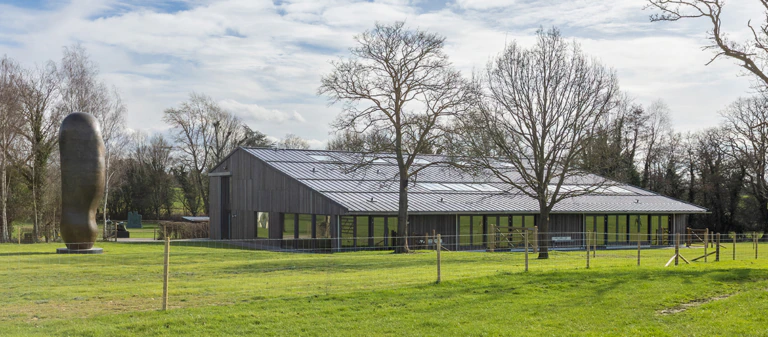
It’s always a joy to walk into the gallery at the Crafts Study Centre. Although small, it is light, cool and uncluttered. Laura Potter, the first of the four artists, is a jeweller whose recent work has explored the emotional support provided by jewellery, particularly in relation to loss and remembrance.
She has created an archive of her own, featuring 25 boxes containing unfinished work from her studio and an accompanying catalogue. She has chosen two pieces from the centre’s collection that would not normally be shown in an exhibition and exemplify what an archive is all about – a box of Rie test pieces, and a piece of calligraphy by Johnston – “56 ‘a’s made as wrongly as possible”.
Exploring museology
Among the pieces made by Elaine Wilson are two ceramic heads with their shape taken from a profile featured in one of Rie’s photograph albums.
They have their eyes closed, are covered in layer on layer of decoration and seem to be looking inward, absorbed in their own memories.
Other works by Wilson are less directly related to the collection, such as the six female figurines holding guns wearing evening dresses decorated with traditional feminine motifs of flowers and birds. This circle of unsettling figures face outwards, with guns pointed at the viewer.
Maisie Broadhead creates C-type digital prints inspired by paintings in public and private collections. Diamond Geezer is based on a portrait of a Belgium diamond dealer and Go On Then is based on The Suitor Accepted by Jean-Frédéric Schall.
The piece Broadhead has created for the exhibition, Made in Britton, is my favourite in the show. The work referenced is Vermeer’s 17th-century painting The Milkmaid. The model Broadhead used for the milkmaid is Alison Britton, who curated an exhibition called Three by One at the centre in 2009.
The milk jug is an 13th- or 14th-century English pitcher from Leach’s personal collection and the milk is being poured into a piece made by Britton herself. Not only is there a perfect symmetry about the imagery but the overall result has the powerful simplicity of Vermeer’s original.
Memory plays a vital part in the work of Stephen Dixon. Central to his contribution to this exhibition is a 12-drawer cabinet containing a mix of original documents and found and reworked objects.
They give tantalising snippets of information about the life of a young Italian soldier who ended up as a prisoner of war in Tripoli in the 1940s. In this piece the artist’s practice and the nature of archives and museology blend into a work of great power.
Academic exhibition
The exhibition is completed by a fascinating selection of pieces chosen by the curators of the exhibition and the Crafts Study Centre archivist. These give an insight into the range of work in the collection, the importance of it, and make public the importance of the collection for research by contemporary makers and students.
Works chosen include beautifully handwritten weaving notes by Alice Hindson that document her practice and serve as a memoranda for her and others; Bernard Leach’s 1913 diary, which he used as a day book recording events, items of interest, ideas and quotations that inspired him; and three painted stoneware cylinders made by Eric James Mellon in 1969. These convey some of Mellon’s ideas about freedom, or the lack of it, in the 1960s.
Memoranda provides a welcome insight into the world of the archivist seen through the eyes of the artist. The most successful exhibits are those where memory, recording, collecting and archiving are blended with the artist’s practice in a seemingly effortless way – for example Dixon’s Letters from Tripoli, and Broadhead’s Made in Britton.
The exhibition has also produced some fascinating new works that stand on their own, such as Wilson’s Family China I and II. Other work, while contributing to the insights provided by this exhibition, will have less meaning when taken out of context.
This exhibition and the accompanying publication say as much about collections and archives as they do about craft and will therefore be of great interest to museum professionals and archivists. It is, and this is not a criticism, an academic exhibition of the sort that a gallery based in a university should be commissioning.
The works engage and intrigue on first viewing, but visitors will be rewarded by spending time on each exhibit – a lot is revealed through studying them in the context of the material in the free-sheet or the accompanying book.
The book also succeeds in its own right as a contribution to the literature on craft and museum studies. It is a well-produced and thought-provoking publication.
As well as interviews with the two curators, four artists and the collections manager, Jean Vacher, there are essays by Daniel Miller, professor of material culture at University College London, and the V&A’s Glenn Adamson.
Peter Mason is a writer on culture
The Crafts Study Centre houses a unique collection of craft items and archival material relating to the work and lives of makers. For Memoranda, curators Tessa Peters and Janice West have invited four artists to respond to items in the collection and to exhibit the examples they have chosen alongside their own work.
A memorandum is a message to the writer or to its recipient, the word itself embodying the notion of memory.
The items from the collection that stimulated the interest of the artists the most are not the finished pieces but test pieces, note books, memorabilia, and reference objects that shed light on the ideas behind the creativity of the 20th-century’s leading makers such as Lucie Rie, Edward Johnston and Bernard Leach.
It’s always a joy to walk into the gallery at the Crafts Study Centre. Although small, it is light, cool and uncluttered. Laura Potter, the first of the four artists, is a jeweller whose recent work has explored the emotional support provided by jewellery, particularly in relation to loss and remembrance.
She has created an archive of her own, featuring 25 boxes containing unfinished work from her studio and an accompanying catalogue. She has chosen two pieces from the centre’s collection that would not normally be shown in an exhibition and exemplify what an archive is all about – a box of Rie test pieces, and a piece of calligraphy by Johnston – “56 ‘a’s made as wrongly as possible”.
Exploring museology
Among the pieces made by Elaine Wilson are two ceramic heads with their shape taken from a profile featured in one of Rie’s photograph albums.
They have their eyes closed, are covered in layer on layer of decoration and seem to be looking inward, absorbed in their own memories.
Other works by Wilson are less directly related to the collection, such as the six female figurines holding guns wearing evening dresses decorated with traditional feminine motifs of flowers and birds. This circle of unsettling figures face outwards, with guns pointed at the viewer.
Maisie Broadhead creates C-type digital prints inspired by paintings in public and private collections. Diamond Geezer is based on a portrait of a Belgium diamond dealer and Go On Then is based on The Suitor Accepted by Jean-Frédéric Schall.
The piece Broadhead has created for the exhibition, Made in Britton, is my favourite in the show. The work referenced is Vermeer’s 17th-century painting The Milkmaid. The model Broadhead used for the milkmaid is Alison Britton, who curated an exhibition called Three by One at the centre in 2009.
The milk jug is an 13th- or 14th-century English pitcher from Leach’s personal collection and the milk is being poured into a piece made by Britton herself. Not only is there a perfect symmetry about the imagery but the overall result has the powerful simplicity of Vermeer’s original.
Memory plays a vital part in the work of Stephen Dixon. Central to his contribution to this exhibition is a 12-drawer cabinet containing a mix of original documents and found and reworked objects.
They give tantalising snippets of information about the life of a young Italian soldier who ended up as a prisoner of war in Tripoli in the 1940s. In this piece the artist’s practice and the nature of archives and museology blend into a work of great power.
Academic exhibition
The exhibition is completed by a fascinating selection of pieces chosen by the curators of the exhibition and the Crafts Study Centre archivist. These give an insight into the range of work in the collection, the importance of it, and make public the importance of the collection for research by contemporary makers and students.
Works chosen include beautifully handwritten weaving notes by Alice Hindson that document her practice and serve as a memoranda for her and others; Bernard Leach’s 1913 diary, which he used as a day book recording events, items of interest, ideas and quotations that inspired him; and three painted stoneware cylinders made by Eric James Mellon in 1969. These convey some of Mellon’s ideas about freedom, or the lack of it, in the 1960s.
Memoranda provides a welcome insight into the world of the archivist seen through the eyes of the artist. The most successful exhibits are those where memory, recording, collecting and archiving are blended with the artist’s practice in a seemingly effortless way – for example Dixon’s Letters from Tripoli, and Broadhead’s Made in Britton.
The exhibition has also produced some fascinating new works that stand on their own, such as Wilson’s Family China I and II. Other work, while contributing to the insights provided by this exhibition, will have less meaning when taken out of context.
This exhibition and the accompanying publication say as much about collections and archives as they do about craft and will therefore be of great interest to museum professionals and archivists. It is, and this is not a criticism, an academic exhibition of the sort that a gallery based in a university should be commissioning.
The works engage and intrigue on first viewing, but visitors will be rewarded by spending time on each exhibit – a lot is revealed through studying them in the context of the material in the free-sheet or the accompanying book.
The book also succeeds in its own right as a contribution to the literature on craft and museum studies. It is a well-produced and thought-provoking publication.
As well as interviews with the two curators, four artists and the collections manager, Jean Vacher, there are essays by Daniel Miller, professor of material culture at University College London, and the V&A’s Glenn Adamson.
Peter Mason is a writer on culture
Project data
- Cost £5,000
- Funders Crafts Study Centre; Arts Council England Grants for the Arts £3,250; Manchester Institute for Research and Innovation in Art and Design £1,000
- Curators and editors Tessa Peters, Janice West
- Artists Maisie Broadhead, Stephen Dixon, Laura Potter, Elaine Wilson
- Book design and exhibition graphics Rosamund Saunders
- Photography Philip Sayer
- Exhibition ends 1 October